


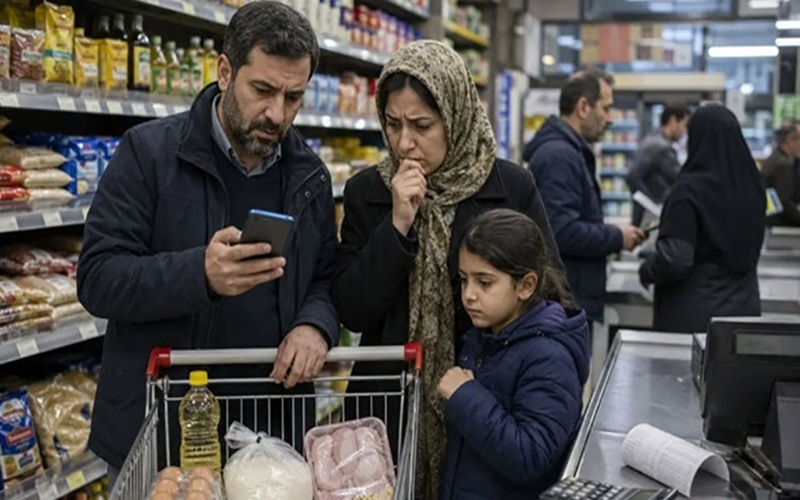

A soaring cost of basic living, collapsing wage purchasing power, and food inflation expose the structural failure of Iran’s economic model.
Iran’s economic crisis has reached a point where working families are no longer struggling simply to maintain a reasonable standard of living. For millions, the basic objective has become survival.
For more than four decades, the economic structure created under the regime has transformed national wealth into an instrument for preserving political power, expanding oligarchic networks, and financing the institutions responsible for repression. While the regime’s propaganda apparatus continues to promote narratives of “economic resistance” and attempt to conceal the depth of the crisis, figures published even by domestic semi-official and state-linked media increasingly reveal the scale of the disaster.
The latest calculations of workers’ living costs offer a particularly stark illustration. They show an economy in which wages are increasingly disconnected from the actual cost of survival, while inflation continues to erode household purchasing power.
A 90-million-toman survival threshold
According to figures published by the Iranian Labour News Agency (ILNA), a working-class family now needs approximately 90 million tomans per month simply to meet its basic living expenses.
As quoted by ILNA:
“Today, a working-class family needs a monthly income of 90 million tomans to remain on its feet and cover its living expenses, but the majority of workers and wage earners do not even earn half of this amount.”
The significance of this figure becomes clearer when compared with actual wages.
According to labor activist and researcher Faramarz Tofighi, the monthly income of a married worker with one child and one year of work experience was approximately 24.9 million tomans, assuming all allowances were paid.
That income covers only a fraction of the minimum cost of living.
The gap is not merely a matter of declining living standards. It means that a worker can remain employed, work throughout the month, and still be unable to finance basic household necessities.
Wages now cover barely a fraction of basic expenses
The deterioration in purchasing power has been exceptionally rapid.
According to the calculations cited by ILNA, at the beginning of the year, the average worker’s wage could cover approximately 58.24 percent of minimum living expenses. That was enough to cover roughly 17.47 days of the month.
By the end of July, however, wage purchasing power had fallen to just 27.58 percent of minimum living expenses—enough for only about 8.27 days.
In practical terms, workers are being paid for an entire month while their income covers barely more than one week of basic expenses.
The figures cited in the report indicate that the cost of the household living basket increased by more than 211 percent in just four months, adding approximately 47.6 million tomans to the financial burden facing working families.
Meanwhile, wages remained largely frozen in comparison with the pace of inflation.
This is not simply a problem of inadequate salaries. It represents a systematic redistribution of the economic crisis downward, transferring the burden of inflation and financial mismanagement onto workers and other low-income households.
Food is becoming a luxury
The deterioration is particularly severe in the food sector.
Basic items that once constituted the ordinary diet of Iranian families—including meat, dairy products, rice and legumes—are increasingly becoming unaffordable for large sections of the population.
According to the figures cited in the source material, point-to-point food inflation has exceeded 128 percent, while overall point-to-point inflation has reached 87.9 percent.
Such figures demonstrate the extraordinary speed at which household purchasing power is being destroyed.
For low-income families, food inflation is especially devastating because food represents a much larger proportion of their monthly expenditure than it does for wealthier households. When prices of basic necessities double or more, families cannot simply eliminate those expenses. They are forced to reduce quantities, abandon more expensive foods, postpone other essential expenditures, or accumulate debt.
The result is a deepening cycle of deprivation in which employment itself no longer guarantees economic security.
A structural wage crisis
At the center of this crisis is the widening gap between officially determined wages and the real cost of living.
Iran’s Supreme Labour Council sets minimum wages through a system in which government representatives and employers have substantial influence. Yet the resulting wage increases have repeatedly failed to keep pace with the actual rise in household expenses.
The consequence is what can be described as systematic wage suppression.
Workers continue to sell their labor, but the real value of that labor is continuously reduced by inflation. A nominal wage increase means little when prices rise substantially faster.
This produces a particularly destructive economic dynamic: workers become poorer even while remaining employed.
The problem also extends beyond industrial workers. Pensioners, public-sector employees, teachers, nurses and other wage-dependent groups face the same erosion of purchasing power. As the cost of housing, food, healthcare, transportation and education rises, fixed or slowly adjusted incomes become progressively inadequate.
Where Iran’s wealth goes
The severity of the crisis cannot be explained by inflation alone.
Iran possesses substantial natural resources, energy reserves, industrial capacity and a large domestic market. The fundamental question is therefore not simply why prices are rising, but why the country’s considerable national wealth has failed to translate into economic security for its population.
Large sections of the economy are controlled by powerful state-linked institutions, foundations and networks associated with the regime’s political and security establishment, including entities connected to the Islamic Revolutionary Guard Corps and the Supreme Leader’s office.
These structures operate with limited public accountability and have played a major role in concentrating economic power outside the reach of ordinary citizens and genuinely competitive private enterprise.
Instead of directing national resources primarily toward productive investment, infrastructure, healthcare, education and improving household welfare, the regime has devoted substantial resources to maintaining its political and security apparatus and pursuing costly strategic projects at home and abroad.
This has created an economy in which political loyalty and proximity to centers of power can be more important than productivity, competition and economic efficiency.
Economic collapse reflects political failure
The crisis facing Iranian workers is therefore not an isolated failure of wage policy. It is the cumulative outcome of a political-economic structure that has prioritized regime survival over public welfare.
An economy cannot remain healthy when corruption is institutionalized, productive investment is undermined, economic power is concentrated in politically connected networks, and national resources are diverted away from the needs of the population.
The extraordinary rise in the cost of living is consequently accompanied by an equally significant loss of confidence in the system’s ability to provide a viable future.
When a worker earning a full monthly salary can afford basic expenses for only eight days, the problem is no longer simply inflation. It is a breakdown of the social contract.
The regime’s economic crisis is increasingly inseparable from its political crisis. The same system that struggles to provide workers with food, housing, healthcare and economic security continues to prioritize the preservation of its power structure.
For millions of Iranians, this has transformed poverty from a temporary hardship into a structural condition.
The growing gap between national wealth and household living standards ultimately raises a broader question about Iran’s future: can an economic system designed around political survival be reformed without fundamentally changing the political structure that sustains it?
The figures emerging from Iran increasingly suggest otherwise. For workers and the broader population, escaping the cycle of poverty, inflation and economic insecurity is becoming inseparable from the demand for fundamental political change and the establishment of a system that places national resources at the service of the Iranian people.