


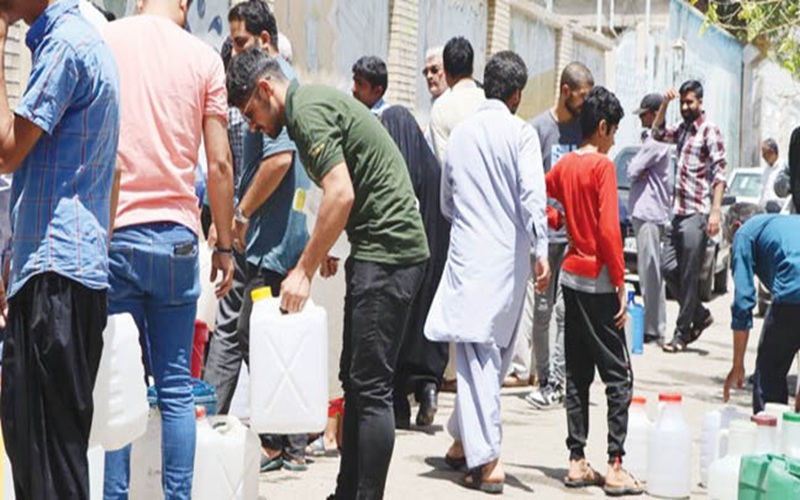

As temperatures soar past 50°C and half of Iran’s dam reservoirs lie empty, mounting outages ignite protests and expose the regime’s chronic mismanagement.
Amid scorching heatwaves and nationwide blackouts, Iran is plunging deeper into a multidimensional crisis marked by failing infrastructure, public outrage, and government confusion. On Tuesday, July 29, residents of Khomam in Gilan province gathered outside the city’s governorate, chanting slogans like “Incompetent officials, we don’t want you!” and “Water, electricity, life—our fundamental right!” Their protest, triggered by recurring water and power cuts, reflects a broader societal breakdown as the regime grapples with intensifying environmental and governance failures.
Videos circulating on social media show angry citizens describing their living conditions as “humiliating” and “destructive to livelihoods.” Protesters blame the regime’s chronic mismanagement, decaying infrastructure, and lack of long-term planning. In Khomam, power outages in the sweltering summer heat have destroyed home appliances, and irregular water distribution has severely disrupted daily life.
Across the country, similar protests have erupted in cities like Marvdasht, Torbat-e Jam, Chaypareh, Saveh, and parts of Chaharmahal and Bakhtiari. In Neyshabur, residents of Barzanun village blocked a major road in protest against water scarcity. In the Tehran suburb of Chahardangeh, industrial workers and bakers rallied against power cuts, while security forces used tear gas against demonstrators in Sabzevar. Nighttime protests in Tehran and Eslamshahr have included chants directly targeting the regime’s Supreme Leader.
This pattern of unrest coincides with record-breaking temperatures that have paralyzed public services. The government announced that on Wednesday, July 30, offices in at least 13 provinces—including Khuzestan, Hormozgan, and Yazd—are closed due to extreme heat and persistent power and water shortages. In some provinces like Fars, office hours were reduced to just a few morning hours. Several cities, including Mehran in Ilam Province, recorded temperatures as high as 52°C.
According to Iran’s Meteorological Organization, dozens of cities are enduring daily highs between 49°C and 52°C. In oil-rich Khuzestan, cities like Abadan, Ahvaz, Dezful, and Ramhormoz are experiencing temperatures above 50°C, with failing water supplies and blackouts compounding the hardship.
The regime’s public messaging has only fueled frustration. Fatemeh Mohajerani, government spokesperson, admitted on Tuesday: “There is no doubt we are in a water and power crisis.” She said the government was considering a one-week nationwide shutdown to manage the energy imbalance, though such measures have sparked concerns about the economic fallout.
Regime President Masoud Pezeshkian has blamed “mismanagement of water resources in past years” for the current crisis. He criticized the placement of water-intensive and polluting industries in unsuitable regions, claiming these decisions were driven by personal influence rather than national interest. He also reiterated his controversial call to relocate the capital away from water-stressed Tehran, warning: “If we don’t take urgent and serious measures today, it may be too late tomorrow.”
Official data paint a grim picture. According to Iran Water Resources Management Company, water reserves in 15 major dams have dropped by over 50% compared to last year. As of now, 56% of the country’s dam reservoirs are empty, with just 22.6 billion cubic meters of stored water remaining. The regime also reports entering the fifth consecutive year of drought, with a drastic reduction in rainfall further limiting hydropower generation.
Environmental experts warn that the crisis may escalate into a full-scale disaster. Last year, the head of the Atmospheric and Oceanic Research Center at Shiraz University stated that even if average rainfall returns to normal, Iran’s current water resources can only support 40 to 50 million people—far below its population of over 85 million.
The regime, still fixated on projecting power regionally and investing in military and proxy operations, has systematically neglected domestic infrastructure and public needs. What began as localized complaints about outages is rapidly evolving into a deeper confrontation between a weary population and an unresponsive government. The protesters’ message is clear: a nation deprived of light and water will not remain silent.
As unrest grows, the regime fears the protests in Khomam and elsewhere may spread further. Analysts describe the regime’s silence and delayed responses as signs of deeper institutional erosion. In the eyes of many, Iran’s water and electricity crisis is not just a resource issue—it is a vivid symbol of systemic collapse and the widening chasm between the rulers and the ruled.