


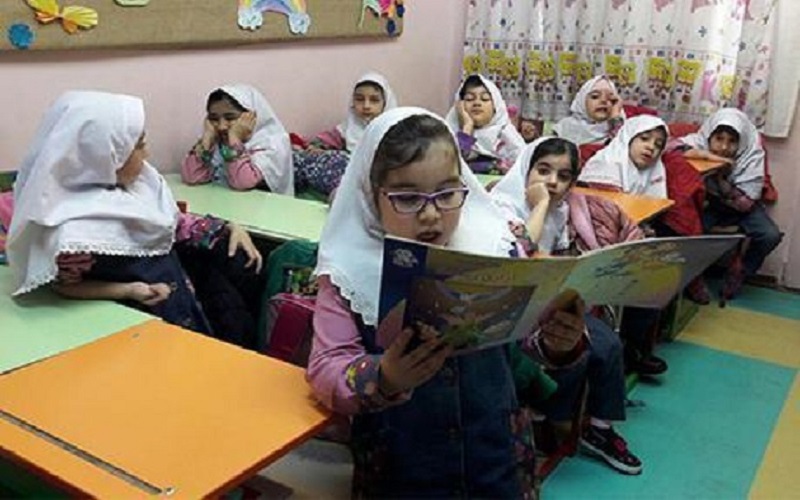

On September 1, the state-run Ham Mihan newspaper published a report titled “Disaster of Illiteracy,” shedding light on the alarming rise in illiteracy rates among students in Iran. The report specifically focused on the dire situation in the provinces of Sistan and Baluchistan, South Khorasan, and Khuzestan. This investigation revealed that the educational crisis is not confined to these regions alone, but is a pervasive issue across the entire nation.
A Nationwide Decline in Educational Standards
The report begins by referencing an official document that highlights the average final grades across various provinces, painting a bleak picture of the country’s educational standards. The data reveals a significant decline in academic performance nationwide, with several provinces, such as Sistan and Baluchistan, Kerman, Hormozgan, Fars, Bushehr, Kohgiluyeh and Boyer-Ahmad, Chaharmahal and Bakhtiari, Lorestan, Ilam, Kermanshah, Kurdistan, West Azerbaijan, Gilan, Golestan, North Khorasan, and Khuzestan, recording average final exam scores below 10 in all theoretical subjects.
Among these, Sistan and Baluchistan stands out as the province with the most critical educational conditions. A teacher from this region reported that out of every 20 students transitioning from sixth to seventh grade, at least four or five are completely illiterate.
Root Causes of the Educational Crisis
The report attributes this educational decline to several key factors, particularly in Sistan and Baluchistan. Teachers in this province point to a severe lack of educational facilities, extreme poverty among students and their families, and systemic educational discrimination and inequality as primary contributors to the dismal state of education.
Danesh Dadollah Zehi, a middle school teacher in Iranshahr, Sistan and Baluchistan, highlighted the immense challenges faced by students. He noted that primary school students often have to walk 10-12 kilometers to reach their schools, and high school students may need to travel 20-30 kilometers. Given these hardships, many students opt to work as apprentices, builders, carpenters, or fishermen, earning a meager income of 400,000 to 500,000 tomans instead of pursuing their education.
Social activist Mina Kamran also emphasized the poor quality of education in rural areas of Sistan and Baluchistan, where even high school students struggle with basic arithmetic, such as the multiplication table, and lack fundamental knowledge in addition and subtraction.
The Plight of Students in South Khorasan and Khuzestan
The report further explores the educational challenges in South Khorasan and Khuzestan. A principal of an elementary school in South Khorasan, who requested anonymity due to fear of security repercussions, revealed that many students do not attend school due to economic hardship. For girls, the situation is even more dire; they often drop out when they reach secondary school because their families cannot afford the cost of transportation to schools in other cities. Many girls are forced into early marriages or remain at home.
In Khuzestan, a province rich in oil but plagued by severe educational challenges, the situation is equally concerning. Pirooz Nami, a teacher in Khuzestan, reported that the province faces a shortage of educational resources, poorly paid teachers, and a struggling economy. He recounted how, at the beginning of the school year, his computer class had 32 students, but by the end of the year, only 17 or 18 remained.
The economic struggles are exacerbated by the high cost of education. One school in Khuzestan requested families to pay 600,000 tomans for an academic year, leading 15 families to withdraw their children from school.
A Widespread and Growing Crisis
The report also cites statistics from the Center for Measuring and Evaluating the Quality of Education, which revealed that in the final exams of the previous academic year, the average grade point across the three major fields of humanities, experimental sciences, and mathematics and physics was a mere 10.89 out of 20. In mathematics and physics, the average was slightly higher at 11.82, but in humanities, it was a dismal 9.13.
Further compounding the crisis, Babak Neghadari, head of the Parliament Research Center, stated in July that there is a shortage of 176,000 teachers for the upcoming academic year, with 72,000 teachers expected to retire by October, exacerbating the already dire shortage of qualified educators.
The latest data from the regime’s Statistics Center indicates a 26% increase in school dropouts, rising from 777,000 students in the 2015-2016 academic year to 930,000 in 2022-2023. The majority of these dropouts are in the second secondary level (ages 15-17), followed by students in the first secondary level (ages 12-14), and a significant number of children aged 6 to 11.
A Nation of Wealth, Yet an Educational Crisis
Iran, despite being one of the richest countries in the world in terms of natural and underground resources, is grappling with a severe educational crisis. Experts argue that the Iranian regime, during its four and a half decades of rule, has failed to invest in the country’s vast human resources. Instead of using Iran’s wealth for sustainable growth and development, tens of billions of dollars have been squandered on destructive policies and the export of a medieval ideology, leading to widespread economic, political, social, and environmental crises.
The “Disaster of Illiteracy” report serves as a stark reminder of the urgent need for educational reform in Iran. Without immediate and significant intervention, the country’s future generations will continue to suffer the consequences of this growing illiteracy crisis.