



As the cold months approach, Iran is transitioning from its summer electricity crisis to a looming winter gas crisis. The Iranian Chamber of Commerce has issued a stark warning regarding the severe impact that gas shortages will have on the nation’s petrochemical industry.
Unused Capacity and Economic Losses
According to a report from the Research Center of the Iranian Chamber of Commerce, a significant portion of Iran’s petrochemical capacity remains unused, with nearly 20% of it lying idle. Alarmingly, over 62% of this unused capacity is attributed directly to a lack of gas supply.
The Chamber of Commerce has highlighted the profound economic losses resulting from this shortfall. Each year, approximately 15 million tons of petrochemical products are left unproduced due to insufficient gas supply. The report estimates that this results in a loss of roughly $500 million in potential revenue from selling gas to petrochemical companies at higher prices. Additionally, the lost profits for petrochemical units are estimated at $200 million, while the decline in petrochemical exports amounts to around $1 billion—an alarming consequence of the ongoing gas deficit.
A Deteriorating Situation
The statistics provided by the Chamber of Commerce primarily reflect the performance of the years 2021 and 2022. However, official figures from Iran Customs indicate that the situation has worsened in 2023. Last year, Iran exported approximately 49 million tons of petrochemical goods valued at $19.4 billion. This represents a decrease of 11% in volume and 29% in value compared to previous years.
The Wasted Potential of Iran’s Gas Resources
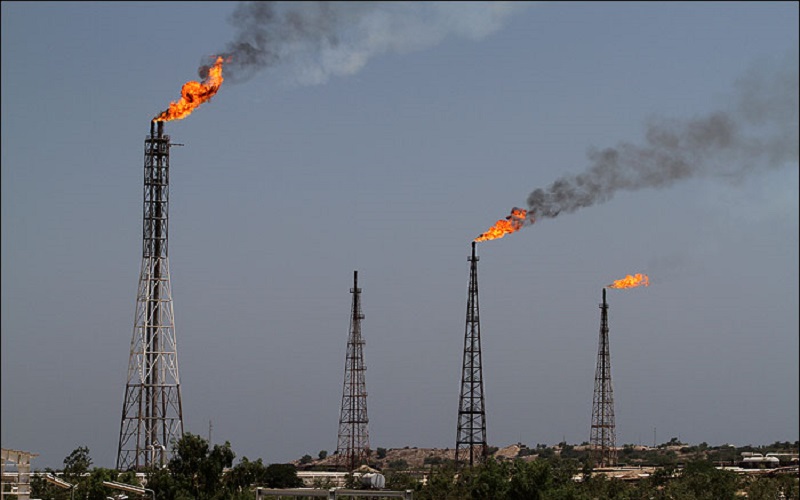
The Chamber of Commerce has also drawn attention to the significant amount of gas wasted during production. It argues that if the government had taken measures to prevent this waste, the gas could have been redirected to meet the needs of the petrochemical industry.
According to the latest statistics from the World Bank, Iran burned and wasted more than 21 billion cubic meters of gas last year due to the lack of equipment to capture gas produced from oil fields. The value of this wasted gas is estimated to exceed $6 billion.
Furthermore, data from the International Energy Agency reveals that approximately 8 billion cubic meters of Iran’s produced gas are lost annually during the refining and transmission stages. To put this in perspective, these losses exceed the total gas consumption of the entire petrochemical sector. Iran’s gas losses are also equivalent to twice the gas consumption of the steel sector, four times that of the cement sector, and three times that of the transportation sector.
A Growing Crisis
Iran’s industries are already reeling from severe energy shortages. During the summer, the country struggles with a significant electricity deficit, forcing the government to cut electricity supplies to industries by half. In winter, the situation is equally dire, with a severe gas shortage leading to restrictions on gas deliveries to industrial sectors.
The current crisis is only a precursor to a much larger problem. Estimates from the Iranian Chamber of Commerce, the National Development Fund, and the Parliament Research Center predict a sharp increase in the country’s gas deficit in the coming years. By 2041, the regime is expected to be unable to meet two-thirds of the nation’s gas demand, exacerbating the crisis further.