


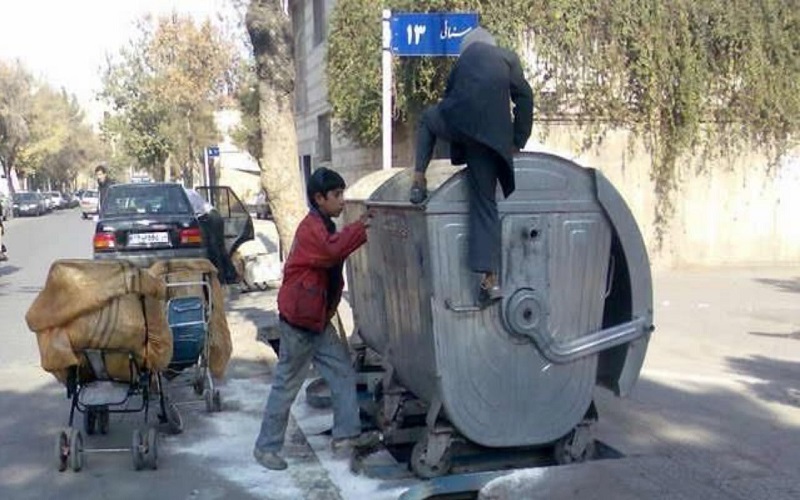

In the bustling streets and alleys of Iran, a disturbing sight has become heartbreakingly commonplace: children rummaging through garbage, their small hands sifting through waste in search of anything of value. These children, now an all-too-familiar part of the urban landscape, are victims of a regime that seems to have turned a blind eye to their plight.
A New Form of Slavery
The Iranian regime appears to be deliberately overlooking the fundamental rights of these children, rights that should allow them to experience the innocence and joy of childhood. This grim reality has been likened to a new form of slavery, where vulnerable children are exploited for profit. Despite the government’s knowledge of this cruel industry, it continues to flourish, generating millions of dollars while the regime remains silent.
These “cheap” laborers are often driven to the streets by poverty, seeking a semblance of security amidst the chaos. For many, the streets offer a better alternative than the harsh conditions of workshops.
Lost Dreams in Dirty Gold
A recent report by the state-run news agency YJS sheds light on the harrowing conditions faced by Iran’s garbage-collecting children. The report states, “Because of poor management and misguided policies, inflation, and skyrocketing prices, instead of resting and playing under the care of their families, these children are forced to scavenge through garbage cans for their daily sustenance and future.”
This search through what is referred to as “dirty gold” reveals a deep-seated social injustice. An injustice that has widened the gap between the rich and the poor, leaving the government’s promises of poverty eradication unfulfilled. The increasing number of working children stands as a stark testament to this failure.
According to YJS, “Working children now make up 15% of the country’s child population.” In Bushehr province, the situation is particularly dire. Although no recent statistics are available, the Director General of Welfare reported in 2022 that over 870 child laborers lived in the province, with 80% being literate boys engaged in selling flowers, cleaning car windows, carrying cargo, and collecting garbage.
Nasser’s Story: A Glimpse into Desperation
One such child is Nasser, an 11-year-old boy whose story is both heartbreaking and emblematic of the plight of many others. Nasser spends his mornings and evenings collecting waste in various neighborhoods of Bushehr. His work exposes him to foul, polluted, and hazardous materials. He recounts, “Many times, my hand has been badly cut by broken glass. Once, I needed stitches. But when my father left, I had to work to ease the burden on my mother and sister.”
Nasser dreams of a better future. “I want to grow up soon and find an honorable job to make a better life for my sister and mother,” he says. For now, he endures the suffocating stench and scorching heat, scavenging for bottles, jars, containers, plastic, and cardboard. Despite falling ill several times, he feels he has no choice.
In a poignant moment, Nasser explains why he carries such a large sack. “This sack holds about 40 kilos. If I had a handcart, I could carry 90 kilos and earn more, but I can’t afford one.” His meager earnings for 40 kilos of waste remain a closely guarded secret, as he fears revealing his income.
The Price of Poverty
Nasser’s story is just one of many. Thousands of children like him are ensnared in this cycle of poverty and exploitation, victims of the regime’s destructive economic policies that have pushed much of the population below the poverty line. Health experts warn that the harsh conditions faced by these young garbage collectors significantly shorten their lifespans.
As we read Nasser’s words and countless other stories like his, it’s clear that these children deserve so much more. They deserve a childhood free from the filth and dangers of the streets. They deserve a chance to dream, to grow, and to live with dignity.
The plight of Iran’s garbage-collecting children is a stark reminder of the urgent need for change. Until then, their stories remain a testament to resilience in the face of unimaginable hardship.