


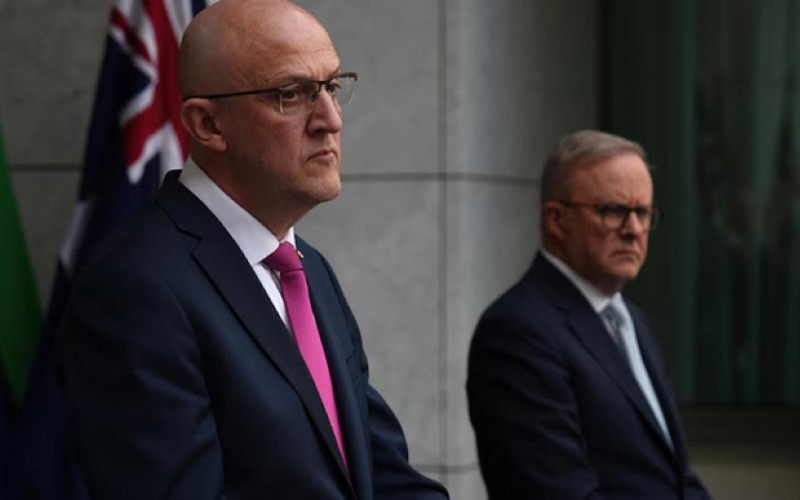

Canberra takes unprecedented action, accusing the Iranian regime of organizing antisemitic attacks and hostile operations on Australian soil.
Australia has expelled the Iranian regime’s ambassador and announced the closure of its embassy in Tehran, in what officials described as a direct response to terror plots and “hostile acts” carried out on Australian territory. The move marks the first time since World War II that Canberra has expelled a foreign envoy.
Prime Minister Anthony Albanese accused the regime of orchestrating aggressive and destabilizing activities inside Australia. Intelligence services reportedly linked the Iranian regime’s embassy to at least two antisemitic attacks in Sydney and Melbourne. Albanese also confirmed that parliament would soon advance legislation to designate the regime’s Islamic Revolutionary Guard Corps (IRGC) as a terrorist organization.
Foreign Minister Penny Wong declared the ambassador and three other Iranian regime diplomats persona non grata, ordering them to leave within seven days. According to reports, the regime’s ambassador only learned of the expulsion minutes before the announcement was made public.
A History of Strained Relations
This escalation follows years of deteriorating ties between Canberra and the Iranian regime. Since 2022, Australian officials have condemned Tehran’s brutal crackdown on nationwide protests, especially the targeting of children and students. Wong voiced solidarity with Iranians fighting for free expression and gender equality, though Australia was initially slower than the United States, Canada, and some European governments in imposing sanctions.
By mid-2023, Canberra began to align more closely with its allies. In July that year, the U.S. and Australia jointly accused the regime of widespread human rights abuses, including systemic repression of women and girls, censorship, and persecution of civil society. Later that October, Australia sanctioned 19 individuals and 57 entities tied to the regime’s nuclear and missile programs. Some of these measures were imposed under “Magnitsky-style” legislation, targeting perpetrators of human rights violations, including members of the regime’s morality police linked to the death of Mahsa Amini.
In 2024, additional restrictions followed, blacklisting senior regime military and political officials, including the commander of the Quds Force, as well as companies tied to the regime’s drone and missile industries. By then, nearly 90 individuals and 100 entities connected to the Iranian regime had been sanctioned by Australia.
Iranian Regime Activities in Australia
Security agencies have long warned about the regime’s activities within Australia. In February 2023, the Minister of Home Affairs revealed that Iranian regime operatives attempted to carry out an operation targeting an Iranian-Australian critic of the regime, but the plot was foiled. At the same time, the number of Iranian diplomats in Australia had quietly increased, even as threats against members of the Iranian diaspora intensified.
That same year, investigations linked IRGC-controlled companies to cyberattacks on Australian organizations, seeking to extort and steal sensitive data. Iranian Australians who opposed the regime reported surveillance, harassment, and threats.
The regime’s reach also extended to academia. In April 2023, Australia’s foreign ministry urged more than 30 universities to suspend cooperation with Iranian institutions over concerns about Tehran’s human rights record and its exploitation of academic ties for strategic purposes.
Broader Context
Australia’s uneasy relationship with the Iranian regime is not new. Between 2018 and 2019, tensions spiked over the detention of several Australian citizens, most notably academic Kylie Moore-Gilbert, imprisoned on espionage charges until a prisoner swap in 2020. The incident deepened mistrust between the two governments.
Canberra’s latest decision to expel the regime’s ambassador represents the sharpest break yet. Officials concluded that alleged terror plots, interference in domestic affairs, cyberattacks, and repeated human rights violations left no space for continued diplomatic engagement.