


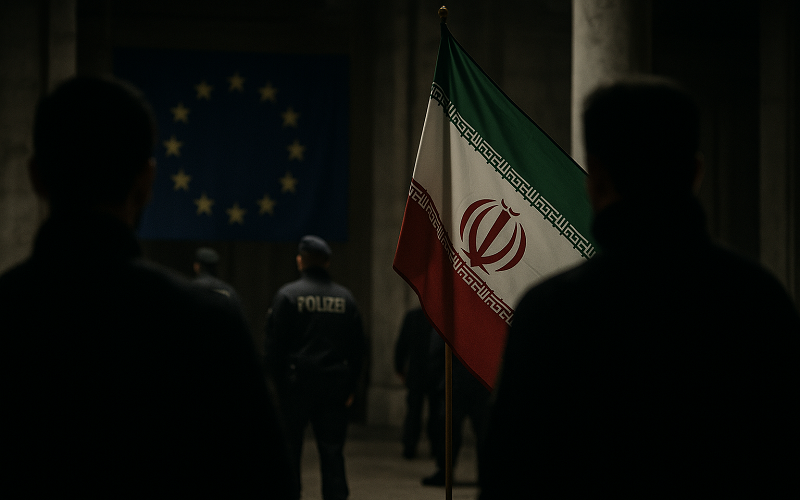

A groundbreaking investigation by Sweden’s Doku has exposed a chilling network of Iranian regime agents operating under the guise of asylum seekers and students across Europe. The report reveals how these operatives use asylum protections to infiltrate communities, spread Islamist propaganda, intimidate regime critics, and pose a grave security threat both to European national interests and the Iranian diaspora abroad.
At the heart of this network are Mohammad Heidari and Shayan Tousynezhad, two individuals linked to Iran’s notorious Islamic Revolutionary Guard Corps (IRGC) and the Ministry of Intelligence. Their story provides a clear insight into the Islamic Republic’s broader covert strategy: embedding loyal agents into Western societies under false pretenses.
Double Lives: Converts, Students, and Agents
Mohammad Heidari’s case exemplifies the regime’s tactics. Claiming conversion to Christianity and persecution in Iran, Heidari secured refugee status in Sweden. In public, he portrayed himself as a devoted Christian, embedding within church communities and building trust with prominent Iranian exiles, including women’s rights activist Soheila Fors.
Behind the facade, however, Heidari led a very different life. He co-founded the regime-backed movement “Be Ma Bepeyvandid” (“Join Us”), openly praising Iran’s Islamic Revolution and advocating for the IRGC. His social media activities blended anti-Israel and pro-terrorist propaganda with threats against Iranian dissidents. In one chilling post, he vowed that critics of the regime would “get flowers — on their graves.”
Similarly, medical student Shayan Tousynezhad — who falsely claimed to be a qualified oncologist and surgeon — operated parallel lives across Sweden, Poland, and Norway. He used his platform as a “doctor” to spread Iranian regime propaganda, glorifying Hezbollah, Hamas, and the IRGC, even posting images of patients alongside political messages. He has also been photographed proudly wearing the IRGC emblem.
In early 2024, Tousynezhad traveled to Iran and met with Majid Noury, son of the convicted war criminal Hamid Noury. At a public gathering sanctioned by Tehran’s leadership, Tousynezhad denounced Sweden, echoing Iranian government narratives that accuse the West of holding Noury “hostage.”
Threats Against Iranian Dissidents
The infiltration of Sweden’s Iranian exile community by regime operatives is not merely a case of espionage — it has direct, violent consequences.
After trusting Mohammad Heidari, Soheila Fors became the target of a firebomb attack on her home, days after Heidari had filmed inside her residence under the pretext of making a documentary. Threats followed online, with individuals bragging about being able to “kill” Fors.
While Swedish police initially opened an investigation, the case was quietly closed, leaving Fors and other regime critics vulnerable.
Abuse of Asylum Systems
Doku’s investigation highlights how the Iranian regime exploits Western asylum systems. Both Heidari and Tousynezhad obtained residency rights under false pretenses, concealing their loyalty to Tehran while accessing the freedoms and protections of European democracies.
At the same time, they waged coordinated propaganda and intimidation campaigns — blending anti-Semitic, anti-Israel, and anti-dissident narratives while actively supporting Iran’s state terror networks.
Alarmingly, even after receiving refugee status, Heidari and Tousynezhad maintained close ties with Iran, traveling freely despite claiming to be at risk of persecution.
In conversations with Doku, Heidari — now back in Iran — casually dismissed his supposed Christian faith, saying, “all Christians lie,” and expressed disappointment over losing access to Swedish child support payments.
Organizational Backing: Habilian and the IRGC
The Iranian organization Habilian, identified as a front for Iran’s intelligence services, played a key role in coordinating activities in Sweden. Both Heidari and Tousynezhad participated in demonstrations organized by Habilian against the People’s Mojahedin Organization of Iran (MEK) during the high-profile trial of Hamid Noury.
Experts, including political scientist Arvin Khoshnood, affirm that Habilian works closely with Iran’s Ministry of Intelligence and the IRGC’s Intelligence Organization, reinforcing the investigation’s findings that Tehran uses NGOs and cultural centers in Europe as cover for espionage and repression.
A Broader Threat to Europe
The exposure of this network reveals a broader and deeply worrying trend: the Iranian regime’s global strategy of embedding agents abroad, not only to monitor and threaten exiled dissidents but also to shape narratives and mobilize loyalists for future operations.
“The Islamic Republic systematically combines terrorism and narrative control as key instruments in its foreign policy,” Khoshnood explains. “The individuals and their networks constitute a clear security threat to Swedish national security and to the Iranian diaspora in the country.”
This is not an isolated case. Similar plots have been uncovered across Europe — from foiled assassination attempts in France and Denmark to espionage operations in Germany and the Netherlands. Tehran’s malign activities in Europe are increasingly sophisticated, blending ideological warfare with tangible threats of violence.
Conclusion
The revelations from Doku should serve as a wake-up call to European governments: the Iranian regime is not only repressing its citizens at home but is actively exporting its state terror and propaganda to the heart of Europe.
As the Iranian people continue their fight for freedom, Western democracies must remain vigilant against the Islamic Republic’s infiltration efforts — and take stronger, coordinated action to protect exiled dissidents, uphold national security, and expose the regime’s covert war against freedom worldwide.