


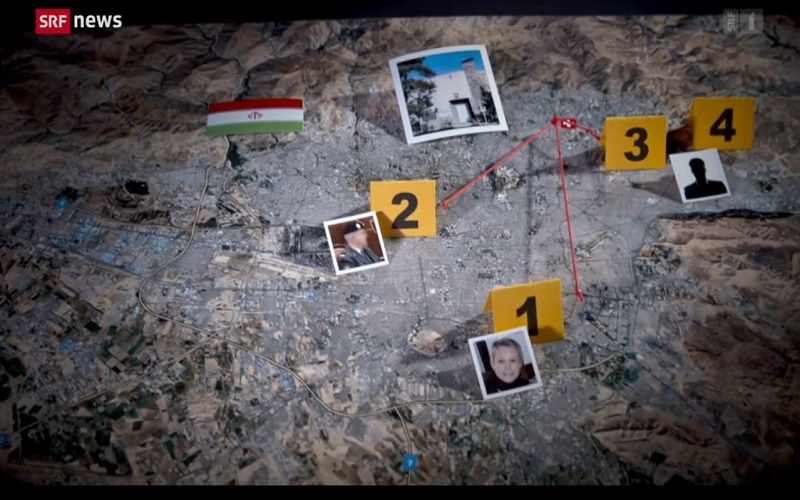

Based on an investigation by SRF (Swiss Radio and Television)
A recent investigation by Swiss public broadcaster SRF has revealed troubling new details about a string of deaths and attacks involving Swiss diplomats and citizens in Iran—raising the possibility that the Iranian regime may be targeting Switzerland due to its unique diplomatic role as the representative of U.S. interests in Tehran.
While Switzerland’s neutrality and discretion have long made it a trusted intermediary in sensitive international matters, its dual role in Tehran—serving as a liaison between the U.S. and Iran—appears to have made it a target of paranoia and suspicion within the regime. SRF’s report uncovers disturbing evidence and credible testimony that point toward possible state involvement in several mysterious incidents.
The Case of Sylvie Brunner: A Diplomat’s Fatal Fall
In May 2021, Sylvie Brunner, deputy head of the Swiss Embassy in Tehran, fell from the 17th floor of a high-rise building in the middle of the night. Iran’s initial claim—that there was no evidence of suicide—was quickly reversed. A government spokesperson who contradicted the suicide narrative was dismissed, and the case was declared closed.
Switzerland launched a homicide investigation, but it was abandoned in November 2024. Brunner’s brother told Swiss media that Iranian intelligence agents had entered her apartment, leaving visible footprints as a form of intimidation.
According to SRF, Swiss authorities were aware of the threats but had no jurisdiction to investigate within Iran. A suicide note was reportedly found—but unsigned. The autopsy, reviewed by an independent expert, confirmed injuries consistent with a fall but revealed major procedural gaps: no internal organs, no bodily fluids, and no access to the crime scene. The expert concluded that while suicide was plausible, the possibility of foul play could not be ruled out.
Testimony from a Former Regime Agent
SRF tracked down a former Iranian intelligence officer now living in exile in Germany. He confirmed that Brunner’s case was widely discussed within Iran’s intelligence community.
“It was a murder. A spy operation gone wrong,” he said, claiming that the Revolutionary Guards’ intelligence service had been involved. According to him, the Guards viewed the Swiss Embassy as a CIA front—a perception fueled by Switzerland’s diplomatic representation of the United States.
While the defector could not provide documentation, his testimony echoes a well-documented pattern of suspicion and aggression by the regime toward foreign diplomats.
Another Death: A Swiss Military Attaché Collapses in Tehran
In 2023, a Swiss military attaché, a colonel with a background in the Federal Intelligence Service, died after reportedly collapsing in a Tehran hotel. Iran claimed he had a fainting spell and suffered head and stomach injuries. He was evacuated to Switzerland, where he later died.
Independent experts believe the colonel may have been engaged in intelligence work and was possibly exposed and targeted. Swiss authorities have refused to comment, citing confidentiality and diplomatic sensitivity.
Pattern of Violence: Stabbing and Suspicious Custody Death
In another troubling incident, a Swiss embassy staffer was stabbed on his way to work in Tehran. The regime labeled it a random robbery—an explanation that many experts reject, given the rarity of such street crimes in Iran’s tightly controlled police state.
And earlier this year, a Swiss tourist was arrested for alleged espionage after photographing a military facility and collecting soil samples. He died two months later in Iranian custody, with officials again claiming suicide.
Swiss diplomats were denied access to the detainee throughout his imprisonment. According to Monika Schmutz Kirgöz, the Swiss Foreign Ministry’s Director for the Middle East:
“The Iranians didn’t tell us anything. When we complained about the lack of information, they said: ‘That’s normal in espionage cases.’”
The tourist’s body arrived in Switzerland under strict monitoring. An autopsy is ongoing.
Targeted for Representing U.S. Interests?
All of the individuals affected had one thing in common: a connection to the Swiss diplomatic mission in Iran, which acts as the official representative of U.S. interests—a role that places Switzerland in a uniquely exposed position inside Iran.
While Schmutz Kirgöz cautioned against drawing direct conclusions, she acknowledged the risk:
“Of course, representing the U.S. gives us a certain visibility. Nevertheless, I wouldn’t want to link these incidents directly to that mandate.”
Yet SRF’s findings suggest that the Iranian regime views the Swiss Embassy not as neutral, but as a potential proxy for American intelligence activity—and has possibly responded with intimidation, surveillance, and even violence.
A Chilling Pattern, An Opaque Truth
With four Swiss nationals dead or injured and no transparent investigations, many are left questioning whether these incidents are isolated tragedies or coordinated actions by the regime.
As one source told SRF:
“Are the stories connected? What happened in Tehran? I may have to live with this uncertainty until the end of my days.”
In a country where state secrecy overrides justice and foreign access is heavily restricted, the truth about what happened to Switzerland’s representatives may remain forever obscured behind the regime’s wall of silence.