


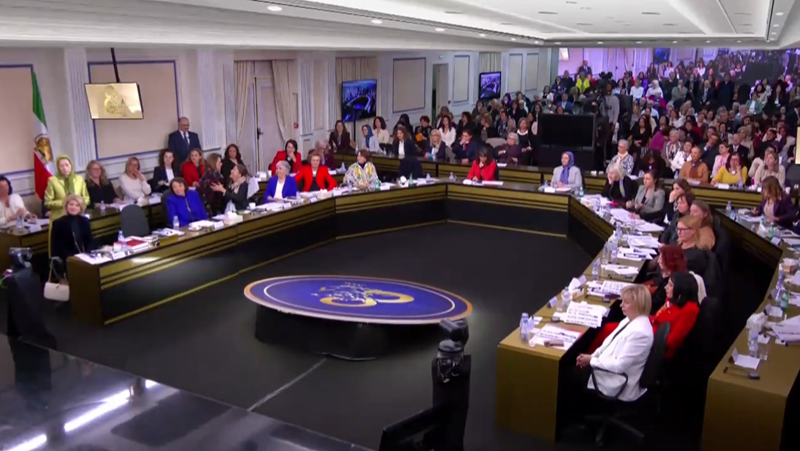

International Women’s Day 2026 Conference Unites Political Figures in Support of a Secular, Democratic Republic in Iran
The 2026 International Women’s Day Conference brought together more than 30 prominent political leaders, parliamentarians, former heads of state, diplomats, jurists, and human rights advocates in a unified call for democratic change in Iran.
The event, organized by the National Council of Resistance of Iran (NCRI), centered on the leadership of Maryam Rajavi and the role of women in shaping Iran’s future. The overarching message was clear: Iran’s future lies neither in a return to monarchy nor in the continuation of religious dictatorship, but in the establishment of a secular, democratic republic grounded in gender equality.
A Broad International Coalition
Among the distinguished participants were:
- Carla Sands
- Michèle Alliot-Marie
- Anneli Jäätteenmäki
- Ingrid Betancourt
- Rosalía Arteaga Serrano
- Judy Sgro
- Naike Gruppioni
- Elisa Pirro
- Linda Chavez
- Ana Helena Chacón Echeverría
- Dominique Attias
- Donna Hughes
- Pilar Rojo
- Rosa Romero
- Zinat Mirhashemi
- Helena Carreiras
- Fiona O’Loughlin
- Helen Goodman
- Eve Borg Bonello
- Elly van Wijk
- Dorien Rookmaker
- Karen Smith
- Vida Niktalean
- Elisabetta Zamparutti
- Azadeh Akhbari
The January 2026 Uprising and State Repression
A central theme of the conference was the January 2026 uprising. According to figures cited during the event, more than 2,400 people were killed, including hundreds of women and minors. Speakers emphasized that the regime attempted to obscure the scale of repression through internet shutdowns and information blackouts.
Multiple participants described systematic human rights violations: mass arrests, torture, executions, and the use of the judiciary to intimidate protesters. The designation of the Islamic Revolutionary Guard Corps (IRGC) as a terrorist entity by several governments was welcomed as a long-overdue step toward accountability.
Canadian and European representatives highlighted sanctions, parliamentary resolutions, and calls for further diplomatic isolation of regime-linked entities.
Women at the Center of Political Transformation
Across ideological and national lines, speakers converged on one central argument: gender equality in Iran is not a secondary reform—it is the foundation of democratic transformation.
From the 2022 protests following the killing of Mahsa Amini to the January 2026 uprising, women have served as organizers, leaders, and symbols of resistance. Participants stressed that Iranian women are not passive victims of repression but strategic actors driving political change.
The slogan “Woman, Resistance, Freedom” was repeatedly invoked as a reflection of a deeper political philosophy: a regime built on controlling women cannot produce freedom for society.
Rejection of Both Monarchy and Theocracy
A significant portion of the discussion addressed competing narratives about Iran’s future. Several speakers rejected attempts to rehabilitate the image of the former monarchy.
Referring to documented historical interviews, participants noted the openly misogynistic positions expressed by Mohammad Reza Pahlavi. The argument presented was that dictatorship—whether crowned or turbaned—cannot coexist with genuine equality.
The idea of dynastic restoration, particularly around Reza Pahlavi, was criticized as lacking democratic legitimacy. As multiple speakers framed it, lineage is not a substitute for a democratic mandate.
The unified slogan emerging from the conference echoed what has been heard in Iranian streets: “No to the Shah, No to the Mullahs.”
The Ten-Point Plan as a Democratic Blueprint
Throughout the conference, Maryam Rajavi’s Ten-Point Plan was presented as a structured roadmap for transition.
Key elements highlighted included:
- Separation of religion and state
- Abolition of the death penalty
- Gender equality in law and governance
- Free and fair elections
- Freedom of expression and assembly
- A non-nuclear Iran
- Equal economic opportunity within a free-market framework
Speakers described the plan not as abstract rhetoric but as a comprehensive political program supported by thousands of parliamentarians worldwide.
International Responsibility and Moral Consistency
Participants repeatedly argued that support for Iranian women is a matter of international credibility. Governments that advocate for women’s rights globally cannot remain silent in the face of systematic gender-based repression in Iran.
The conference called for:
- Continued sanctions against regime officials
- Closure of regime-linked diplomatic and financial channels
- International investigations into crimes against humanity
- Recognition of the Iranian people’s right to democratic change
A Movement Beyond Symbolism
Beyond policy proposals, the gathering underscored the organizational depth of the Iranian Resistance. References were made to Ashraf 3, to Resistance Units inside Iran, and to decades of structured opposition.
Speakers emphasized that democratic transition requires not only protest but preparation. According to the broad consensus at the conference, the NCRI and its women-led structure represent a viable and organized alternative.
Conclusion
The 2026 International Women’s Day Conference did more than commemorate women’s achievements. It presented a unified international endorsement of a democratic alternative for Iran—one that rejects both the legacy of monarchy and the brutality of religious dictatorship.
From Europe to the Americas, from former prime ministers to senators, ministers, ambassadors, jurists, academics, and activists, the message was consistent:
Iran’s future must be secular, democratic, non-nuclear, and built on full equality between women and men.
And, as repeated throughout the gathering: Iranian women are not waiting for change. They are leading it.