


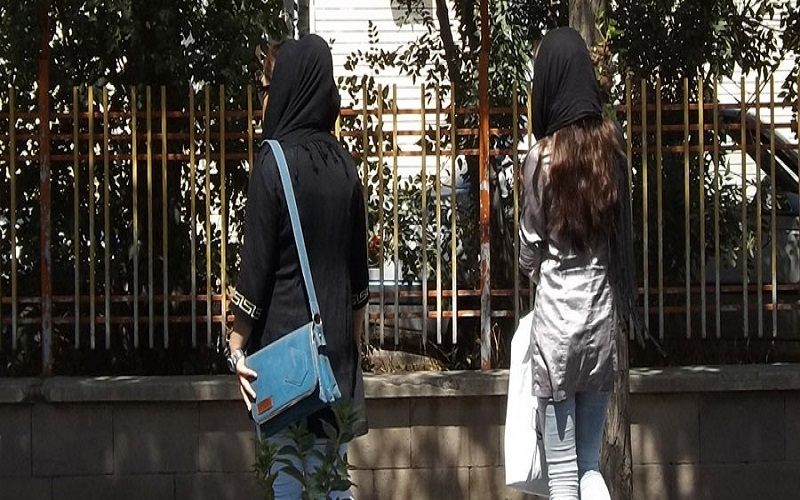

Recent statements by key Iranian regime officials have reignited the debate surrounding the country’s mandatory hijab policy, highlighting the complex political landscape and the challenges facing newly elected President Masoud Pezeshkian.
Law Enforcement’s Stance
Ahmad-Reza Radan, commander of Iran’s Law Enforcement Command and a prominent figure in suppressing the 2022 popular uprising, recently reaffirmed his commitment to the controversial “Noor project” targeting Iranian women. On August 17, Radan emphasized, “We must refer to the law regarding the implementation of the Noor project. The police are the enforcers of that law and must act accordingly unless a task is legally removed from their purview.”
Radan, a staunch supporter of strict hijab laws, views the issue as a critical bulwark against Western influence. In May, he stated, “If they take away the hijab, neither the homeland nor the religion will exist; they will be destroyed.” His recent comments, in response to images of police officers violently confronting women, have been interpreted by some as tacit approval for intensified enforcement measures.
Presidential Promises vs. Reality
The regime’s president Masoud Pezeshkian’s campaign promise to cancel the Noor Project and ease restrictions on women’s dress code appears increasingly difficult to fulfill. Throughout his presidential campaign, Pezeshkian and his supporters emphasized the importance of stopping the Noor Project, disbanding guidance patrols, and reducing internet censorship.
However, many regime insiders suggest that Pezeshkian, like his predecessors, will lack the authority to implement such changes. The experience of former President Hassan Rouhani, who struggled to fulfill promises regarding social and political freedoms, serves as a stark reminder of the limitations faced by the regime’s officials.
Supreme Leader’s Influence
The ultimate authority on issues like the mandatory hijab rests with the regime’s Supreme Leader, Ali Khamenei. Khamenei has repeatedly framed the removal of hijab as both a religious transgression and a political threat to the Islamic system. In April 2023, he declared the removal of hijab as religiously and politically forbidden, providing justification for law enforcement and security institutions to take harsh measures against those opposing mandatory hijab laws.
Institutional Resistance
Key regime ministries, including the Interior, Intelligence, and Culture and Islamic Guidance, have become primary implementers of security and police control programs related to mandatory hijab. The newly appointed officials in these ministries are expected to continue the policies of the previous administration.
This stance is echoed by other regime’s influential figures, such as Ahmad Alamolhoda, the Friday Prayer Leader of Mashhad, who recently claimed, “The enemy aims to undermine the religious foundation of our young generation by promoting immodesty and encouraging them to abandon the veil.”
Pezeshkian’s Past and Present
It’s worth noting that Pezeshkian’s own history with hijab enforcement is complex. In a 2014 interview, he revealed his role in making hijab compulsory in hospitals and universities at the beginning of the Islamic Revolution. He stated, “I coordinated with the Revolutionary Court and issued a directive that everyone must wear a scarf, mantle, and long-sleeved clothes. We closed the university. We started the Cultural Revolution and closing universities.”
While Pezeshkian and his supporters have called for an end to the Noor Project, they have not explicitly advocated for the complete abolition of mandatory hijab laws or the cessation of all restrictions on women’s dress.
This ongoing conflict over mandatory hijab policies exacerbates tensions between the Iranian people and the regime, significantly increasing the likelihood of renewed mass protests.