


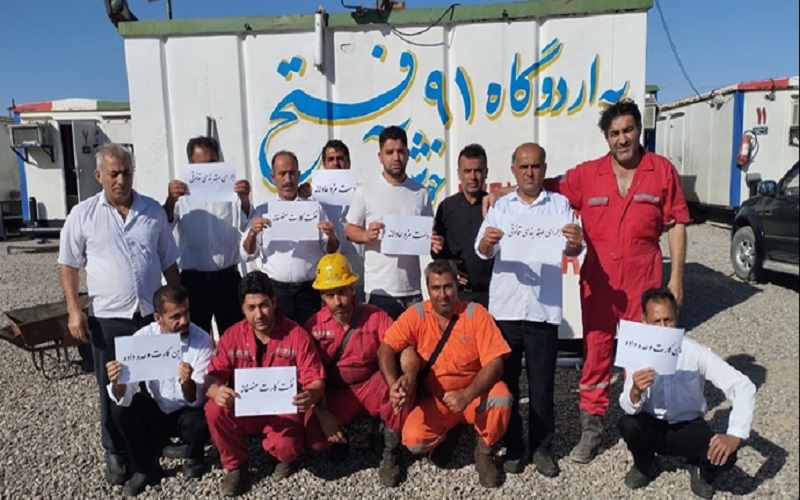

On Saturday, June 1, the ILNA news agency reported that the government lacks the ‘will’ to address the wage restoration demands of Iranian workers, leading to a more severe livelihood crisis than ever before.
According to the Supreme Labor Council’s recent decision, the minimum wage for married workers with children covered by the labor law has increased by approximately 2 million tomans, reaching about 11 million tomans this year. However, this wage adjustment does not apply to workers not covered by the labor law. Additionally, reports from media outlets and Telegram channels indicate that some workers in various workshops and companies are still receiving last year’s wages.
Ali, who works in a clothing manufacturing company in central Tehran, told ILNA that he earns 8 million tomans for 10 hours of daily work without any additional benefits.
This situation is dire, as government-recognized labor organizations estimate the monthly cost of living for a household at around 25 million tomans. Independent labor organizations assert that this cost exceeds 30 million tomans per month.
ILNA reported that essential aspects of life, such as home and car ownership, quality education, and adequate medical treatment, are no longer affordable for many workers. The majority of working and retired laborers cannot afford necessary medical treatments. Official data highlights a severe livelihood crisis, evidenced by the declining consumption rates of essential food products.
ILNA also interviewed Baqer, another worker, who shared that he can only afford to buy one kilogram of veal per month for his family of five, and they do not purchase lamb at all. This translates to a monthly per capita meat consumption of just 200 grams, totaling less than 2.5 kilograms per year.
The significant decline in per capita consumption is not limited to red meat. Dairy product consumption has also drastically decreased, from 130 kilograms per person in 2009 to just 55 kilograms currently.
The reduction in per capita consumption and the substitution of essential, high-quality goods like white and red meat with cheaper alternatives such as potatoes and, at best, soybeans, pose a serious threat to the health of working families and society. The broader consequences of this situation are even more alarming.
Labor activist Faramarz Towfighi, in an interview with ILNA, described the reduction in per capita food consumption as a long-term trend. He linked the rise in metabolic diseases to the decreasing quality and quantity of the food available to families.
Towfighi warned that if the livelihood crisis is not addressed, the situation will deteriorate further in the coming months, leading to higher treatment costs, weakened family structures, and reduced workforce efficiency.
He emphasized that inadequate nutrition impairs accuracy and vigilance, increasing workplace accidents, and fostering aggression and conflict within families, communities, and workplaces.
Despite numerous reports from ILNA and other outlets on the severe livelihood issues facing workers and their families, Solat Mortazavi, Minister of Cooperation, Labor, and Social Welfare, stated on May 29 that the minimum wage for workers has increased satisfactorily.
However, the ongoing strikes and workers’ protests across various regions in Iran highlight the inadequacy of current wages and the persistent issue of delayed payments.
The worsening livelihood crisis underscores the urgent need for comprehensive and effective solutions to support Iran’s workers and ensure their basic living standards.