


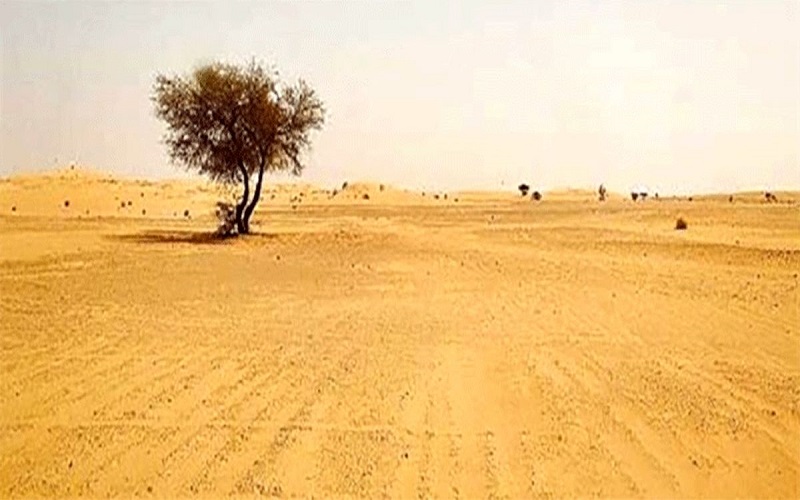

Desertification is one of Iran’s most critical environmental issues, reaching alarming proportions in recent years due to human activities and climate change. Iran accounts for 1.2% of the world’s dry land and 3.08% of the world’s desert areas.
The Extent of Desertification
Iran’s deserts span 32.5 million hectares, but the entire country is affected by desertification. Over the past decade, areas impacted by wind erosion have increased by 30%. Each year, one million hectares of desert are created in Iran. At this rate, considering Iran’s total area of 1,648,196 square kilometers, the country could become a complete desert within the next 164 years.
Accelerating Land Degradation
Desertification, driven by both natural and unnatural factors, now covers large areas of Iran with increasing speed. This phenomenon has led to decreased soil fertility and land degradation in forests, wetlands, deserts, and agricultural lands. Over the past decade, areas affected by wind erosion have grown from 20 to 30 million hectares. Critical areas have expanded from 7 to 13 million hectares, causing significant damage to biological, social, and economic resources.
Impact on Various Land Types
Desertification affects diverse parts of the country, from forests and pastures to wetlands and agricultural lands. Data on land degradation indicates that Iran is far from ideal in terms of preventing this degradation. Excluding ultra-arid areas like the Dasht-e Kavir, which have no potential for desertification, the rest of the country’s lands are at risk of severe damage due to exploitation.
Development and Desertification
Development projects, such as roads, railways, and urban development, have been carried out in areas affected by wind erosion over recent decades. These areas have become crisis centers. Additionally, the drying up of wetlands, lowering of underground water levels, and salinization of agricultural lands have turned other regions into crisis zones. Limited financial and annual resources allow for the management of only 300,000 hectares of the country each year, which is insufficient given the pace of desertification.
The Threat to Forests
A large part of Iran’s pastures and forests are being destroyed annually. An environmental activist has warned that if the destruction of oak forests continues at the current rate, there will be no oak forests left in the next 50 years. Over the past 70 years, nearly 7 million hectares of oak forests have been lost, leaving only about 5 million hectares remaining. Each oak seedling requires substantial investment to plant and maintain, whereas the cost of preserving existing oak forests is much lower.
Since the beginning of the 20th century, 43% of Iran’s forests have been destroyed. Most of the remaining forest areas are now confined to the Alborz mountain range near the Caspian Sea and the Zagros mountain range. Today, almost no virgin forest remains in Iran.
In provinces such as Chaharmahal and Bakhtiari, Lorestan, and Khuzestan, large tracts of forest land were cleared for cultivation. In Gilan, forests were cut down to facilitate the production of tea, rice, and tobacco.
Since 1979, Iran’s forests have suffered increasing destruction, with about one million hectares of the ecologically rich Zagros forests lost due to climate change. Government agencies responsible for implementing laws and regulations related to forest conservation are often outdated, plagued by budget issues, and hindered by inefficient bureaucracy.
Over the past 70 years, seven million hectares of Zagros forests have been destroyed, leaving only five million hectares remaining. If current trends continue, Iran is at risk of losing all its forests within the next 50 years and all its pastures within the next 80 years.
Inappropriate Construction Projects
Inappropriate construction projects and engineering decisions have caused significant destruction of forests to build structures such as dams and roads. Unrestrained dam constructions, exemplified by the ‘Chamshir Dam’ in Kohgiluyeh and Boyer-Ahmad provinces, are draining water resources in areas rich in oak forests. These dam constructions are a major cause of the drying up of lakes and wetlands, leading to the loss of forests and pastures.
Conclusion
Desertification in Iran is a severe and escalating problem, driven by both natural phenomena and human activities. Immediate and effective measures are essential to manage and mitigate the impact of desertification on the country’s diverse landscapes and resources. Without significant intervention, Iran faces the dire prospect of widespread land degradation and ecological collapse.