


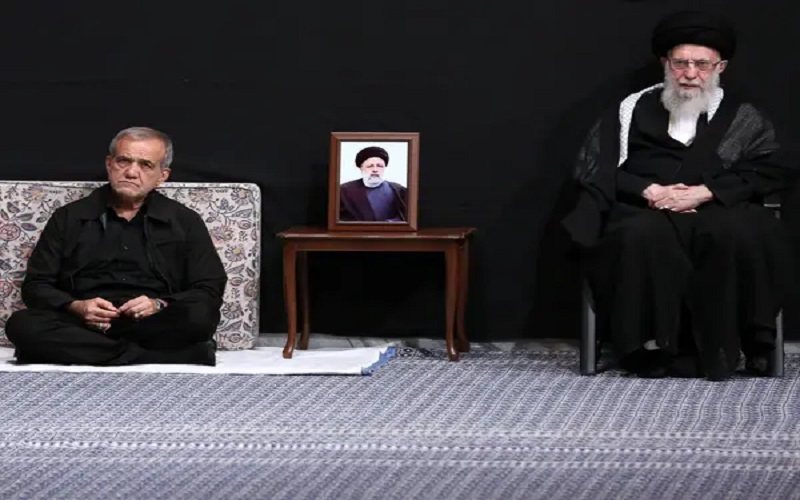

In a recent development, Iran’s Supreme Leader Ali Khamenei has advised the newly appointed President Masoud Pezeshkian to steer clear of cultural and social issues. This information was revealed by Haddad Adel, a member of the Council for Expediency and adviser to Khamenei, during an interview with the state-run Khabar TV channel.
Adel quoted Khamenei as saying, “You know how much I care about cultural issues. However, I want to advise the president to focus on solving economic problems. The president should be cautious in cultural and social matters to avoid creating trouble for himself. Your main problem is economic issues. So focus on that, pay attention to cultural issues as well, but don’t create trouble for your government.”
This advice raises questions about Khamenei’s intentions regarding cultural and social issues. Historically, dictators tend to avoid or exert strict control over these areas, as they can lead to social changes, public awareness, and political protests. Culture and art often serve as tools for expressing dissent and criticism, which autocratic regimes seek to suppress.
Cultural and social changes have the potential to challenge the status quo, highlighting existing inequalities and injustices. Dictators prefer to maintain a stable, controlled society. Many employ censorship to limit information access and use propaganda to shape public opinion, particularly in areas such as art, literature, and media.
Khamenei’s concern stems from recent uprisings that have shaken the regime’s foundations. The 2022 uprising, which lasted six months, resulted in nearly 800 casualties and thousands of arrests, with some detainees reportedly dying under torture. In response, Khamenei ordered harsh confrontations with protesters.
The Supreme Leader’s advice to Pezeshkian extends to selecting cabinet members who are unwaveringly loyal to him and the regime. The concept of “jihadi managers” is emphasized, not in the sense of addressing people’s problems, but rather as individuals ready to suppress dissent and preserve the government at all costs.
Haddad Adel attempts to soften this stance, stating, “Jihad work does not mean doing something illegal. Some people think that jihadi management requires violating all rules and regulations. I sometimes jokingly call it ‘uncontrollable fire’.”
Khamenei’s warnings to Pezeshkian dash the hopes of those seeking reform within the regime. The unchanging nature of the Iranian government is evident in three key areas: politics, economy, and international relations.
In politics, presidents over the past 45 years have had little power to effect change, with Khamenei remaining the primary decision-maker. Economically, 80% of the country’s economic management and profits are controlled by Khamenei and the Islamic Revolutionary Guard Corps (IRGC), leaving Pezeshkian with limited ability to address economic crises.
Regarding international relations, the Supreme Leader has been the final arbiter for 45 years. The regime’s approach, based on hostage-taking, blackmail, terrorism, and the export of medieval ideology, has led to persistent diplomatic challenges.
In conclusion, the Iranian regime appears resistant to reform, offering no viable solutions to free the country from its structural constraints in politics, economy, and international relations. Khamenei’s advice to Pezeshkian serves as a stark reminder of the regime’s unwillingness to change and its prioritization of maintaining power over addressing the needs and aspirations of its people.