


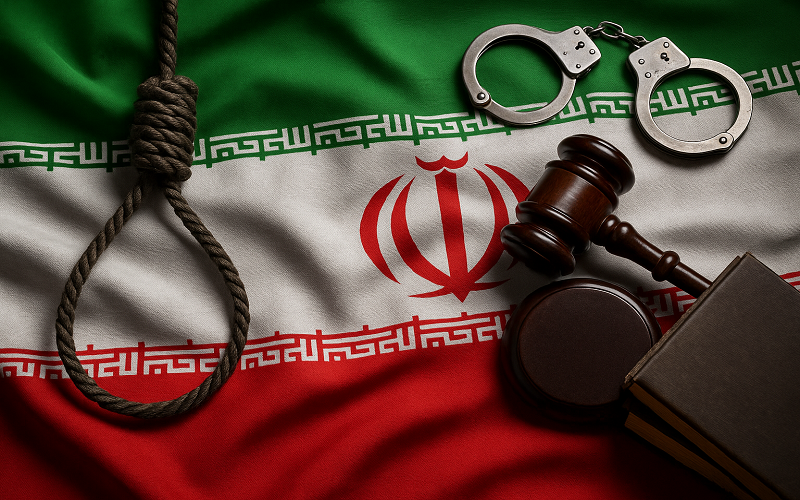

Between Monday, May 12, and Thursday, May 15, the Iranian regime executed at least 19 individuals across various prisons in the country. Among them were two juvenile offenders and a woman—an alarming detail that underscores the brutality of the Islamic Republic’s judicial and security apparatus.
With this latest wave, the total number of executions since July 2024 under President Masoud Pezeshkian has reached at least 1,164—the highest in over three decades. This unprecedented surge reflects a sharp escalation in state violence aimed at silencing dissent and maintaining the regime’s grip on power.
A Timeline of Executions
-
May 15: Reza Dehmardeh (24) and Mohammad Ebrahim Esfandiari were executed in Zabol and Vakilabad (Mashhad) prisons.
-
May 14: Five prisoners, including 18-year-old Hadi Soleimani (who was under 18 at the time of the alleged crime), were executed in Ghezel Hesar, Urmia, and Adel Abad prisons.
-
May 13: Mohammad Reza Sabzi (20), who was only 16 when accused of his crime, along with Ebrahim Joghatai and another unidentified individual, were executed in Malayer, Gonabad, and Ghezel Hesar prisons.
-
May 12: Nine individuals were executed in Isfahan, Arak, and Ghezel Hesar prisons, including Mahmoud Hojatzadeh (35), Nemat Pirizali, Mohammad Abdi, Jalil Azizi, and Kourosh Jalili.
-
Earlier (May 6–7): Mahtab Amiri was executed in Adel Abad (Shiraz), Payam Mokhtari in Tabriz, and two more individuals in Shiraz.
These executions—many involving political prisoners, ethnic minorities, and young offenders—highlight a pattern of systemic abuse and judicial violence that has become central to the regime’s strategy of governance.
Executions as a Political Weapon
The Iranian regime increasingly uses the death penalty as an instrument of political control. Political prisoners such as Behrouz Ehsani and Mehdi Hassani, both affiliated with the People’s Mojahedin Organization of Iran (PMOI/MEK), were sentenced to death on vague charges like “moharebeh” (enmity against God) and “rebellion” in sham trials lasting mere minutes. Denied legal counsel, their right to a fair trial was blatantly violated.
Similarly, Reza Rasaei and Mohammad Ghobadlou—linked to the 2022 nationwide protests—were executed following unfair trials and under confessions extracted through torture. These executions serve not justice, but the regime’s need to instill fear, deter protest, and stamp out dissent.
Alarming Surge in Execution Rates
According to reports by human rights groups, executions have increased by 75% in the first four months of 2025—rising from 195 cases in early 2024 to 343 in the same period this year. In April 2025 alone, 110 people were hanged, marking a shocking monthly high.
Such figures are not only alarming in scale but also in opacity. Just 4% of executions (13 out of 343) were officially acknowledged, revealing a deliberate effort by authorities to evade accountability and prevent scrutiny.
Violations of International Law
Iran is a signatory to the International Covenant on Civil and Political Rights (ICCPR), which limits capital punishment to the “most serious crimes,” typically involving intentional killing. The use of the death penalty for non-violent offenses, particularly drug-related crimes—which accounted for nearly half of all executions in early 2025 and 60% in April alone—is a flagrant violation of this obligation.
The regime’s judiciary frequently disregards basic legal protections. Executions such as that of Hamid Hosseinnejad Heydaranlu—carried out without notifying his family or lawyer and while his appeal was still under review—demonstrate systemic contempt for due process and human dignity.
Ethnic Discrimination in Capital Punishment
Executions also disproportionately target ethnic minorities, especially the Baluch and Kurds. In April 2025, 35 Baluch individuals—accounting for 32% of all executions—were hanged, despite representing only 2–6% of the population. Baluch prisoners also constituted 17% of drug-related executions in 2024, indicating deep structural discrimination against this marginalized group, often trapped in poverty and denied fair legal representation.
The Kurdish minority has faced even harsher political repression. Between 2010 and 2024, Kurds represented 52% of political executions in Iran. The case of Heydaranlu, executed for alleged membership in the PKK, exemplifies how the regime uses the death penalty to suppress Kurdish political and cultural aspirations, especially in border regions where dissent is framed as a national security threat.
The Silence of the International Community
Despite the rising toll, international reactions have remained largely ineffective. Human rights advocates are urging the global community to take more decisive action. Recommendations include:
-
Targeted sanctions against judicial and security officials involved in executions.
-
Suspension of international cooperation with Iran’s judiciary.
-
Referral of Iran’s human rights record to the UN Security Council.
A Regime Built on Violence
The current surge in executions is not an isolated trend but part of a broader, calculated strategy:
-
Spreading fear to prevent uprisings, especially in the aftermath of the 2022 protests.
-
Suppressing ethnic minorities, particularly in restive border regions like Sistan and Baluchistan and Iranian Kurdistan.
-
Criminalizing dissent by equating political opposition with crimes against the state, using broad charges like “moharebeh” to delegitimize and eliminate opponents.
Conclusion
Iran’s use of the death penalty has become a cornerstone of its authoritarian governance. Under President Pezeshkian, this tool of repression has been wielded with chilling efficiency. Executions of minors, political prisoners, and ethnic minorities are not only a human rights catastrophe but a clear indication of a regime that thrives on violence, secrecy, and impunity.
The time for symbolic condemnation is over. The international community must act—decisively and urgently—before more lives are extinguished by a regime that sees no limits to its cruelty.