Cross-party support in London strengthens international recognition of Iran’s organized resistance as a viable democratic alternative to the ruling regime.
On July 16, 2025, the UK Parliament hosted a major political event under the title “The Third Option: Change by the Iranian People and Resistance”. Chaired by Baroness Uddin and attended by members of both the House of Commons and House of Lords from across the political spectrum, the conference reflected a growing consensus around a new direction in policy toward Iran—one that rejects both military intervention and appeasement in favor of democratic regime change from within.
The Rise of the Third Option
The “Third Option” represents a strategic and ethical alternative to the failed approaches of the past. It neither calls for foreign war nor promotes concessions to a regime notorious for its human rights abuses. Instead, it focuses on empowering the Iranian people and their organized resistance movement to bring about democratic change. At the center of this vision stands the National Council of Resistance of Iran (NCRI) and its political platform, which has gained increasing international support in recent years.
This position was especially relevant given Iran’s current political and social context. In recent weeks, the regime has intensified its internal repression, approving draconian legislation aimed at silencing dissent and issuing execution sentences against political prisoners accused of affiliation with the opposition. These moves signal the regime’s growing insecurity and its recognition of the increasing influence of a democratic alternative.
International Support for Iran’s Democratic Movement
Parliamentarians at the conference emphasized the failure of both military adventurism and diplomatic appeasement in dealing with the Iranian regime. They acknowledged that neither approach has curbed Tehran’s internal repression or its destabilizing actions in the region. In contrast, the Iranian Resistance, particularly the NCRI, was presented as a credible and principled alternative capable of leading the country toward democracy.
Speakers highlighted the urgency of supporting this democratic alternative, especially in light of the regime’s continued use of executions, imprisonment, and systemic violence against dissidents. There was a strong consensus that international silence in the face of such actions would be morally unacceptable and politically short-sighted.
Attention was also drawn to concerns over individuals or groups attempting to engage or coordinate with the regime’s military institutions, particularly the Islamic Revolutionary Guard Corps (IRGC). Such actions were criticized as dangerous, politically irresponsible, and deeply offensive to the victims of the regime’s brutality.
The Ten-Point Plan and the Need for Political Recognition
Throughout the event, there was repeated reference to the NCRI’s Ten-Point Plan, which advocates for democratic reforms including gender equality, freedom of expression, an independent judiciary, separation of religion and state, and ethnic autonomy within a united Iran. The plan was seen as not only comprehensive and progressive but also reflective of the aspirations of a broad segment of Iranian society.
Several speakers underlined the importance of officially recognizing the Iranian people’s struggle for freedom and the resistance movement that supports it. This recognition was viewed as a critical step in shifting international policy away from passive observation toward active support for change.
A Warning and a Turning Point
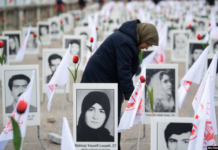
Parliamentarians also raised alarms about the current trajectory of the Iranian regime, noting similarities between recent developments and the period leading up to the 1988 massacre of political prisoners. The danger of repeating history, they argued, made international action even more urgent. Suggestions were made for stronger measures, such as designating the IRGC as a terrorist entity and activating international mechanisms—like the UN Security Council’s snapback provisions—to hold the regime accountable.
Some speakers also rejected the idea of returning to monarchy as a viable political future for Iran, pointing to the historical rejection of both the Shah’s regime and the current theocracy by the Iranian people. The NCRI, in contrast, was acknowledged as having built a clear, organized, and democratic alternative.
A Shift in the International Landscape
The conference represented more than a single event—it marked a visible shift in international attitudes toward Iran. The presence of high-level British lawmakers and former European officials signaled growing global recognition of the NCRI as a legitimate political force. The emphasis on human rights, democratic values, and grassroots change echoed a broader demand for a policy reset toward Iran.
At a time when the Iranian regime is facing growing internal instability, economic collapse, and loss of credibility, international support for the organized opposition appears not only timely but also strategically essential.
Conclusion: From Policy Debate to Action
The “Third Option” conference in the UK Parliament served as a call to action. It urged democratic governments to move beyond passive criticism and toward active support for the Iranian people’s struggle for freedom. The momentum behind the resistance, combined with the regime’s increasing fragility, suggests that a democratic transition is no longer a distant hope but a tangible possibility.
What was once considered a theoretical alternative has now emerged as a practical, urgent, and morally sound strategy: regime change by the Iranian people and their resistance — with the support and recognition of the international community.