


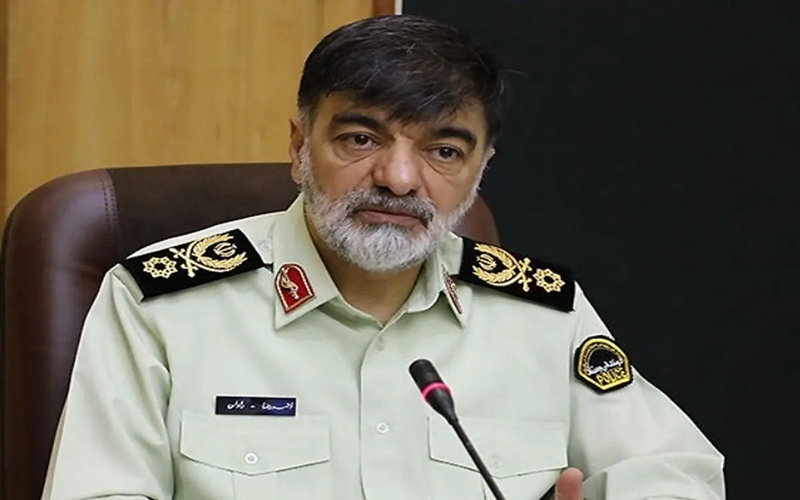

Iranian police chief resorts to threats and insults, exposing the regime’s internal rot and fear of public revolt
In a revealing interview with the state-run SNN News Agency on July 15, 2025, Brigadier General Ahmad-Reza Radan, commander of Iran regime’s Law Enforcement Forces and one of the most notorious enforcers of Supreme Leader Ali Khamenei’s oppressive apparatus, unleashed a barrage of threats, deflections, and insults directed at the Iranian people. Far from projecting strength, Radan’s words laid bare the regime’s deepening fear and fragility in the face of growing public unrest.
Recycling a tired narrative, Radan claimed that “spies and traitors are under surveillance, and the remaining ones will soon be eliminated.” This statement, seen by many as a desperate diversion, attempts to shift public attention away from the regime’s endemic corruption and dysfunction. Mounting evidence suggests that the recent leaks of sensitive information — including from senior ranks within the Revolutionary Guards and the Ministry of Intelligence — stem not from foreign sabotage but from insiders disillusioned with the system.
The regime’s internal disintegration has become so blatant that even high-profile figures like former Supreme National Security Council secretary Ali Shamkhani and his son are under suspicion. The younger Shamkhani’s unexplained departure from home moments before a projectile struck nearby has sparked ridicule and widespread distrust, underscoring how far public confidence in the regime’s elites has collapsed.
Radan also referenced the recent 12-day war, claiming, “Fortunately, thanks to actions taken and public cooperation, there was no mischief from thugs during the conflict.” His words betray a fundamental anxiety within the regime. The general’s description of potential dissenters as “thugs and criminals” reflects both a deep contempt for the Iranian public and a poorly veiled fear of mass uprising. In Radan’s framing, citizens demanding dignity, rights, and freedom are cast as threats to national security.
To most Iranians, the real thugs are those who, under Radan’s command, brutalize women, youth, and activists in the streets. Radan, known widely as a cold-blooded enforcer, has come to symbolize the regime’s violent repression and inhumanity.
In a renewed attempt to intimidate the population, Radan warned: “Spies and traitors will continue to be tracked by our police and security forces — and by the people — and the rest will be rooted out.” But such threats ring increasingly hollow. Iranians recognize these warnings as the last gasps of a regime in terminal decline. What Radan describes as “cooperation from the people” is, in truth, a calm before the storm — a society on the edge, awaiting its historic moment to rise.
Ultimately, Radan’s rhetoric reflects the desperation of a crumbling theocracy facing an awakened nation. The regime may continue to spill blood in its bid to survive, but history has shown that no force can permanently suppress the will of a united and determined people. As Iranians say, the regime’s foundations are coming apart — and the final reckoning is only a matter of time.