


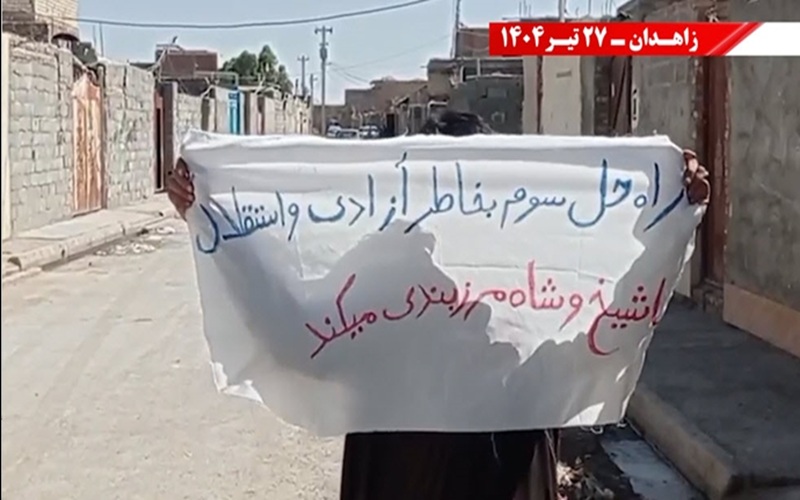

Statements by Khamenei and former regime officials expose deep concern over the growing role of resistance networks and public dissent in accelerating the downfall of the Iranian regime.
As Iran’s theocratic regime grapples with one of the most severe crises in its history—spanning economic, political, and social dimensions—its senior figures are making rare admissions that reveal a mounting fear of collapse. Recent statements by Mohammad-Taqi Taqavi, former head of the Policy Council for Friday Prayer Leaders, and Supreme Leader Ali Khamenei himself, suggest that Tehran’s ruling elite increasingly views the threat of overthrow not as a foreign plot, but as the result of an internal, organized resistance.
On July 18, Taqavi openly stated:
“They calculated that by attacking the regime’s personalities, the system would weaken, and then the infiltrating cells of the [MEK] and thugs would take over the scene, and eventually the discontented people would bring down the regime.”
This striking comment reflects a critical shift in narrative. No longer are mass protests dismissed merely as spontaneous or foreign-instigated events. Rather, the regime now acknowledges a domestic infrastructure of dissent—particularly the MEK’s Resistance Units—as a decisive force in the ongoing destabilization of the Islamic Republic.
Taqavi added, “When they attack personalities, the system is weakened.”
This remark appears to reference recent public exposure and criticism of key regime figures such as Mohammad Bagher Ghalibaf, Gholam-Hossein Mohseni-Eje’i, and regime’s president Masoud Pezeshkian—insiders at the core of Iran’s power apparatus. The fact that such prominent names are now under fire from within the regime’s own propaganda network highlights growing internal fissures.
Perhaps most significantly, Taqavi described the MEK’s Resistance Units as “infiltration cells” that begin “field command” once the regime’s foundations are weakened. This terminology suggests the regime perceives current protests and unrest not as isolated flashes of anger, but as strategically guided steps in a broader revolutionary plan.
Khamenei’s Echo of Fear
In a July 16 meeting with judiciary officials, Khamenei himself voiced similar anxieties:
“This was something they had planned… when we are attacked, our sensitive centers are hit, and the system becomes weak—that is when the sleeper cells of the MEK, monarchists, mercenaries, and thugs activate.”
He continued:
“They figured those paid in dollars to burn their compatriots’ cars would become active… when the system is weakened, they enter society and incite the people… in the end, they ‘finish the regime.’”
These words, coming from the highest authority in the Iranian regime, indicate more than a security concern—they are a confession. They mark a grudging recognition of the effectiveness of the opposition, particularly its capacity to capitalize on regime weakness and social dissatisfaction to mobilize rebellion.
The Turning Point: Resistance as the Primary Threat
For years, Tehran has deflected responsibility for domestic unrest by blaming foreign “enemies” or economic sabotage. Yet these latest comments—from both Khamenei and Taqavi—indicate a fundamental shift. By naming the MEK and its Resistance Units as the core threat, the regime is tacitly acknowledging a new political reality: that the threat to its survival now lies within Iran, not beyond its borders.
Moreover, references to “field command,” “activation,” and “infiltration” illustrate a newfound concern about the coordination between organized resistance groups and the broader public. The regime no longer treats protests as accidental or chaotic, but as the potential frontlines of an orchestrated movement capable of toppling the Iranian regime.
A Regime Entering Its Final Phase?
The frightened tone of these admissions suggests that the regime views itself as entering a terminal phase. No longer able to dismiss its critics as isolated or ineffective, it now confronts the specter of a unified front—one that connects long-standing organized opposition with widespread public outrage.
The evolution of this rhetoric—from denial and suppression to reluctant recognition—signals a loss of control at the heart of the system. Rather than projecting strength, the regime’s public acknowledgment of internal threats points to deepening instability and growing desperation.
In this context, the ongoing wave of protests—from December 2017 to November 2019, and from September 2022 through the spring of 2025—appears not as a series of disconnected uprisings, but as a continuum of revolt, shaped and strengthened by organized leadership and an unrelenting public demand for regime change.
These cracks in the narrative—and the fear they expose—may well be the first open signs of a regime on the brink.