


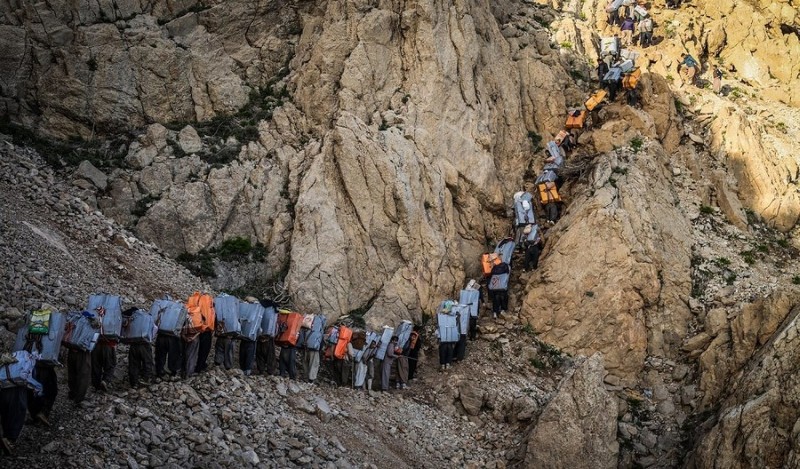

For tens of thousands in Iran’s western borderlands, “kolbari” is not a job but a desperate act of survival—born of systemic poverty, neglect, and repression.
In western Iran’s mountainous borderlands, kolbari—the practice of carrying heavy goods across the border on foot—has become the last means of survival for tens of thousands. Once an informal trade tradition, it now stands as one of the starkest symbols of poverty, inequality, and state neglect under Iran’s regime.
Although the regime provides no official statistics, human rights organizations estimate that over 70,000 people in Kurdistan, Kermanshah, and West Azerbaijan provinces depend on kolbari to survive. Many are young men—some university graduates—who face total unemployment in regions long abandoned by Tehran’s economic policies.
The deadly road to survival
Kolbars travel through steep, freezing mountain paths, often under temperatures below minus ten degrees Celsius, carrying loads that can weigh up to 60 kilograms. Their lives are constantly at risk—from falls, avalanches, frostbite, or gunfire by border guards.
According to human rights data, between 2012 and October 2025, at least 2,574 kolbars have been killed or injured along Iran’s western borders. Of these, 656 died and 1,918 were wounded. The overall trend has been rising, with casualties peaking between 2017 and 2024. The year 2023 saw the highest toll, followed by a slight decline in 2025—not because of improved conditions, but because of the regime’s heavy militarization of the borders.
Militarization, not reform
Since 2023, Iran regime’s authorities have expanded military outposts, rolled out barbed-wire fences, and blocked traditional mountain routes. These measures have not solved the problem—they have only pushed kolbars toward more dangerous and remote paths, increasing the risk of death.
Despite these crackdowns, the regime has introduced a so-called “border crossing card” system, allowing residents to transport limited goods through designated routes. But kolbars and activists say the program is a façade. The cards offer no insurance, no legal protection, and no real economic relief. Many workers, facing corruption or restrictive quotas, are forced back into illegal and deadly paths.
Human rights advocates argue that the card system is a tool of economic control and social pacification, keeping border residents dependent on the regime and discouraging them from demanding real economic rights.
A symptom of structural poverty
Economic experts describe kolbari as the direct result of structural poverty and regional discrimination. Western border provinces suffer from the country’s highest unemployment rates and lowest development levels. Factories are scarce, and infrastructure projects remain unfinished for years. For thousands of families, kolbari is not an option—it is the only source of income.
The state’s response over the past 14 years has been systematic repression. The surge in casualties in 2023, and the only apparent “decline” in 2025, reflect not policy improvement but the closure of traditional routes through militarization. With every new restriction, kolbars take even riskier paths—over cliffs, minefields, and freezing ridges—to survive.
Silence, denial, and censorship
The Iranian regime publishes no data on the number of kolbars, their deaths, or the types of goods carried. All available information comes from field investigations, family testimonies, and human rights reports, reflecting the regime’s deliberate censorship and securitization of the issue.
Analysts note that kolbari is not a profession but a form of coercion. Through mechanisms like the border card system, the regime institutionalizes dependence and suppresses dissent. As one observer put it, “A man who becomes a kolbar no longer demands anything from the state—he’s too busy staying alive.”
Children among the dead
In recent years, even children and teenagers have been forced into kolbari. Rights groups have documented cases of minors among those killed or injured. While state media labels kolbars as “smugglers,” for border communities, kolbari means life itself—a life without safety, insurance, or future.
A national wound ignored
Despite years of criticism from civil society and local activists, the regime has offered no real solution. Instead, it has deepened its militarized approach, turning border regions into security zones rather than centers of development.
As poverty, repression, and neglect continue to intersect, kolbari has come to represent more than economic desperation. It is a mirror of a state that has abandoned its citizens, criminalizing their survival while offering no path toward dignity.
In today’s Iran, kolbari is not a job—it is a sentence. And as long as structural poverty and regional inequality persist, thousands will continue to walk those frozen paths between life and death, carrying not just goods on their backs, but the unbearable weight of a failed state.