


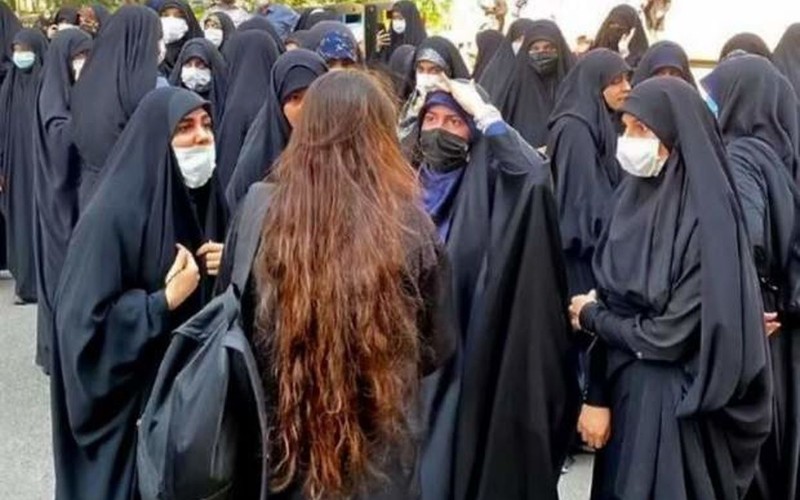

Conflicting messages inside the government surface as leaked reports point to renewed security-led enforcement of compulsory veiling
Growing tensions over the future of Iran’s mandatory hijab policy have resurfaced after Elyas Hazrati, head of the government’s information council, confirmed that Ali Khamenei sent an official directive on compulsory veiling to the administration of Masoud Pezeshkian.
Hazrati stated on November 26 that the cabinet had agreed to the confidential order and framed the issue as a matter of religious commitment, while also acknowledging public concerns regarding state approaches to social conduct.
His remarks followed earlier statements from Hossein Rafiei of the seminaries’ cultural division, who said the Ministry of Intelligence submitted a post–Iran–Israel war report on the state of hijab to Khamenei.
Rafiei claimed the leader described the findings as “shocking” and instructed that the report be shared with the president so intelligence bodies could identify and pursue those allegedly involved in organized resistance to compulsory veiling. He portrayed unveiled women as part of a coordinated foreign plot, a recurring narrative used by Iranian authorities to justify repression.
Within this climate, senior regime figures have increasingly emphasized harsher enforcement. Judiciary chief Gholamhossein Mohseni-Eje’i ordered prosecutors on November 13 to work with security forces to confront what he labeled “organized networks linked to foreign actors” supposedly responsible for social “abnormalities.”
Hazrati added that the Intelligence Ministry’s report detailed at least twenty-three categories of such “abnormalities,” claiming that unveiled women represented only one segment within a broader set of alleged moral violations.
Despite repeating that Pezeshkian and his ministers remain “sensitive” to the hijab issue, Hazrati insisted the government does not intend to repeat previous enforcement models in fear of the public outrage. He asserted that the regime’s president has long argued that the morality patrol system has failed, and that persisting with ineffective methods serves no purpose.
The debate intensified after a leaked eleven-minute audio file, published by domestic outlet Rouydad24, described what the speaker called a nationwide “enemy operation” unfolding after the twelve-day war between Iran and Israel.
In the recording—attributed to Azim Ebrahim-pour, head of the so-called Jihad Tabyin headquarters—the speaker claims the Intelligence Ministry briefed Khamenei that public gatherings, social events, and online posts reflected a coordinated plan to undermine the regime.
According to the audio, Khamenei again characterized the report as “shocking” and issued instructions that included deploying security forces, pressuring government bodies to act, and intensifying activities by regime-aligned cultural groups.
The audio further alleges that Pezeshkian, after reviewing the report, asked his cabinet to enter an “operational phase,” but that ministers Ali Rabiei, Zahra Behrouz-Azar, and Elyas Hazrati objected.
The speaker also claims Khamenei approved an eleven-article enforcement scheme based on the “Hijab and Chastity” plan, under which restrictions—including text-message warnings and service limitations—would be quietly implemented in eleven major provinces without formal public announcement.
Following publication of the audio, Rafiei reiterated at a public event on November 25 that the Intelligence Ministry’s report produced strong reactions from Khamenei, who allegedly ordered the identification and prosecution of those considered responsible for organized defiance.
Meanwhile, Hazrati told reporters that the government seeks new, unspecified approaches and does not intend to reinstate former methods, arguing that their failure is evident in ongoing tensions.
Inside Iran, several outlets described both the leaked file and subsequent events—including calls for pro-hijab demonstrations—as elements of a broader project aimed at forcing full implementation of the hijab law. Political figures close to the Pezeshkian administration suggested that some regime factions may be attempting to generate divisions within the cabinet or pressure it into adopting harsher policies.
The resurgence of debates over compulsory hijab comes two years after the death of Mahsa (Jina) Amini in morality-police custody in September 2022, which triggered the nationwide 2022 uprising.
Despite severe repression, many Iranian women, particularly younger generations, continue to appear in public without mandatory veiling. Morality-police vans were temporarily withdrawn during the protests, and the parliament’s “Hijab and Chastity” bill—controversial for its extensive punitive clauses—was approved by the Guardian Council earlier this year but stalled at the implementation stage.
Recent weeks have seen renewed punitive measures, including unannounced SIM-card deactivations targeting women who appear unveiled in public or online, as well as men posting critical commentary.
These actions have caused significant disruption to daily life and intensified concerns that regime authorities are adopting new covert mechanisms to enforce the compulsory hijab while publicly asserting that no return to past policies is planned.