


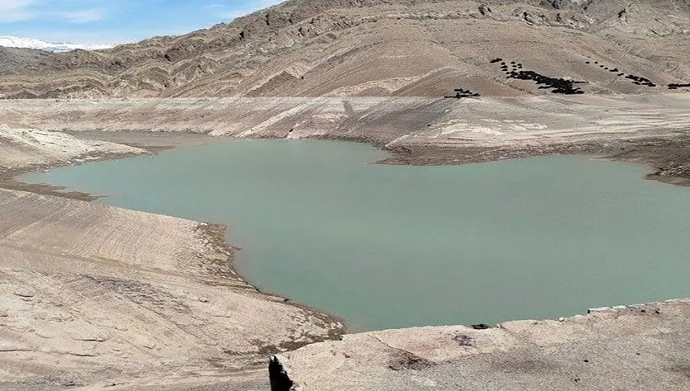

From the looming depletion of Tehran’s reservoirs to the drying of 19 major dams, Iran is entering its worst water crisis in modern history — a disaster driven overwhelmingly by mismanagement, corruption, and destructive development models imposed by the Iranian regime.
A Nation on the Brink of Thirst
Iran is now in its sixth consecutive year of severe drought, and the situation has reached an unprecedented level of danger. Rainfall that should have replenished reservoirs simply never arrived. Nearly 20 provinces have seen no measurable rainfall since the start of the wet season in late September, and according to international reporting, 10% of the country’s dams are effectively dry. But the problem is not merely meteorological. Iran has always been a semi-arid country. What is new — and catastrophic — is that decades of destructive policies under the Iranian regime have pushed the country’s hydrological systems to collapse. A crisis that should have been manageable has now become existential.
Tehran, a megacity of 15 million, now faces the unthinkable: possible temporary evacuations. Officials openly admit that “the water of Tehran may run out completely.” Yet the capital is only the most visible frontline of a nationwide emergency.
The Worst Drought in 40 Years — But 80% of the Damage is Man-Made
Environmental experts inside Iran emphasize that climate change explains only 10–15% of the current water crisis. More than 80% of the damage is rooted in human decisions — or more precisely, regime decisions. As one water governance researcher summarized:
“What we are witnessing today as a water crisis is the result of a long path of decisions, policies, and human interventions — not a sudden event.”
Decades of groundwater over-extraction, aging infrastructure leaking up to 30% of treated drinking water, a development model centered on water-intensive agriculture, unrestrained dam construction, and the placement of petrochemical, steel, and gas industries in dry regions have all pushed Iran past the point of sustainability. Added to this is the regime’s refusal to modernize water management, combined with systematic corruption involving “water mafias,” engineering consultancies, and politically connected contractors. By all measures, this is not a drought — it is a collapse of governance.
Agriculture: The Engine of Depletion
The most damning statistic is that 90% of Iran’s total water consumption goes to agriculture. After 1979, the regime aggressively pursued “food self-sufficiency,” expanding irrigation networks and doubling irrigated farmlands even in desert regions. Politically, the policy was attractive. Hydrologically, it was suicidal.
Iran’s renewable water resources total approximately 102 billion cubic meters. Of this, 70–80 billion cubic meters are consumed by agriculture, while only 8–9 billion cubic meters go to drinking water and a mere 2–3 billion cubic meters are used by industry. This imbalance is mathematically impossible to sustain. Hydrologists warn that the depletion of aquifers is now so severe that many will never recover, even if rainfall patterns return.
Lake Urmia: The Symbol of a Broken System
Lake Urmia, once one of the largest saltwater lakes in the world, has shrunk to a fraction of its former size. While drought played a role, the true drivers were the construction of dams on inflowing rivers, the drilling of thousands of legal and illegal wells for agriculture, and the expansion of farmlands encouraged by the state. The lake’s decline is a visible symbol of a national collapse: water systems drained faster than natural processes can replenish them.
Air Pollution and Water Collapse: A Vicious Feedback Loop
Hydrologist Hojjat Miyan-Abadi warns that Iran’s severe air pollution — intensified by the regime’s use of mazut-burning power plants — is suppressing rainfall. He explains:
“Air pollution and particulate matter disrupt the process of cloud formation and precipitation.”
With Tehran experiencing 50 consecutive rainless days and drought conditions spreading nationwide, he adds: “If rainfall does not arrive by the end of mid-December, the possibility of water rationing becomes serious.” Thus, the regime’s failures in one environmental sector are accelerating disaster in another.
Nineteen Major Dams at the Edge of “Death”
Iran has roughly 200 active dams, but 19 of the largest now hold less than 5% of their capacity. Many are located in populous provinces. If these dams fail, the regime has no meaningful backup supply system. Solutions repeatedly advertised by officials are either superficial or scientifically doubtful. The Taleqan water transfer project, for instance, would add only 80–100 million cubic meters per year to Tehran — insignificant compared to the capital’s 1.65 billion cubic meters of annual consumption. Cloud-seeding, another favored announcement, offers little scientific evidence of effectiveness. Iran is rapidly nearing a point where supply cannot meet demand.
A Political and Economic Dead-End
Researchers describe Iran’s water crisis not as a technical challenge, but as a political-economic impasse. One expert explains: “Solving Tehran’s water crisis is no longer merely a technical issue. It has turned into a political and economic deadlock that has put a knife to the city’s throat.”
Meaningful solutions — reducing irrigated agriculture, shutting down water-heavy industries, relocating populations — directly collide with the regime’s economic interests or threaten politically sensitive sectors. Iran remains trapped in a development model defined by heavy industries in deserts, agriculture in water-scarce regions, and massive population centers located in hydrologically unsustainable zones.
As one Iranian geographer put it: “We are suffering from a drought of intellect and wisdom. This country has been governed without collective rationality.”
Population Location: The Ignored Strategy
Experts have warned for decades that Iran’s population is distributed in hydrologically unsuitable regions. International consultants long ago recommended relocating 25–30% of the population to the coasts of the Oman Sea, where water is accessible and desalination is viable. The regime instead spent billions transferring water to desert cities such as Yazd and even built steel factories in regions with no sustainable water supply. Today, specialists estimate that as much as 35% of the population must be relocated to the southern coasts within two decades to avoid irreversible collapse.
A Country Without Water Recycling
While many drought-stricken countries have turned to large-scale water reuse and recycling, Iran has barely begun. Singapore now supplies 40% of its national water through advanced recycling, aiming for 55% by 2030. California meets more than 30% of its needs through groundwater recharge and treated wastewater. Perth in Australia injects 100 billion liters of recycled water into its aquifers.
Iran, in contrast, recycles only about 830 million cubic meters — mostly from industry — which is negligible relative to national consumption. Municipal wastewater remains almost entirely unused for industrial or groundwater purposes, recycling projects go unfunded, and the regime frequently tells citizens to purchase household tanks and water pumps rather than implementing systemic solutions. Some analysts refer to this as “silent rationing,” where families simply lose water at night while officials deny the existence of any rationing plan.
Social Consequences: A Powder Keg
The implications are enormous. A megacity like Tehran cannot realistically be evacuated. Most families cannot afford relocation. Any form of forced or even temporary displacement could trigger severe economic disruption and widespread social unrest. Miyan-Abadi warns that prolonged drought without rainfall will lead to “severe social and economic crises.” In other words, water scarcity is becoming a driver of political instability.
The Road Ahead: Limited Time, Shrinking Options
Even if rainfall returns tomorrow, it will not restore the drained aquifers, revive collapsed ecosystems, reverse land subsidence zones that are sinking irreversibly, or undo decades of structural policy failure. As one environmental scientist states: “Groundwater tables that have been depleted will not refill again.”
Iran’s water crisis is no longer an environmental issue — it is a collapse of national governance. It threatens the country’s social stability, economic foundation, and long-term viability. The longer the Iranian regime delays meaningful change, the fewer options remain. The crisis is accelerating toward a moment where Iran may confront not only water shortages, but the question of basic survival.