



Officials admit nationwide land subsidence threatens cities, infrastructure, and ancient heritage as decades of regime negligence take their toll
Senior officials of the Iran regime are now openly acknowledging a nationwide land subsidence crisis—one that experts warn is the direct consequence of chronic mismanagement of water resources, unchecked extraction, and years of policy failure. Yet these admissions come as much of the damage is already irreversible.
Speaking on December 14, the head of Iran’s National Cartographic Organization told the regime-affiliated ILNA news agency that nearly the entire country is affected. “Almost all regions, except for provinces along the Caspian Sea such as Gilan, are experiencing land subsidence at varying rates,” Eskandar Seydaii admitted.
Seydaii attributed the phenomenon to repeated droughts and excessive water extraction. However, critics point out that drought alone cannot explain the scale of the crisis. The decisive factor has been the Iran regime’s long-standing failure to regulate groundwater use, enforce environmental safeguards, or modernize water management practices.
In the same interview, a deputy from the regime’s Planning and Budget Organization described the situation in stark terms, calling for an immediate halt to water extraction in already damaged areas. He warned that even cities will soon face strict limitations—and outright bans—on water withdrawal. Such statements underscore the severity of a crisis that has moved well beyond rural farmlands and into major urban centers.
Earlier warnings from regime-linked environmental officials paint an even darker picture. A senior adviser to Iran’s Environmental Protection Organization disclosed that land subsidence has reached as much as 40 centimeters per year in some locations. By comparison, globally only about 5 percent of known subsidence zones exceed 10 centimeters annually—highlighting how extreme Iran’s situation has become.
Ali Beitollahi, speaking to the regime’s IRNA news agency on December 12, conceded that Iran has extracted water far beyond sustainable limits in recent years, surpassing many other countries in overexploitation.
According to his assessment, Iran ranks third globally—after China and the United States—in groundwater depletion, and third after China and Indonesia in total subsidence area. Crucially, he emphasized that Iran holds the grim distinction of ranking first worldwide in the number of high-rate subsidence zones.
The most severe cases include the Bahreman area near Rafsanjan, where subsidence has reached 40 centimeters per year. Southern Alborz Province follows at 35 centimeters annually, with southwest Tehran at around 30 centimeters. Provinces such as Qom, Golestan, and Khorasan Razavi are experiencing annual subsidence rates of 20 to 22 centimeters.
Beitollahi warned that whether subsidence occurs suddenly or gradually, the consequences are devastating. “All surface structures are affected,” he said, including residential buildings, historical sites, fuel and energy transmission lines, water and sewage systems, railways, roads, and airports. This is not merely an environmental issue but a direct threat to public safety and economic stability.
Focusing on Tehran’s District 18, Beitollahi—who also heads the Risk Assessment Department at the regime’s Road, Housing, and Urban Development Research Center—confirmed that authorities had previously warned of subsidence risks in the Valiasr Township area.
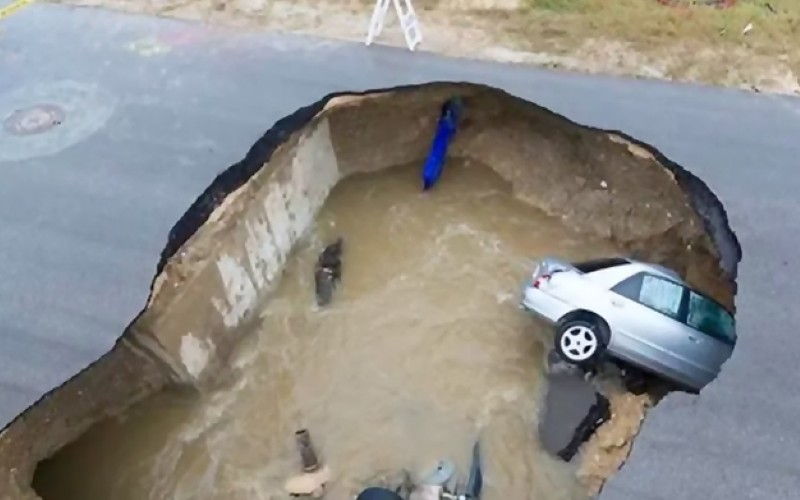
He stated that groundwater extraction to supply Tehran’s drinking water has tripled the subsidence rate in the past two years compared to earlier periods. While the process has been largely gradual, a sudden collapse was also recorded on Thursday night, underscoring the unpredictable and dangerous nature of the crisis.
Adding to the risk, extensive sand and gravel mining in the area has created massive pits—some as deep as 40 meters and comparable in size to football stadiums. Beitollahi also warned about the Tehran–Tabriz railway line passing through the zone, stating that repeated alerts to railway authorities have not resulted in adequate monitoring or preventive action.
Experts estimate that 18.5 million hectares—roughly 11 percent of Iran’s total land area—are currently affected by land subsidence. Approximately 39 million people, nearly half of Iran’s population, live in these vulnerable zones. The crisis also threatens irreplaceable cultural heritage sites, including Persepolis, Naqsh-e Rostam, and Naqsh-e Jahan, placing centuries of history at risk.
Taken together, these admissions reveal a stark reality: the Iran regime’s environmental mismanagement has pushed the country into one of the most severe land subsidence crises in the world. While officials now issue warnings and recommendations, years of neglect, corruption, and short-term policymaking have left millions of lives, critical infrastructure, and national heritage hanging over collapsing ground.