


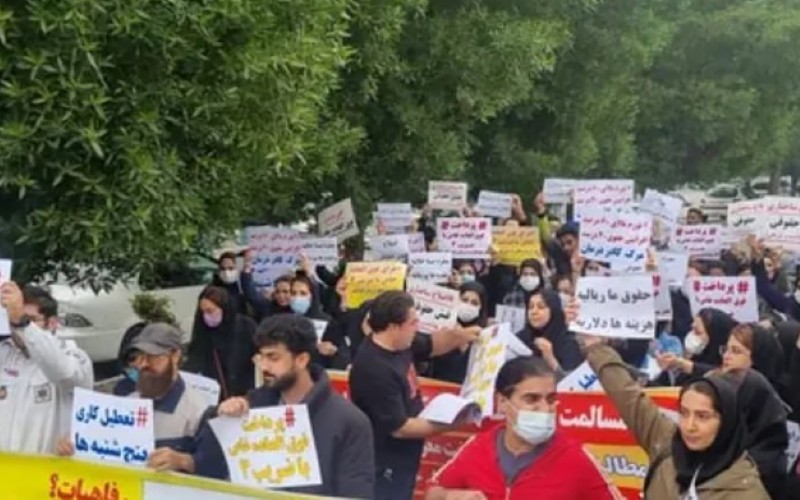

Brain drain and a marriage crisis expose the systemic failures of the Iranian regime
A Nation Losing Its Future Capital
Two recent reports published in Iran’s state-aligned daily Arman-e Melli inadvertently shed light on a far deeper reality: Iran is experiencing a silent but accelerating collapse of its human and social capital. One crisis unfolds through the mass emigration of educated elites; the other through the breakdown of marriage and family formation among the younger generation. Though presented separately, both stem from the same source—systemic failure in governance under the clerical regime.
Brain Drain: A Predictable Outcome of Hostile Governance
The decline of Iran’s scientific standing in recent years is not a statistical anomaly nor an isolated academic issue. As sociologist Amanollah Gharaei-Moghadam notes, this decline reflects the increasingly toxic social, cultural, and institutional environment that has taken shape over decades.
Rather than attracting and retaining talent, the regime has created conditions that actively push elites out of the country. Warnings about brain drain were raised as early as 25 years ago by academics and experts. Those warnings were ignored. Today, they have materialized into a structural loss.
When educated professionals leave Iran, it is not merely individuals who depart, but the accumulated outcome of years of public investment in education and research. Scientific papers, patents, and innovations produced by Iranian experts are now registered under foreign universities and research centers. As a result, Iran’s global scientific ranking declines—not because Iranians lack talent, but because the regime has made productive intellectual life unsustainable at home.
Science and innovation require basic conditions: job security, academic freedom, professional growth, and social dignity. The Iranian regime has consistently undermined all four through ideological control, political repression, institutional opacity, and chronic economic instability. In such an environment, migration is not a choice—it is an inevitability.
Elite Migration Is a Political, Not Economic, Phenomenon
A second Arman-e Melli analysis underscores a crucial point often obscured by official narratives: elite migration is not driven by economics alone. Political science literature identifies human capital—particularly elites—as a cornerstone of national power and sustainable development.
According to the analysis, the exodus of Iran’s educated class is closely tied to declining quality of life, lack of institutional transparency, absence of political participation, systemic injustice, and the inability of individuals to exert meaningful influence over their future. In this sense, the brain drain crisis is fundamentally political and institutional, rooted in the nature of the state’s relationship with society.
A system that suppresses accountability, concentrates power, and excludes citizens from decision-making cannot expect loyalty from its most capable members. The regime’s persistent refusal to reform governance structures has transformed Iran into a country that educates its youth for export.
The Marriage Crisis: Another Symptom of Structural Failure
Alongside the flight of elites, Iran is facing what officials themselves now describe as a demographic warning stage. According to official data from the Ministry of Health, 16 to 17 million Iranians of marriageable age remain unmarried.
Reza Saeedi, head of the Ministry’s Population and Family Health Center, reports that annual marriages have fallen to around 470,000, down from nearly 800,000 in previous years. He warns that without serious intervention, declining fertility rates and rapid population aging will intensify.
Yet the regime’s own role in creating this crisis remains conspicuously absent from official discourse. Marriage decline is not a cultural accident—it is the direct outcome of economic precarity, housing shortages, unemployment, inflation, and the absence of social stability. Young Iranians increasingly view marriage not as a milestone, but as an unaffordable risk.
Policies That Destroy, Not Support, Family Formation
For years, the regime has relied on slogans and coercive population policies while ignoring the structural barriers faced by young people. High inflation, collapsing purchasing power, insecure employment, and lack of future prospects have made long-term commitments nearly impossible.
The contradiction is stark: a system that claims to prioritize “family values” has systematically dismantled the economic and social foundations required to form a family. Instead of meaningful support—such as affordable housing, stable jobs, and social freedoms—the regime offers propaganda and blame-shifting.
One Root Cause, Two National Crises
Iran’s brain drain and marriage crisis are not separate phenomena. They are parallel expressions of a deeper collapse in governance. When elites leave, innovation and productivity decline. When young people abandon marriage and family formation, demographic and social sustainability erodes. Together, they signal a nation being hollowed out from within.
Despite mounting evidence, the ruling establishment continues to evade responsibility, treating symptoms while preserving the structures that generate them. Without fundamental political and economic change, Iran will continue to lose both its minds and its future generations—quietly, steadily, and at enormous cost.