


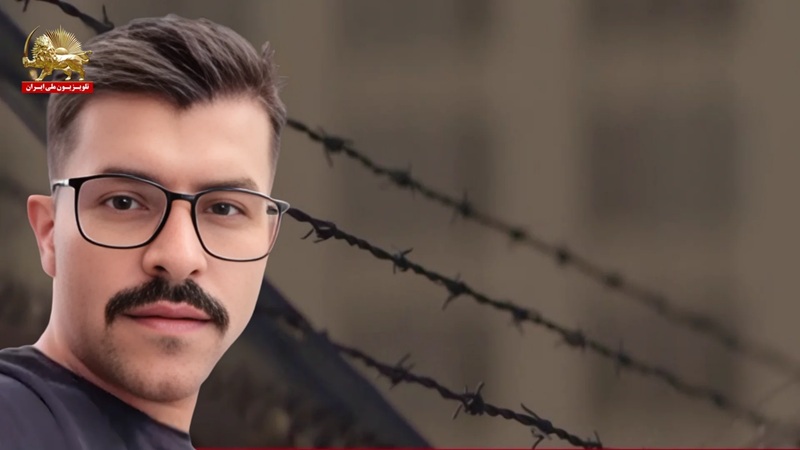

Meisam Dehban-Zadeh invokes the legacy of Gholamreza Takhti to condemn both monarchy and clerical regime repression, warning that executions and terror only fuel Iran’s uprising
In a powerful letter smuggled out of Qezel Hesar Prison, political prisoner Meisam Dehban-Zadeh draws a direct line between Iran’s past and present dictatorships, invoking the legacy of legendary wrestler Gholamreza Takhti to expose what he describes as the unbroken cycle of repression—from the Shah’s SAVAK to today’s clerical regime.
Writing on the anniversary commemorating Takhti, Dehban-Zadeh emphasizes that the murder of popular heroes has never silenced society. Instead, he recalls how state violence historically ignited resistance and ultimately sealed the fate of tyrannical rule.
“The crimes of SAVAK and the martyrdom of popular heroes did not create silence and submission,” he writes. “They created a storm and an uprising, and consigned the monarchy to the graveyard of history forever.”
Dehban-Zadeh stresses that no amount of propaganda can erase such crimes, warning that both past and present dictatorships are doomed in the face of organized resistance.
“No voiceover, no narrative engineering can cleanse this level of brutality from history,” he states. “Mullahs and Shah alike are condemned to destruction before the waves of uprising and organized resistance.”
Honoring Takhti as more than a sports icon, Dehban-Zadeh presents him as a moral compass for Iranian society—someone who stood with the people during the darkest years of monarchy and embodied dignity, humility, and resistance to injustice.
“Gholamreza Takhti was not merely a great champion,” he writes. “He was a model of conduct and a way of life. He taught us never to humiliate the weak, and never to abandon the field of honor and humanity.”
From his prison cell, Dehban-Zadeh directly challenges the assumption shared by dictatorships that killing revolutionaries can extinguish revolutionary thought.
“Do dictators really imagine that by killing the hopes of revolution, they can also hang our ideas?” he asks. “A brief look at Iranian society and the ongoing uprising proves the opposite.”
According to the letter, the values and blood of fallen heroes have multiplied within Iran’s younger generation and among organized resistance units, becoming stronger rather than weaker.
Turning to the present, Dehban-Zadeh accuses the clerical regime of attempting to delay its inevitable collapse through executions, torture, and street violence. He highlights the case of Mohammad Javad Vafaei Sani, a national boxing champion imprisoned and sentenced to death following the November 2019 uprising.
“The regime places him at a crossroads between love for the people and death,” Dehban-Zadeh writes. “But the answer—whether in the streets or in prison—is one and the same: ‘Far from us is humiliation.’”
He warns that repression has consistently backfired, producing defiance rather than submission.
“You miscalculated,” the political prisoner declares. “What is multiplying in every alley and neighborhood is the refusal to surrender—men like Mohammad Javad and chests bared before the executioners’ bullets.”
In one of the letter’s most striking passages, Dehban-Zadeh reiterates a slogan that rejects all forms of dictatorship in Iran, past and present.
“Death to the oppressor, whether Shah or Supreme Leader,” he concludes.
The letter, dated January 2026 and signed from inside Qezel Hesar Prison, stands as both a tribute to Iran’s fallen heroes and a stark warning to the ruling regime: executions and terror do not secure power—they accelerate its end.