



Khamenei’s latest threats betray panic as nationwide uprising shatters the regime’s last illusion of control
Iran regime’s Supreme Leader, Ali Khamenei, appeared once again before a carefully selected audience of battered Basij loyalists, attempting—like so many times before—to bury an undeniable reality under hollow rhetoric: the depth of national hatred toward the theocratic dictatorship ruling Iran.
Trapped in the rising fury of an exhausted and enraged society, Khamenei unsheathed the familiar sword of repression against unarmed protesters. In his latest remarks, he declared: “Protest is different from riot. Talking to a rioter is useless; a rioter must be put in their place.” These words, spoken by an unrestrained dictator whose sole objective is the preservation of power at any cost, are not a display of strength. They are an admission of fear—fear rooted in the scale, persistence, and radicalization of the nationwide uprising.
What began as limited economic and professional grievances rapidly evolved into an open revolutionary confrontation between the Iranian people and the regime’s repressive forces across dozens of cities. This transformation was neither accidental nor spontaneous. It is the inevitable result of decades of betrayal, systemic corruption, plunder of national wealth, relentless repression, and a society suffocating under a regime that has invested everything in two pillars only: organized poverty and bloody suppression enforced through executions.
The tide of public anger continues to swell. Markets in major cities, universities, and entire provinces have been swept into protest. The persistence of this resistance has deeply shaken the regime. The message from the streets is unmistakable: fear is changing sides. The continuation of protests terrifies the regime’s leadership—and it must be terrified further until the day of its overthrow.
Khamenei knows this reality better than anyone. He is fully aware that without bloodshed, mass arrests, executions, and the heavy militarization of cities, his regime cannot survive even a single day. The reported deployment of foreign mercenaries, including militias linked to Iraq’s Hashd al-Shaabi, is a stark confession of the regime’s internal collapse. It reveals how exhausted, demoralized, and fractured the IRGC and Basij forces have become—and how deeply they fear their inevitable fate at the hands of an uprising population.
This reality was recently underscored by a leaked audio recording attributed to Ahmad-Reza Radan, the regime’s police chief, in which he admits: “Our armed forces are running away from the people.” He then adds bluntly: “If you can’t do your job, then resign.” This is the same regime that endlessly boasted of having more than half a million so-called “self-sacrificing forces.” Yet on the streets of Iran, an entirely different truth is unfolding.
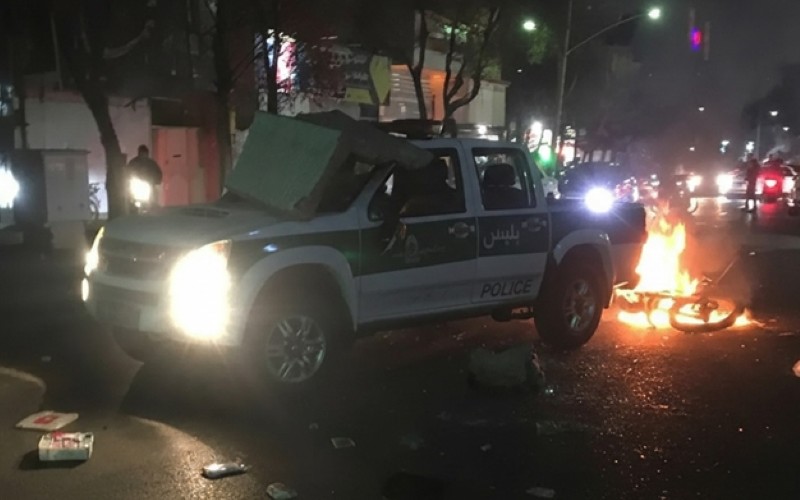
Every day, courageous youth alongside organized resistance units target symbols of repression: Basij bases, police stations, regime vehicles, and centers of indoctrination. With each attack, they deliver Khamenei his “due” through a slogan that now defines the uprising: “Death to Khamenei.”
From every angle, it is evident that fear within society—once imposed by a heavily armed regime—is rapidly disintegrating. The turn toward revolutionary resistance reflects a hard-earned realization: neither hollow calls for “civil struggle,” nor recycled illusions promoted by remnants of the Pahlavi dynasty, nor artificial soundtracks imposed on genuine public rage can lead Iran to freedom or a democratic republic.
One decisive factor behind this resilience is the enduring revolutionary culture embodied by the People’s Mojahedin Organization of Iran (PMOI/MEK). Despite relentless repression, reactionary conspiracies, and one of the most suffocating censorship systems of the modern era, this voice has not been silenced. On the contrary, it grows louder and more assertive by the day.
To the cornered Supreme Leader—who resurfaced after a week of silence to boost the morale of his crumbling forces—the message is clear: fear the people’s final uprising. Hide longer if you must. But the will of the Iranian people is now firmly set on dismantling your medieval system of rule. And this time, it will be done.