



From street repression to slogan manipulation, the Iranian regime’s real battle is over meaning, memory, and the fear of change.
When public anger reaches a breaking point and a political system begins to lose its legitimacy, the real struggle no longer takes place only in the streets. It moves into a less visible but equally decisive arena: the battle over meaning, language, and collective perception.
Italian political thinker Antonio Gramsci described this situation as a “war of position”—a moment when a ruling power, unable to rely on genuine public consent, tries to restore control by shaping how people think, speak, and imagine the future. Instead of responding to demands, it manipulates awareness and distorts alternatives.
This is precisely what is happening in Iran under the rule of the velayat-e faqih regime. The repeated uprisings of recent years, culminating in the nationwide protests of January 2026, show that Iranian society has entered a new and irreversible phase. The question is no longer reform, but the end of the system itself.
Gramsci warned that in such moments, “the old is dying and the new cannot yet be born.” In this dangerous gap, the ruling system attempts to create confusion. One clear example is the spread of manipulated protest videos, fake voice-overs, and misleading slogans—often amplified by regime-linked or opportunistic media—to divert the uprising from its real direction.
Why Slogans Matter
French philosopher Michel Foucault explained that power does not operate only through brute force. It also works by producing and controlling discourse—the frameworks through which people interpret reality.
Political slogans are the most condensed form of such discourse. They can either turn lived oppression into a language of liberation, or redirect it into dead ends.
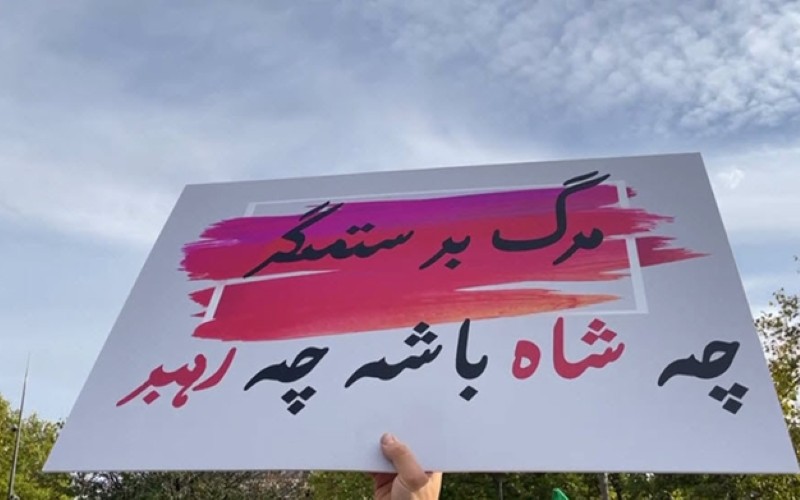
Slogans like “Death to Khamenei” or “Death to the oppressor, whether Shah or Supreme Leader” are radical not because they are emotional, but because they directly name the core of power. They reject both the current religious dictatorship and any return to authoritarian rule from the past. These slogans leave no room for cosmetic reform.
This is what Hannah Arendt called a crisis of legitimacy: a point where obedience no longer comes from belief, but only from fear.
Violence Is a Sign of Weakness
Arendt made a crucial distinction between power and violence. Power exists when people accept authority. Violence appears when that acceptance has collapsed.
Public executions, open threats, medieval-style punishments, and the televised glorification of repression are not signs of strength. They are symptoms of decay.
The mass killings of protesters in November 2019 temporarily cleared the streets, but structurally deepened the divide between society and the state. Violence may force obedience, but it never creates legitimacy. Recognizing this, the Iranian regime moved to a new battlefield: meaning itself.
From Demonization to Distraction
In its early decades, the velayat-e faqih regime relied on demonizing opponents with labels such as “enemy of God” or “traitor.” This method aimed to dehumanize dissent and make repression appear natural.
But social and generational change has rendered this tactic ineffective. Today’s protesters do not accept the regime’s ideological categories or its definition of “the enemy.”
As a result, the regime has shifted strategy. Instead of merely discrediting protesters, it now seeks to redirect the uprising away from the future and toward the past.
This is where manufactured alternatives and diversionary slogans come into play.
The Political Use of Nostalgia
One of the most effective tools during revolutionary crises is political nostalgia. This is not serious historical reflection, but a selective, mythologized version of the past—stripped of repression, inequality, and violence.
According to Foucault, this process is part of a “regime of truth”: producing a specific narrative of the past to control political behavior in the present.
Slogans such as “Reza Shah, rest in peace” operate exactly in this way. They do not invite historical analysis. They trigger emotion. Their function is to freeze revolutionary imagination and replace future-oriented thinking with longing for a supposedly “orderly” past.
The message is subtle but powerful: change is dangerous; the future is frightening; even dictatorship was better before.
Fear of the Future as a Political Weapon
Gramsci noted that when ruling elites face a crisis of dominance, they attempt to neutralize protest by offering false choices. In Iran, this appears as a fabricated dilemma: Shah or Sheikh.
Diversionary slogans reduce a popular uprising against dictatorship into a choice between two forms of authoritarianism. Their hidden message is simple: any real change will make things worse.
In this logic, the rejected past is rebranded as the “lesser evil.” Fear replaces hope. When people fear the future, they tolerate the present.
This is how mental control complements physical repression: one frightens the body, the other paralyzes the mind.
A Global Pattern
This strategy is not unique to Iran.
- In Egypt after 2011, media narratives gradually equated revolution with chaos, reviving nostalgia for Mubarak-era “stability.”
- In Eastern Europe, selective nostalgia for socialist-era security was used to weaken demands for justice.
- In Chile, the memory of Pinochet’s dictatorship was partially rehabilitated through the language of economic growth and order.
In all cases, the goal was the same: disconnect protest from a vision of the future.
Shah and Mullahs: United Against the Future
At first glance, the Pahlavi monarchy and the velayat-e faqih regime seem fundamentally different—one secular-authoritarian, the other religious-totalitarian. But at a deeper level, they share a core trait: fear of popular political participation.
Both systems treat an active, conscious society as an existential threat. In moments of crisis, both rely on historical regret and nostalgia to discredit revolutionary action.
One key message embedded in diversionary slogans is that revolution itself was a mistake. In this narrative, every Iranian struggle for freedom—from the Constitutional Revolution to the 1979 revolution—is portrayed as irrational and premature.
Arendt warned that counter-revolutionary forces often equate freedom with disorder, making repression appear preferable to uncertainty.
Why This Strategy Is Failing
The Iranian uprising is fundamentally future-oriented. Its central slogans reject both monarchy and theocracy. This dual rejection is not emotional revenge, but political rationality shaped by lived experience.
Diversionary slogans may create temporary noise, but they cannot compete with collective memory and growing political awareness. They are not signs of strength; they are evidence of fear—fear of a society that refuses to move backward.
The Emerging Horizon
What is taking shape in Iran is not a return to old forms of domination, but a demand for a new political order:
a democratic republic, based on popular sovereignty, separation of religion and state, and rejection of unaccountable power.
This vision is not designed in think tanks. It is being formed through conscious social action, sacrifice, and the collective determination of a society that sees the future as its own.
The regime’s manipulation of nostalgia is a last defense against that future. And it is failing.