


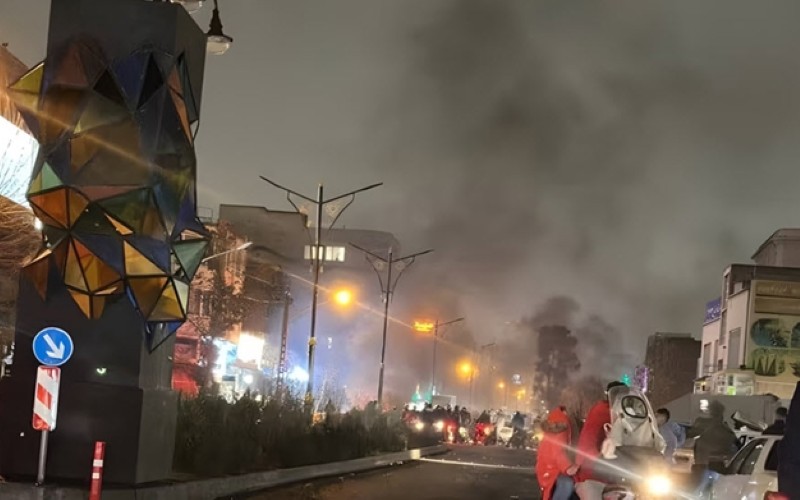

Despite live fire, mass arrests, and heavy security deployment, protesters in Tehran’s Narmak district sustained demonstrations and street resistance throughout early January 2026.
Tehran – Narmak | January 2026
For several consecutive days in early January 2026, Tehran’s Narmak district became a focal point of sustained popular uprising, marked by strikes, mass demonstrations, direct confrontations, and street-level resistance against the Iranian regime’s security forces.
Despite heavy deployment of police, anti-riot units, live ammunition, and violent crackdowns, protesters—referred to by witnesses as “rebels” and “uprising youth”—continued to mobilize, responding to repression with persistence, coordination, and running street battles.
What follows is a chronological field report from inside Narmak, documenting the escalation of resistance from January 2 to January 10, 2026.
January 2, 2026 – Shopkeepers’ Strike Turns into Mass Protest
On Friday, January 2, shopkeepers across Narmak launched a strike that quickly evolved into a large public gathering and street protest.
Security forces moved in to disperse the crowd, triggering clashes. Protesters responded with chants of:
- “Death to the dictator”
- “This is the year of blood; Seyed Ali will be overthrown”
- “Shameless! Shameless!”
Despite the intervention of regime forces, the protest expanded rather than subsided.
January 3–4, 2026 – Expanding Protests and Arrests
On Saturday, January 3, demonstrations resumed across Narmak with repeated chants of “Death to Khamenei” and “Death to the dictator.” Regime forces opened fire and carried out multiple arrests.
On Sunday, January 4, protests continued amid direct confrontations. Demonstrators again chanted “Shameless! Shameless!” as clashes intensified in several streets.
January 4, 2026 – Open Defiance
Later that day, protests escalated further with crowds chanting:
-
“Khamenei is a murderer”
The slogan reflected growing public rage as reports of injuries and arrests spread through the district.
January 6, 2026 – Street Battles and Molotov Attacks
On Tuesday, January 6 (Dey 16), protests took the form of dispersed gatherings and running street battles. Young protesters reportedly used Molotov cocktails to push back advancing security units.
In larger gatherings, crowds again shouted “Death to Khamenei,” signaling continued defiance despite escalating violence.
January 7, 2026 – Heavy Security Deployment Fails to Contain Protests
On Wednesday, January 7, the regime attempted to impose control by deploying large numbers of anti-riot forces, water cannons, and armored vehicles around Haft-Hoz Square and the Narmak police station.
Nevertheless, protests and hit-and-run confrontations continued. Demonstrators chanted:
-
“Don’t be afraid, don’t be afraid—we are all together”
The slogan echoed the collective resolve of residents facing overwhelming force.
January 8, 2026 – Police Vehicle Set Ablaze
On Thursday, January 8, protests in Narmak coincided with a dramatic escalation: protesters set a police vehicle on fire near Sarsabz Metro Station.
Regime forces responded with direct live fire aimed at intimidating and dispersing crowds. Despite this, protesters engaged in street resistance and evasion tactics, preventing security forces from fully suppressing the demonstrations.
January 9, 2026 – Government Buildings Torched Amid Bloodshed
On Friday, January 9, protests persisted despite an atmosphere of extreme repression and bloodshed.
Demonstrators again chanted “Death to Khamenei” and “Death to the dictator.” Multiple government buildings in Narmak were set on fire.
Security forces fired live ammunition indiscriminately, resulting in numerous deaths and injuries. Eyewitnesses described extreme brutality by Basij and regime units during the clashes.
January 10, 2026 – Protests Continue Despite Killings
On Saturday, January 10, residents returned to the streets once more—despite the killings and injuries of previous days.
Night-time protests and clashes erupted amid ongoing gunfire. Chants of “Shameless! Shameless!” and “Death to the dictator” echoed through Narmak. Reports confirmed additional casualties as security forces continued to shoot at demonstrators.
A District That Refused to Submit
The events in Narmak illustrate a broader reality unfolding across Iran: even under conditions of live fire, mass arrests, and militarized repression, public resistance continues.
For more than a week, Narmak’s residents demonstrated that fear no longer guarantees submission—and that each act of repression has instead fueled deeper resolve against the ruling system.