


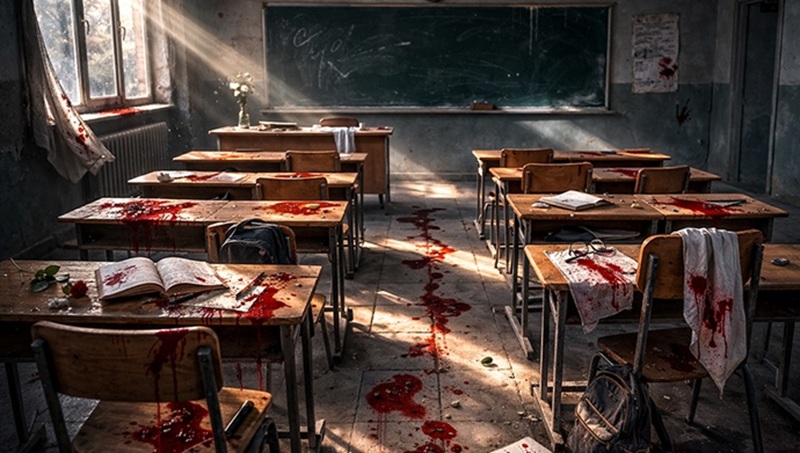

Three decades after Amnesty International labeled Iran the world’s leading executioner of minors, new reports point to hundreds of student deaths in the January unrest.
Nineteen years ago, Amnesty International described Iran as the “last executioner of children,” citing its record as the country that had executed more individuals under the age of 18 than any other state at the time. That designation reflected a grim reality: the institutionalization of capital punishment against minors.
Today, the issue has resurfaced in a different but equally disturbing form.
On February 25, the state-run daily Etemad published an article under the headline “Empty Desks.” The report acknowledged that the deaths of students during the January unrest, alongside the detention of others, had become “one of the important issues in the field of education.”
The newspaper referred to the killing of “220 children” during the January events, noting that the highest concentration of fatalities occurred in Tehran, Isfahan, and Khorasan Razavi provinces. It further stated that most of the victims were teenagers between 16 and 18 years old, although younger children were also among the dead.
The phrase “empty desks” is more than a metaphor. It captures both the immediate tragedy of January and a deeper historical pattern—one in which minors have repeatedly been caught in the machinery of state violence.
A Documented Pattern
Last year, at the conclusion of his six-year mandate, Javaid Rehman, the UN Special Rapporteur on human rights in Iran, presented a comprehensive report detailing systematic and severe violations across the country. In his final assessment, he characterized the scale and brutality of abuses as among the gravest in Iran’s contemporary history. He concluded that senior state officials had been directly involved in the planning and implementation of actions that could amount to crimes against humanity and, in certain instances, acts consistent with genocide under international law.
The report also documented that hundreds of those executed in past decades were children. Among the cases highlighted was that of a 13-year-old girl arrested during a September 1981 demonstration in Tehran and executed just days later. Her case was cited as emblematic of a broader pattern in which minors were subjected to the harshest forms of punishment.
The Continuity of Violence
Forty-four years after earlier generations of students disappeared from classrooms—some executed, others imprisoned—the imagery of “empty desks” has returned. What was once associated with mass executions in the 1980s is now linked to student deaths during contemporary protests.
The significance lies not only in the number of victims but in the continuity of the pattern. Schools and universities have long functioned as epicenters of dissent in Iran. Each wave of protest has been met with force, and each cycle has left behind a new set of absences—names struck from attendance lists, chairs left unoccupied.
That even a state-affiliated newspaper now acknowledges hundreds of child fatalities suggests the depth of the crisis. Yet acknowledgment without accountability risks becoming another entry in a long record of unresolved abuses.
“Empty desks” are not merely symbols of a single month of unrest. They stand as evidence of a system in which children and adolescents have repeatedly paid the highest price. As long as investigations remain opaque and justice deferred, those desks will continue to represent not only loss—but an enduring demand for accountability.