


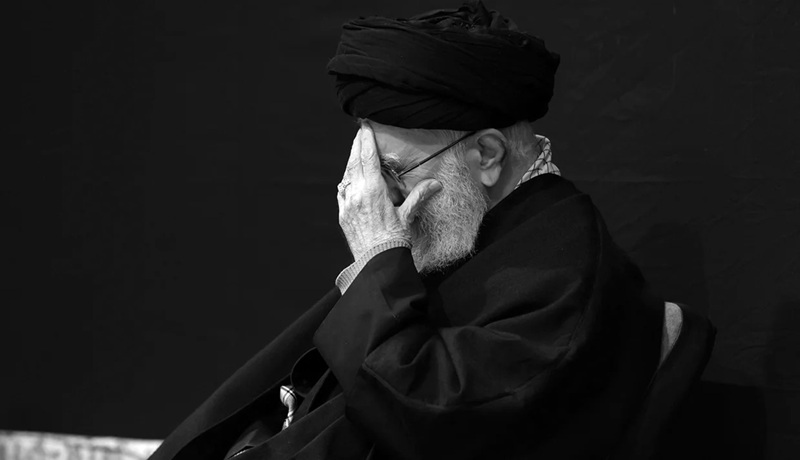

The life and rule of Iran regime’s second Supreme Leader, from a cleric in Mashhad to the architect of an authoritarian system marked by repression, economic monopolies, and international confrontation.
Ali Khamenei, the second Supreme Leader of the Iranian regime, ruled Iran for nearly 37 years—from June 1989 until his death on February 28, 2026. His tenure marked one of the longest and most consequential periods of centralized power in modern Iranian history. Rising from a relatively obscure cleric in Mashhad to the apex of the political system built on the doctrine of Velayat-e Faqih (Guardianship of the Islamic Jurist), Khamenei presided over an era characterized by strict political control, extensive security apparatuses, and vast economic networks tied to the leadership.
Supporters portrayed him as the guardian of the Iranian regime and the protector of its ideological foundations. Opponents, however, described his rule as an era of systemic repression, economic monopolization, and severe restrictions on political and civil freedoms. His death has intensified debates over the historical legacy of his leadership and the future of the political structure he dominated for decades.
From Mashhad Seminary Student to Supreme Leader
Ali Khamenei was born in 1939 in the northeastern Iranian city of Mashhad into a modest clerical family. His early education was rooted in traditional Shiite seminaries. During the 1960s, he became increasingly influenced by revolutionary religious currents, particularly the teachings of Ruhollah Khomeini.
Khamenei emerged as a political activist during the growing opposition to Mohammad Reza Shah Pahlavi. The movement culminated in the 1979 Iranian Revolution, which overthrew the monarchy and established the Iranian regime.
Following the revolution, Khamenei quickly rose through the ranks of the new regime. He held several influential positions, including deputy minister of defense, supervisor of the newly formed Islamic Revolutionary Guard Corps, and later served as president of Iran from 1981 to 1989.
The death of Khomeini in 1989 triggered a decisive turning point. Despite not being a senior religious authority at the time, Khamenei was selected as Supreme Leader by the Assembly of Experts after significant political maneuvering within the ruling elite. The choice was controversial even within clerical circles because the constitution then required the Supreme Leader to be a recognized religious authority.
Consolidation of Absolute Political Authority
After assuming power, Khamenei gradually consolidated authority across the state’s major institutions. Through Article 110 of the Iranian constitution, the Supreme Leader commands the armed forces, appoints the judiciary chief, and exerts decisive influence over the legislature and electoral process.
Institutions such as the Guardian Council became central tools in shaping the political landscape. Through its vetting authority, candidates for elections were screened to ensure ideological loyalty to the system.
Over time, critics argued that the political structure evolved into a highly centralized system in which major decisions flowed through the office of the Supreme Leader, often referred to as the “Leader’s Office” or Beit-e Rahbari.
Economic Networks and Financial Power
Another defining feature of Khamenei’s rule was the emergence of vast economic conglomerates connected to the Supreme Leader’s office.
Among the most prominent were:
- Execution of Imam Khomeini’s Order (Setad), a massive holding organization reportedly worth tens of billions of dollars.
- Astan Quds Razavi, the powerful trust managing the shrine of Imam Reza in Mashhad and extensive business assets.
- Mostazafan Foundation, one of the largest economic institutions in the country.
These organizations controlled major sectors of Iran’s economy, including industry, agriculture, real estate, and finance. Critics frequently described them as opaque financial empires operating beyond government oversight, while officials defended them as institutions serving social and religious purposes.
Repression and Crackdowns on Protest Movements
Khamenei’s leadership coincided with repeated waves of political unrest inside Iran. Major protest movements occurred in 1999, 2009, 2017–2018, 2019, 2022, and again in 2026.
Security forces—including the Revolutionary Guard and paramilitary Basij units—were frequently deployed to suppress demonstrations. Human rights organizations documented thousands of arrests and numerous deaths during these crackdowns.
One of the most controversial events of his tenure was the suppression of protests in November 2019, during which international rights groups reported hundreds of fatalities after security forces used live ammunition.
The nationwide uprising in January 2026 (Dey 1404 in the Iranian calendar) became another turning point. According to various reports, the government ordered a sweeping crackdown, resulting in mass arrests and casualties. The scale of violence during these events intensified domestic and international criticism of the regime.
The Use of Capital Punishment
Iran has long maintained one of the highest execution rates in the world. During Khamenei’s leadership, capital punishment remained a central component of the criminal justice system.
Executions were carried out for a wide range of offenses, including drug-related crimes, political charges such as “enmity against God,” and other capital offenses. Human rights groups repeatedly condemned the practice, citing concerns about due process, coerced confessions, and political motivations behind some cases.
International organizations such as Amnesty International and the United Nations frequently criticized Iran’s execution practices during this period.
Foreign Policy and Regional Influence
Khamenei’s foreign policy strategy centered on what Iranian officials called “strategic depth.” This doctrine emphasized expanding Iran’s influence across the Middle East through alliances with regional actors.
The Iranian regime provided support to groups and governments aligned with Tehran in countries such as Iraq, Syria, Lebanon, and Yemen. Critics accused Iran of exporting militancy and destabilizing the region, while Iranian leaders framed these policies as resistance against Western and Israeli influence.
Khamenei also oversaw the expansion of Iran regime’s nuclear and missile programs. These initiatives triggered extensive international sanctions and diplomatic disputes with Western powers.
The Final Years and the Crisis of Succession
In his final years, Khamenei presided over an increasingly fragile political environment. Economic sanctions, domestic unrest, and internal factional disputes created mounting pressure on the ruling system.
When news of his death on February 28, 2026 emerged, senior officials issued statements emphasizing stability and continuity. Nevertheless, analysts immediately began discussing the possibility of a leadership crisis.
Figures such as Mohammad Bagher Ghalibaf, Gholamhossein Mohseni-Ejei, and Ali Larijani called for unity within the political establishment, highlighting concerns about the future of the system without the central authority that had defined it for decades.
A Contested Legacy
The legacy of Ali Khamenei remains deeply contested. Supporters argue that he preserved the Iranian regime through decades of geopolitical pressure and internal challenges. Critics contend that his rule entrenched authoritarian governance, deepened economic inequality, and isolated Iran internationally.
What is certain is that his nearly four decades in power reshaped Iran’s political institutions, economic structures, and regional strategy. With his death, the Iranian regime now faces a critical transition that could redefine the country’s political trajectory.