


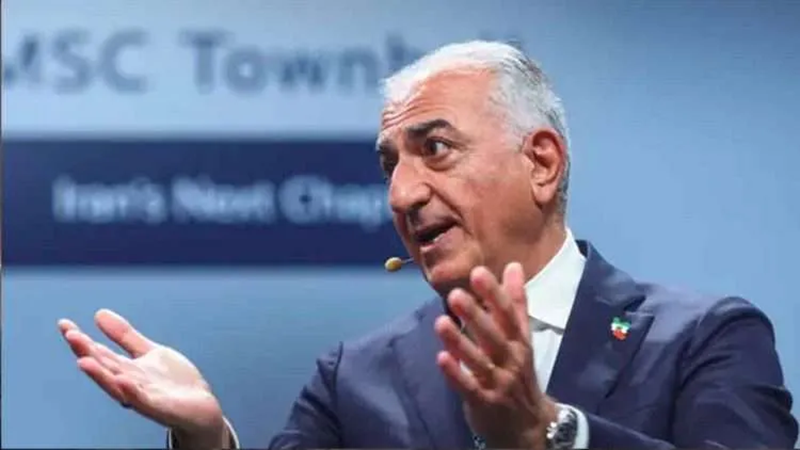

The self-appointed role of the Shah’s son highlights the growing gap between monarchist narratives abroad and the political realities of Iran’s opposition.
Reza Pahlavi, the son of Iran’s last Shah, has recently announced that he has “accepted” the role of leader of Iran’s future transitional period. The declaration has triggered widespread debate among Iranian political observers and opposition circles—largely because the role he claims to have accepted was never formally offered to him, nor has it been endorsed by any credible political coalition.
In essence, the announcement resembles a political paradox: accepting a position that no one proposed and that no political force has agreed to create.
Pahlavi’s remarks have once again drawn attention to the persistent attempts by monarchist networks to portray him as a central political figure for Iran’s future, despite the absence of any institutional mechanism, political consensus, or democratic mandate supporting such a role.
A Title Without a Process
Various media outlets and political commentators noted that the claim comes at a time when no recognized framework exists for appointing a “transition leader” for Iran. The country’s opposition landscape remains diverse and fragmented, and discussions about a transitional authority have long centered on the need for broad political consensus and structured mechanisms.
Political activists emphasize that leadership of any transitional period—particularly in a country emerging from authoritarian rule—cannot be determined through personal declarations. Instead, it requires agreement among political forces, civil society, and representatives of the Iranian people.
Against this backdrop, Pahlavi’s claim has been widely interpreted as a unilateral attempt to insert himself into a position of authority without the political legitimacy typically required for such a role.
Forty-Four Years in Comfort, Suddenly a Revolutionary
Critics also point to the irony surrounding the timing of Pahlavi’s announcement.
For more than four decades since the fall of the monarchy in 1979, Pahlavi has lived abroad in considerable comfort. His life in exile was sustained in part by wealth that originated from assets transferred out of Iran during the final days of his father’s rule.
Now, as Iran faces one of the most turbulent periods in its modern history—amid war, domestic unrest, and severe economic hardship—monarchist factions appear eager to position him as a political beneficiary of the crisis.
For many observers, the situation resembles political opportunism: while millions of Iranians endure repression and hardship, the remnants of the former monarchy seem primarily concerned with claiming the political fruits of a struggle they have not led.
A Debate Over Iran’s Real Political Alternative
The controversy surrounding Pahlavi’s statement has also revived broader discussions about Iran’s political alternatives.
For years, the question of leadership during a potential transition has been debated among opposition movements. Many political actors insist that such a process must be based on organized structures, defined political programs, and broad social support.
Among the groups that present themselves as a structured alternative is the National Council of Resistance of Iran (NCRI), which has maintained organized political activity for more than four decades. The council has proposed a political framework for a future democratic republic in Iran, including the separation of religion and state, gender equality, and democratic elections.
Supporters of this movement argue that discussions about transitional leadership should emerge from institutional political frameworks and concrete programs—rather than personal declarations made by individuals who lack grassroots support inside Iran.
The Unresolved Legacy of the Monarchy
Another recurring criticism directed at Pahlavi concerns his refusal to clearly condemn the human rights abuses committed during his father’s rule.
The monarchy of Mohammad Reza Shah was marked by political repression, censorship, and the activities of the notorious SAVAK secret police. For many Iranians, the unresolved legacy of that period continues to undermine the credibility of attempts to revive monarchist leadership.
As a result, Pahlavi’s efforts to present himself as a democratic alternative often encounter skepticism among activists who believe that Iran’s future must break not only from clerical authoritarianism but also from the authoritarian practices of the monarchy.
A Political Illusion?
The debate surrounding Pahlavi’s declaration illustrates a broader issue within Iranian opposition politics: the ongoing struggle to define a credible and democratic alternative to the ruling regime.
Leadership in a democratic transition, must emerge from the collective will of the people—not from personal proclamations or media-driven narratives.
Until such a consensus emerges, Pahlavi’s claim to lead Iran’s hypothetical transition may remain what many critics already describe it as: less a political reality than a carefully staged illusion.