


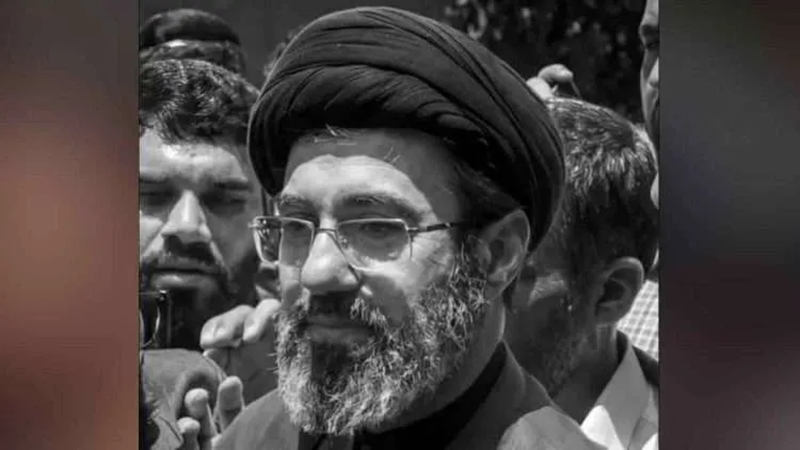

The appointment of Ali Khamenei’s son exposes the Islamic Republic’s shift toward dynastic power—mirroring parallel attempts by monarchist factions to promote Reza Pahlavi as Iran’s next ruler.
In a development that underscores the deepening crisis within Iran’s ruling system, the regime’s Assembly of Experts has reportedly selected Mojtaba Khamenei, the second son of the killed Supreme Leader Ali Khamenei, as the new head of the Iranian regime. The announcement was reported late Sunday night, March 8, by the state-affiliated Tasnim News Agency.
According to the report, the Assembly of Experts had already conducted the vote earlier but delayed publicly announcing the result. With this decision, Mojtaba Khamenei becomes the third Supreme Leader since the establishment of the Iranian regime in 1979.
The official statement released by the Assembly of Experts framed the decision as a continuation of the regime’s ideological and religious doctrine. The body claimed that, after extensive deliberations and based on constitutional provisions, it had chosen Mojtaba Khamenei with an overwhelming vote as the new leader of the Iranian regime. The statement also praised nearly five decades of rule under what it described as the “wise leadership” of the founders and called on the Iranian public and elites to pledge loyalty to the new leader and preserve unity under the principle of velayat-e faqih.
Behind the formal language of the announcement, however, the decision highlights a striking reality: the Iranian regime—founded on revolutionary slogans against monarchy—has effectively adopted a hereditary model of power.
From Revolutionary Republic to Dynastic Rule
Ali Khamenei ruled Iran for nearly four decades as Supreme Leader, presiding over a period marked by systematic repression, widespread human rights violations, and aggressive regional policies. During his tenure, thousands of political prisoners were executed, protests were violently suppressed, and Iran’s political system remained tightly controlled by clerical and security institutions.
Mojtaba Khamenei has long been considered one of the most powerful figures operating behind the scenes of the regime. Though never holding a formal high-ranking government office, he has reportedly exercised significant influence within the Revolutionary Guards and the intelligence apparatus. Numerous observers and former officials have described him as a key coordinator of political and security decisions during his father’s rule.
His elevation to the position of Supreme Leader therefore reflects not only continuity within the ruling establishment but also the consolidation of power among the same inner circle that has dominated the Islamic Republic for decades.
Parallel Paths of Dynastic Ambition
The move has also reignited debate about competing visions for Iran’s future—particularly as some monarchist factions abroad attempt to promote Reza Pahlavi, the son of Iran’s last Shah, as a potential future ruler.
In recent months, remnants of the former monarchy and their supporters have intensified efforts to present Reza Pahlavi as the rightful successor to power in Iran, advocating a restoration of the monarchy or a system centered around his leadership.
The simultaneous emergence of these two narratives—one clerical and the other monarchist—reveals a striking parallel: both rely on hereditary claims to authority rather than the democratic will of the Iranian people.
While the Iranian regime now appears to have formally embraced a dynastic succession by appointing the son of its former Supreme Leader, monarchist advocates are similarly attempting to promote the son of the deposed Shah as Iran’s next ruler.
A Rejection of the People’s Sovereignty
For many Iranians who have repeatedly taken to the streets demanding freedom and democracy, these developments highlight the persistence of authoritarian thinking within both camps.
The appointment of Mojtaba Khamenei signals that the clerical establishment intends to preserve its power structure through familial succession. At the same time, attempts to reintroduce monarchical rule under Reza Pahlavi reflect another model of governance rooted in inherited authority.
In contrast, Iran’s pro-democracy movement continues to emphasize that the country’s future must be determined by the Iranian people themselves—through free elections and the establishment of a democratic republic.
As Iran faces one of the most turbulent periods in its modern history, the regime’s decision to pass leadership from father to son may ultimately reinforce a broader public perception: that the Iranian regime, despite its claims and rhetoric of revolutionary origins, has come full circle—transforming into a system of dynastic rule not unlike the monarchy it once claimed to overthrow.