


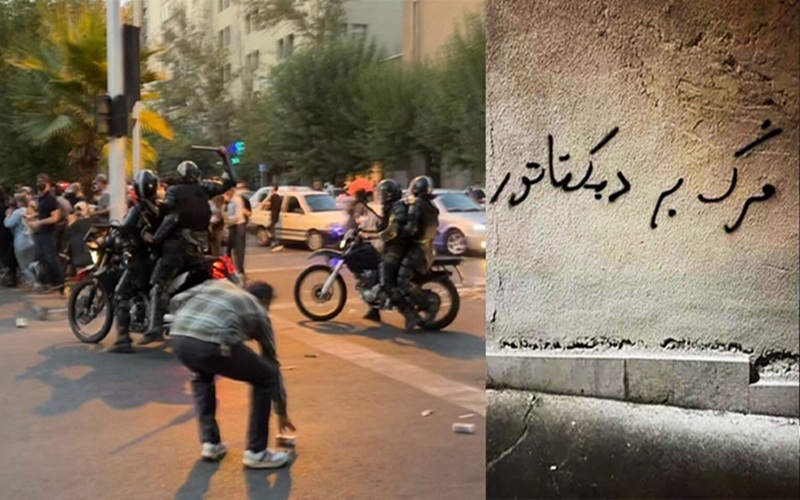

Chronic crises, psychological erosion, and economic decay converge to strip Iranian society of its capacity to imagine — and build — a future
Iran today is not merely enduring isolated crises—it is bearing the cumulative weight of decades of structural failure. The pervasive sense of futurelessness now saturating the social landscape has emerged at the intersection of war, chronic inflation, and institutional decay. This is not a transient disruption but the manifestation of long-entrenched dysfunction within the ruling order—one that has now surfaced as both psychological exhaustion and economic collapse.
What is unfolding in Iran transcends the boundaries of a typical economic downturn or wartime emergency. It is the reproduction of a “state of exception” sustained through chronic instability. As psychological research shows, when crises persist without resolution, societies lose their capacity for mental recovery. In Iran, this endless strain has profoundly eroded the collective psyche.
The consequences are visible in the texture of everyday life. Sleep disorders, declining motivation, and a deep sense of uncertainty have become normalized. A society unable to imagine its future is one losing its agency. The erosion of forward-looking imagination has dismantled the capacity for collective action and transformation.
At the root of this condition lies a political structure that consistently privileges security over sustainability and short-term control over long-term solutions. Rather than resolving crises, governance in Iran has institutionalized them, transforming instability into a permanent feature of national life.
This futurelessness is not confined to the psychological realm—it seeps into Iran’s social and moral fabric. Chronic inflation plays a central role in this transmission. As inflation endures, the time horizon for decision-making collapses; long-term aspirations give way to the logic of immediate survival. In such an environment, the “logic of law” gradually yields to the “logic of survival.”
The result is a slow unraveling of social norms. Formal institutions weaken, while informal and unstable practices replace them. This transformation is no accident—it is the predictable outcome of a rentier economy that sustains inflation as a permanent condition. Social trust deteriorates, relationships become transactional, and survival replaces solidarity as the organizing principle of daily life.
The erosion of social capital—a cornerstone of any functioning society—is therefore inevitable. Inflation undermines equal access to basic goods, magnifies inequality, and erodes human dignity. Under such conditions, even the notion of citizenship begins to lose its meaning.
One of the clearest structural expressions of this crisis is Iran’s accelerating deindustrialization. Instead of progressing toward modernization, the economy is regressing. External pressures, including sanctions, have aggravated this trend, but they are not its main cause. At its core lies a governance model that discourages production while rewarding speculation.
As industrial investment collapses, capital gravitates toward quick profits rather than long-term productivity—a rational response to distorted incentives. The consequences are visible: aging machinery, declining output, and erratic production cycles. This is not a natural transition; it is a premature and self-inflicted retreat from industrial development.
Unlike advanced economies where the shrinking of industry is balanced by the rise of high-value services, Iran’s industrial decline has coincided with the expansion of low-wage, unstable work. The nation’s path of development has effectively stalled.
This dynamic has created a self-perpetuating loop: instability deters investment; weak investment depresses productivity; falling productivity deepens inequality. These are not merely economic effects—they carry heavy psychological weight. Anxiety undermines rational decision-making, both individually and collectively.
Even Iran’s elite class is not immune. The widening gap between professionals and productive sectors, compounded by escalating emigration, signals a deeper crisis: a society losing its human capital is one forfeiting its future.
The governing system has not broken this cycle—it has entrenched it. Each policy measure that claims to stabilize the present serves only to reproduce the structural decay of the future.
Ultimately, the absence of a future in Iran is not speculation—it is an observable condition embedded in everyday existence. It reflects a historical trajectory defined by accumulated miscalculations and chronic crises. War, inflation, and deindustrialization are not separate ailments; they are manifestations of a singular systemic failure.
A society burdened by a fractured past and an unstable present cannot build a coherent future. In Iran today, futurelessness is no longer a concept—it has become a lived reality.