The executions of Vahid Bani Amerian and Abolhassan Montazer highlight a continuing cycle of political repression, linking generations of resistance from the 1980s to today
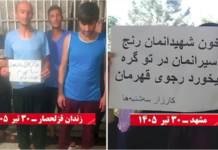
At dawn on Saturday, April 4, Iranian regime authorities executed two political prisoners—Vahid Bani Amerian, a 33-year-old university elite with a master’s degree in management, and Abolhassan Montazer, a 66-year-old architect and former political prisoner from both the pre-1979 monarchy and the 1980s. Their deaths once again exposed the regime’s reliance on execution as a tool of political control, even as it seeks to obscure internal crises behind the smoke and tension of external conflict.
Their executions follow four others in recent days: Mohammad Taghavi, 59, an art graduate and former political prisoner from the 1980s; Babak Alipour, 33, a legal expert; Pouya Ghabadi, 33, an electrical engineer; and Akbar Daneshvar Kar, 60, a civil engineer. These six individuals, spanning different generations, professions, and life paths, were united by a shared commitment to freedom.
This sequence of executions illustrates more than isolated acts of repression. It reflects the continuity of a resistance movement that has persisted from the mass crackdowns of the 1980s to the present day. Despite decades of executions, torture, and imprisonment, the trajectory of organized opposition has not been extinguished.
Before his execution, Vahid Bani Amerian issued a defiant message that encapsulated this enduring resistance. Addressing interrogators and security agents, he rejected demands to renounce his beliefs, declaring that a life stripped of identity and conviction was not worth living. He framed execution not as defeat, but as a final affirmation of loyalty to his cause and principles.
In a separate message, he reaffirmed his commitment to the broader resistance movement and its leadership, emphasizing his determination to continue the struggle under all circumstances. He vowed that even in captivity, his efforts would remain focused on advancing the movement’s objectives, and that, if executed, his final act would be one of defiance.
Such statements underscore a broader dynamic: the emergence of a generation that, even under extreme pressure, refuses to retreat from its political identity or chosen path.
In this context, execution functions not merely as punishment but as a calculated instrument of governance. It is deployed to instill fear, deter organized dissent, and disrupt the networks associated with resistance activities. At the same time, by leveraging the conditions of external conflict, authorities attempt to normalize repression and expand the atmosphere of control across society.
Following these executions, Maryam Rajavi, the President-elect of the National Council of Resistance of Iran (NCRI), condemned the killings. She stated that the ruling establishment is attempting, in vain, to delay its inevitable downfall through the execution of committed opposition members. According to her, the bloodshed will instead intensify public anger and strengthen the resolve of those seeking change.
She further described the executed individuals as symbols of perseverance and sacrifice, whose legacy continues to inspire a younger generation increasingly active in protest movements. Recent cases, including that of Amirhossein Hatami and others executed in the past weeks, were cited as evidence of a growing confrontation between the state and an emboldened society.
The executions of Bani Amerian and Montazer thus stand not only as acts of repression, but as markers in a longer historical struggle—one defined by cycles of state violence and persistent resistance.