
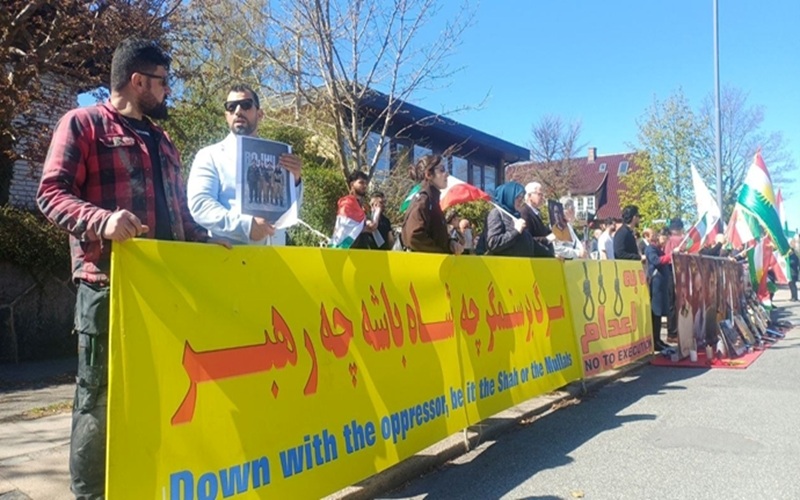

Why manufactured leadership and foreign-dependent narratives cannot replace the organic trajectory of Iran’s uprising
When global powers observed that the current Iran regime had entered a phase of weakness, the engine of “alternative-building” was set into motion at full speed. It is a large engine—but an outdated and worn one.
At its head stands Reza Pahlavi, son of the deposed Shah. He called on people in the streets not to organize or resist, but to stand behind their windows and wait for the fall of “liberating bombs.” At the same time, he repeatedly urged global powers to go to war with Iran—without ever assuming responsibility for the consequences of such calls.
The presence of the people in the January 2026 uprising, amid fire and blood, was repackaged through slogan amplification in his favor. This self-proclaimed “future king,” riding on the pain and aspirations of the people, saw narratives multiplied across social media and mass communication channels—repeated, amplified, and embedded into the minds of those yearning for change.
Cries of “Long live the Shah” flooded social platforms and Persian-language media outlets abroad. Meanwhile, amid all this noise, pleading for foreign military intervention—“strike, strike!”—emerged as the only tangible “strategy” offered by this hollow yet overconfident current.
The January 2026 uprising, like all complex social phenomena, was not the product of impulsive desires or the whims of inconsistent actors. It was rapidly evolving into something far deeper—approaching the threshold of revolution. Yet once again, external war pushed it back beneath the ashes. Still, it has not—and will not—cease. The uprising of the Iranian people has come a long, bloody, and resilient way, and the ruling clerical regime understands this reality well.
For 47 years, the clerical regime has relied on two seemingly “stable” pillars: uncompromising internal repression and the continuous export of crisis outward. The year 2026 will be decisive.
External war, while potentially shaking the head of power, has simultaneously pushed dependent and manufactured alternatives into irrelevance. In war, every state pursues its own interests. Historical experience shows that such wars have largely worked against peace and freedom in Iran, standing in contradiction to the interests of its people.
Moreover, the backward religious regime will not be overthrown by foreign war, and both domestically and externally engineered alternatives—whether war succeeds or fails—have no real chance of assuming power.
The exclusion of manufactured alternatives from the serious arena of change in Iran cannot be reduced simply to the ineffectiveness of the Shah’s son. What Iran and its people require—after a century of struggle—is revolution.
Revolution, as a concept, is a radical response to radical questions embedded in Iranian society. This is not a matter of personal preference, but the logic of history itself. It is this logic that sustains the forces of resistance despite immense challenges, while opportunistic forces retreat into glorifying a past that survives only as a faint and trembling shadow.
Progressive forces understand this historical logic and align themselves with it—and therefore endure. Reactionary forces, incapable of grasping this dynamic, are ultimately eliminated from the stage. The progressive force builds history amid fire and blood; the reactionary current dissolves in illusion and fantasy. The era of manufactured alternatives in 21st-century Iran has effectively reached its end.
Revolution has never been accidental. It does not emerge from coincidence, but from the deepest layers of the demand for transformation—and it leads toward overthrow. Revolution is the most profound form of social transformation, and its engine must be deliberately activated.
Its execution rests on a vanguard and revolutionary force willing to sacrifice, plan, and continuously refine itself to set that engine in motion. Revolution requires thought, program, and organization. Within this framework, the artificial construction of leadership—whether by foreign or domestic reactionary forces—is not designed to advance revolution, but to halt, distort, and abort it.
In 1953, a future-oriented national government aligned with national interests was removed and a fleeing Shah was restored to power. In 1979, when the historical lifespan of monarchy had already ended, the inflation of Ruhollah Khomeini not only derailed the revolution but mutilated it—turning its blade against authentic revolutionaries and the demands of the people.
It is precisely in response to such historical patterns that the National Council of Resistance of Iran was formed on July 21, 1981, in Tehran. After two years and four months, when the system under Khomeini proved irreformable, the conclusion of inevitable overthrow was reached, and an alternative based on specific democratic principles was introduced.
Today, this alternative exists at a qualitatively higher level. Its members, aligned with the democratic demands of the people, are present in today’s struggle—and prepared for tomorrow: to administer a transitional period, establish a provisional government, and ultimately transfer sovereignty to the people of Iran.
The reappearance of the Pahlavi family—once expelled by the people—functions in reality as a shadow cast over a genuine alternative that reflects a century of struggle. The democratic demands of the Iranian people do not appear to align comfortably with the interests of global powers.
For this reason, a powerful media apparatus—spanning social platforms and heavily funded Persian-language broadcasters—has sharpened its blade, ready to descend, with familiar appearance of benevolence, upon a wounded yet rising nation.
But today is neither August 1953 nor February 1979. Today belongs to figures such as Vahid Bani Amerian and his fellow resistance fighters; to young rebels like Amirhossein Hatami, Mohammad Amin Biglari, Shahin Vahedparast, Ali Fahim, Abolfazl Salehi; and to the expanding network of resistance units and figures such as Naeem Abdollahi.
In Iran, over at least the past 150 years, two reactionary forces have consistently acted as twin barriers to fundamental change. These “twins” of a defective cycle—dependent monarchy on one side and regressive religious tradition on the other—have remained in continuous opposition to democracy, monopolizing power and holding a nation of immense potential hostage.
Behind a unique illusion, and through the violent suppression of national and progressive forces, they repeatedly shut down the engine of transformation. Yet, in accordance with the logic of history—and through the determination and awareness of the Iranian people and their organized resistance—that great engine of transformative change has once again been set in motion. This time, it appears increasingly unlikely that any force will be able to stop it.
So it shall be.