


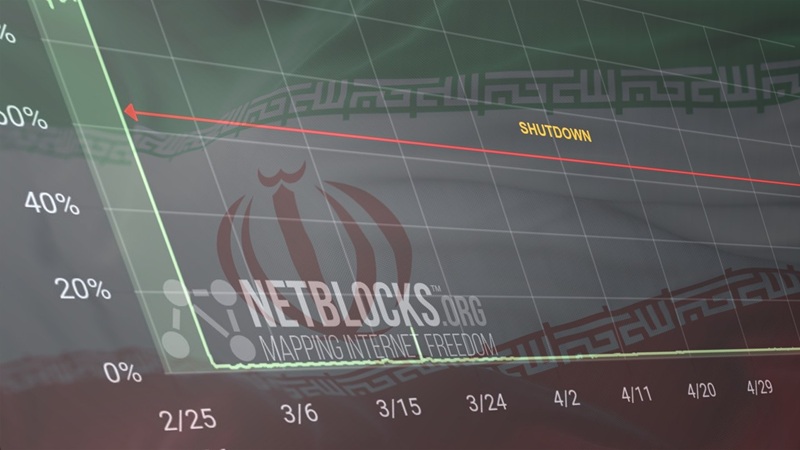

The regime’s prolonged internet shutdown is intensifying economic damage, widening social inequality, and accelerating the exodus of Iran’s skilled workforce.
Iran’s nationwide internet blackout has now entered its thirteenth consecutive week, further isolating millions of citizens from the outside world and deepening the country’s social and economic crisis.
According to the internet monitoring organization NetBlocks, the large-scale disruption of internet access in Iran has surpassed 2,016 hours. In a statement released on Saturday, the organization warned that the prolonged digital isolation is having severe consequences on the daily lives of ordinary Iranians.
NetBlocks emphasized that depriving citizens of internet access strips them of opportunities, information, and essential services that people elsewhere in the world can access within seconds. The organization also noted that the continuation of these restrictions is exacerbating social and economic inequalities across Iranian society.
In a previous report released on Friday, NetBlocks warned that with every additional hour of disconnection, access to the global internet increasingly ceases to be a universal right and instead becomes dependent on social status, political connections, and special privileges.
The blackout comes as regime officials openly admit they have no intention of restoring unrestricted internet access. On Thursday, Ali Yazdikhah, deputy chairman of the regime parliament’s Cultural Commission, declared that because the country remains in “wartime conditions,” there are currently no plans to reopen global internet access.
Iran’s sweeping restrictions on international internet connectivity began on February 28, 2026 making it one of the longest internet shutdowns recorded globally in recent years. The disruption has not only crippled the country’s communications infrastructure but also produced far-reaching economic and social consequences.
Technology experts warn that the prolonged restrictions are sharply reducing economic productivity. Online businesses, startups, export-oriented companies, and even traditional industries that depend on international communications have suffered heavy losses. Many businesses that once relied on digital platforms for trade, marketing, and financial transactions now face severe operational challenges or complete shutdown.
One of the most controversial aspects of the regime’s internet policy has been the implementation of a so-called “tiered internet” system under the label “Pro SIM Card.” According to reports, selected individuals and groups can obtain limited access to the global internet after passing identity verification procedures and receiving government authorization — often at significantly higher costs than ordinary internet services.
Critics describe the system as a form of institutionalized discrimination in access to information. They argue that creating privileged digital access for selected groups deepens Iran’s digital divide and reinforces broader patterns of inequality already present throughout society.
For many Iranians, internet access has increasingly become a privilege reserved for those with political connections, financial resources, or institutional affiliations, while ordinary citizens remain trapped behind heavy censorship and isolation.
The economic damage extends far beyond disrupted communications. The internet shutdown has left segments of Iran’s skilled and productive workforce unemployed, while pushing others toward forced migration. Many professionals working in technology, software development, digital marketing, online education, and international commerce have been compelled to relocate abroad in order to continue their work.
Although some of these departures are initially described as temporary, experts warn that they could quickly become permanent. The longer the restrictions continue, the greater the likelihood that Iran will experience a sustained brain drain involving highly educated and technologically skilled workers.
Analysts describe the trend as a costly transfer of human capital and specialized labor markets out of Iran. If the current policies persist, the country risks not only weakening its already fragile digital economy, but also permanently losing a generation of young professionals who spent years building careers and expertise inside Iran.
The regime’s continued insistence on maintaining internet restrictions reflects a broader strategy of control and surveillance. But as digital isolation deepens, the costs are increasingly being borne by ordinary citizens — through lost jobs, economic decline, restricted access to information, and the growing sense that Iran is being cut off from the modern world.