



Germany’s 2025 constitutional protection report identifies the Iranian regime’s intelligence apparatus as primarily targeting the MEK and NCRI while highlighting Tehran’s use of religious institutions and networks to expand influence and suppress dissent abroad.
For more than four decades, the Iranian Resistance has warned that the embassies, diplomatic missions, and institutions affiliated with the clerical regime—often operating under religious, cultural, or charitable cover—serve purposes far beyond ordinary diplomatic or cultural activities. According to the Resistance, these networks have long been used to advance espionage, influence operations, and efforts aimed at suppressing organized opposition abroad.
The latest report by the Hamburg Office for the Protection of the Constitution (Landesamt für Verfassungsschutz Hamburg) provides further official confirmation of these concerns. The 2025 report identifies the Iranian regime’s intelligence services as actively engaged in monitoring and targeting opposition movements outside Iran, with particular emphasis on the Iranian Resistance.
Iranian Intelligence Focuses on the MEK and NCRI
One of the most significant findings in the report concerns the priorities of the Iranian intelligence apparatus.
According to the Hamburg intelligence service:
“The primary focus of the Ministry of Intelligence (MOIS) in its intelligence activities in Western countries is directed toward the People’s Mojahedin Organization of Iran (MEK) and its political arm, the National Council of Resistance of Iran (NCRI).”
The report explains that the Iranian regime views intelligence operations as an essential instrument for maintaining the rule of the country’s religious and political leadership. As a result, its intelligence agencies concentrate heavily on “the surveillance and combating of opposition groups and individuals at home and abroad.”
This assessment aligns with years of warnings from Iranian opposition groups that Tehran continues to devote significant resources to monitoring, infiltrating, and undermining organized resistance movements operating internationally.
A Religious Dictatorship Behind Democratic Facades
The Hamburg report also offers a blunt assessment of the nature of the Iranian political system.
It describes the regime as:
“A dual system: outwardly possessing elections and a parliament, but in reality a religious dictatorship based on the principle of the Supreme Leader, who exercises virtually unlimited power.”
This characterization mirrors longstanding concerns expressed by international human rights organizations and democratic activists regarding the concentration of power within the office of the Supreme Leader and the absence of genuine political freedoms in Iran.
Closure of the Islamic Center Hamburg
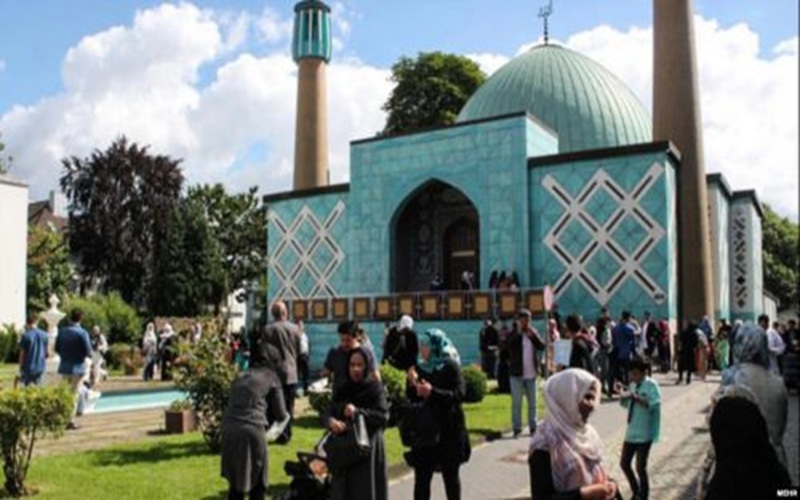
The report highlights the significance of Germany’s 2024 decision to shut down the Islamic Center Hamburg (IZH), an institution long regarded by security authorities as a key vehicle of Iranian influence in Europe.
According to the Hamburg intelligence service:
“The violent suppression of opposition protests in Iran further underscored how important it was to close the Islamic Center Hamburg in 2024 and deny the Mullah regime the opportunity to exert influence across Europe from Hamburg.”
The report notes that the organization operating the well-known Imam Ali Mosque in Hamburg had, in the assessment of German authorities, evolved after the 1979 Islamic Revolution into an instrument of the Iranian state.
Security officials concluded that the Islamic Center Hamburg served as an important tool for promoting the Iranian regime’s ideological agenda throughout Europe and facilitating its influence within Shiite communities.
Human Rights Violations Continue Unabated
The Hamburg report also references the German federal government’s longstanding criticism of Iran’s human rights record.
The document states:
“The human rights situation remains deplorable. Personal and political freedoms are deliberately and systematically restricted to preserve the regime.”
The report points to Iran’s extensive use of executions, restrictions on freedom of expression, arbitrary arrests, forced confessions, and pressure against family members of detainees.
It further notes that:
“Even peaceful protests are regularly suppressed by force.”
The report references the nationwide protests that erupted following the death of Jina Mahsa Amini in September 2022, emphasizing that demands for women’s rights, human rights, and broader political change were met with violent repression.
The document also highlights persistent discrimination against women, religious minorities, and ethnic communities, as well as severe limitations on freedom of information and internet access.
A Pattern of Espionage and Influence Operations
German authorities have repeatedly uncovered networks and structures linked to the Iranian regime operating under various organizational labels.
In recent years, investigations and enforcement actions against organizations connected to Tehran have revealed extensive efforts to establish influence structures within Europe.
The exposure of these networks has reinforced concerns that Iranian intelligence agencies continue to utilize a combination of formal institutions, affiliated organizations, and covert operatives to gather information and monitor opposition activities.
According to the Hamburg report, intelligence gathered by German counterintelligence services also indicates ongoing Iranian interest in collecting information related to foreign and security policy, as well as political, military, economic, and scientific developments in Western countries.
Growing Concern Over Tehran’s Activities in Europe
The findings of the 2025 Hamburg intelligence report demonstrate that concerns about Iranian intelligence operations in Europe remain far from resolved.
By explicitly identifying the MEK and the NCRI as the principal targets of the Ministry of Intelligence’s activities in the West, the report provides official confirmation of the regime’s continued focus on combating organized opposition beyond Iran’s borders.
At the same time, the report’s assessment of Iran’s political system, human rights record, and use of influence structures in Europe underscores the growing scrutiny facing Tehran across democratic societies.
For supporters of the Iranian Resistance, the report represents further evidence that the regime continues to perceive organized opposition as a significant challenge, dedicating intelligence resources and influence networks to countering its activities internationally.