


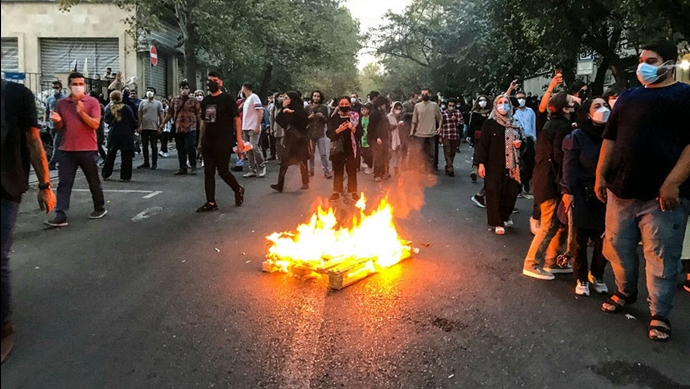

The convergence of military conflict and diplomatic agreement has exposed the limits of both foreign intervention and appeasement, reaffirming that democratic change in Iran can only be achieved by the Iranian people themselves.
The recent convergence of war and diplomacy has brought an important chapter in Iran’s political crisis to a close. A period of uncertainty—suspended between military confrontation and negotiations—has ended. What lies ahead will reveal the calculations of regional powers, international actors, and competing Iranian political currents.
Yet one conclusion is already becoming clear.
Just as the war altered political and social dynamics inside Iran, the subsequent diplomatic developments may prove equally consequential. The implications extend beyond the ruling establishment and touch the future aspirations of millions of Iranians seeking freedom, democracy, and national sovereignty.
The Collapse of the Illusion of Liberation Through War
Among the clearest political losers of this period are those who viewed war as a vehicle for regime change.
For months, some voices promoted the notion that freedom could arrive in Iran through foreign military action. This argument was particularly embraced by monarchist circles surrounding Reza Pahlavi, many of whom openly encouraged a military confrontation that they believed would create a pathway back to political relevance.
The premise was always flawed.
Iran is not a nation waiting for salvation from abroad. For more than a century, generations of Iranians have fought for constitutional government, political freedoms, and independence from both domestic tyranny and foreign domination. The struggle against dictatorship has deep roots in Iranian society and cannot be outsourced to foreign governments, military campaigns, or geopolitical calculations.
The outcome of recent events has underscored this reality.
Rather than producing democratic transformation, war brought additional suffering to ordinary Iranians while leaving the fundamental structures of repression intact.
The Regime Exploited the Crisis
While international attention focused on military developments and diplomatic negotiations, the Iranian regime continued to pursue one of its oldest survival strategies: repression.
During the conflict and its aftermath, authorities intensified executions and crackdowns against political prisoners, dissidents, and activists. The regime sought to exploit the crisis to eliminate opponents and intimidate society at a moment when global attention was directed elsewhere.
Equally revealing was the muted reaction from much of the international community.
Despite extensive concern over military escalation, far less attention was devoted to the regime’s ongoing human rights violations. Once again, the pattern that has characterized decades of Western policy toward Tehran became visible: strategic considerations often take precedence over the rights and aspirations of the Iranian people.
This approach has survived successive governments and international crises. Whether under the banner of engagement, diplomacy, or regional stability, the result has frequently been the same—a reluctance to confront the regime’s domestic repression.
Neither War Nor Appeasement
The lessons of recent months challenge two failed approaches that have long dominated discussions about Iran.
The first is the illusion that foreign military intervention can deliver democracy. The second is the belief that accommodation and concessions can moderate a regime whose survival depends on repression and regional aggression.
Both strategies have repeatedly fallen short.
In a recent statement, Maryam Rajavi emphasized that any development capable of ending war and reducing the suffering of the Iranian people should be welcomed. At the same time, she argued that support for continued conflict has largely come from two camps whose political futures depend on crisis and confrontation: the ruling theocracy and those seeking a restoration of monarchy.
She also reiterated a longstanding assessment of the regime’s behavior—that external conflicts have often served as a protective shield against domestic unrest, while genuine peace and de-escalation create conditions that expose the regime’s internal weaknesses.
Whether one agrees with every aspect of this analysis or not, recent events have strengthened a broader conclusion: neither bombs nor negotiations can substitute for the organized struggle of a people seeking democratic change.
The Real Agent of Change
The end of this phase of conflict has reinforced a historical lesson that many Iranians have learned repeatedly over the past century.
The fate of Iran will ultimately be decided inside Iran.
Neither foreign capitals nor military alliances will determine the country’s democratic future. Lasting change requires a social force capable of confronting dictatorship, mobilizing public support, and offering a democratic alternative.
This reality has become even more relevant as the regime faces growing internal pressures.
The absence of stability at the top of the political system, escalating factional rivalries, economic deterioration, and public dissatisfaction continue to deepen the regime’s vulnerabilities. Internal tensions that were temporarily overshadowed by war are likely to re-emerge with greater intensity.
For the Iranian people, these developments create opportunities as well as challenges.
The Path Forward: Neither Shah Nor Mullah
The political horizon emerging after the war points toward renewed social unrest, public protests, and demands for democratic change.
The aspirations that fueled previous uprisings have not disappeared. Economic hardship, political repression, corruption, and the demand for fundamental freedoms remain central concerns for millions of Iranians.
In this context, the most important task is the expansion of a democratic front that rejects all forms of dictatorship.
The choice facing Iran is not between competing authoritarian models. It is not a choice between theocracy and monarchy. It is a choice between democratic self-determination and the return of systems that deny the people’s sovereignty.
The experience of war, diplomacy, and decades of international maneuvering has demonstrated a simple truth: no foreign power can liberate Iran, and no dictatorship can reform itself into a democracy.
The future belongs to those who are prepared to build a democratic republic through organized resistance, civic engagement, and national solidarity.
The answer to Iran’s crisis lies neither in the restoration of the past nor in the preservation of the present. It lies in the determination of the Iranian people to shape their own future—a future free from both the rule of the Shah and the rule of the Mullah.