


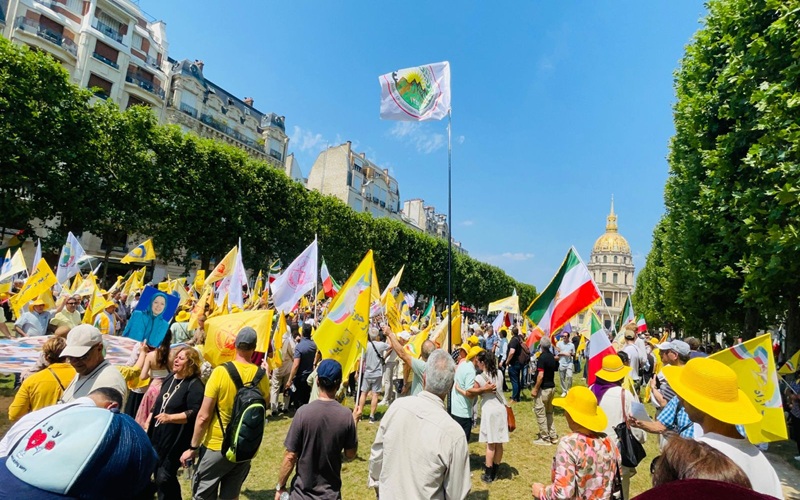

The cancellation of the Paris gathering exposed the growing convergence between Tehran’s intimidation campaign and efforts to silence Iran’s democratic opposition.
For decades, the Iranian regime has relied not only on repression inside the country but also on intimidation beyond its borders. Assassination plots, terrorist operations, hostage diplomacy, and pressure on democratic governments have formed part of Tehran’s strategy to suppress dissent wherever it emerges.
The French government’s last-minute cancellation of the planned Free Iran gathering in Paris has therefore raised questions that extend far beyond a single demonstration. Regardless of the security concerns cited by authorities, the outcome represented a political victory for a regime that has consistently sought to prevent the Iranian democratic opposition from mobilizing internationally.
The event was expected to draw nearly 100,000 participants from across Europe and beyond in what organizers described as one of the largest demonstrations by the Iranian diaspora. Its central message was opposition to executions, political repression, and the clerical dictatorship governing Iran.
According to the Daily Express, the rally was prohibited only hours before it was due to begin after French courts were informed of alleged terrorist bombing threats targeting participants. The newspaper criticized the extraordinary security measures deployed across Paris and noted the irony that thousands of peaceful demonstrators advocating democracy were prevented from assembling because of threats originating from violent extremists.
This outcome illustrates one of the central challenges democratic societies face when dealing with state-sponsored terrorism. If authoritarian regimes—or those acting on their behalf—can effectively prevent peaceful political gatherings simply by creating credible security threats, violence becomes an effective instrument for restricting democratic freedoms.
The Daily Express also observed that the National Council of Resistance of Iran presents a significant political challenge to Tehran because it advocates principles fundamentally incompatible with the current system, including free elections, gender equality, and the separation of religion and state. Whether one agrees with every aspect of its political platform or not, these are demands that fall squarely within internationally recognized democratic norms.
Perhaps even more striking were subsequent reports concerning the security threats surrounding the event.
According to The Times, documents presented before the French court alleged that supporters of Reza Pahlavi had discussed plans to attack members of the Iranian opposition gathering. The newspaper further reported that the court’s findings referred to individuals connected to the former SAVAK intelligence apparatus allegedly becoming active once again in Europe.
If accurate, these allegations would carry political significance beyond the immediate security concerns. They would suggest that elements associated with Iran’s former monarchy and those linked to the current clerical establishment, despite presenting themselves as ideological rivals, share a common interest in weakening an organized democratic alternative that rejects both systems of authoritarian rule.
That political distinction also received attention in Italian media. Reporting from Paris, Italy’s Channel 3 noted that participants explicitly differentiated themselves from both monarchist groups and the ruling establishment in Tehran. The dominant slogan—”Neither Shah nor Mullah”—captured a position increasingly emphasized by many supporters of democratic change: rejecting both the former dictatorship and the current theocracy in favor of a democratic republic.
This distinction matters because debates about Iran’s future are too often reduced to a false binary between the Mullahs’ regime and a restoration of monarchy. Yet many Iranian activists argue that neither model addresses the country’s long-standing demand for representative government, political pluralism, and respect for fundamental freedoms.
The controversy surrounding the cancelled Paris gathering therefore extends well beyond questions of public security.
It raises difficult issues about how democratic governments should respond when authoritarian regimes attempt to export intimidation onto European soil. Protecting public safety is unquestionably a legitimate responsibility. Allowing terrorist threats to determine whether peaceful political opposition may assemble is considerably more problematic.
The greatest beneficiaries of the cancellation were not the French authorities, who faced an impossible security dilemma, nor the peaceful demonstrators who lost their opportunity to make their voices heard.
The primary beneficiary was a regime that has consistently sought to isolate its democratic opponents and discourage international recognition of an organized alternative.
Democracies should remain vigilant against terrorism. They must also remain equally vigilant against allowing terrorism to become an effective tool for limiting democratic participation. Otherwise, those who issue threats achieve precisely what they intended—not through violence itself, but through the fear it creates.