


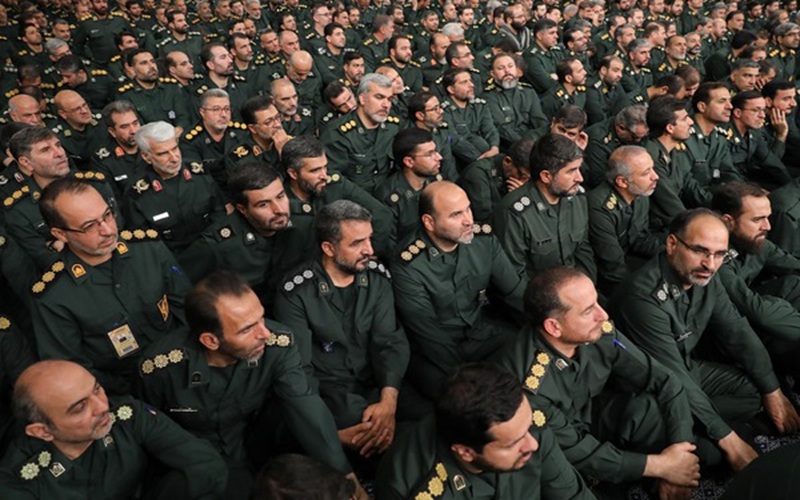

The IRGC’s abrupt rebranding of a once-condemned agreement exposes a regime struggling to justify strategic retreat while fearing a far greater threat at home: an increasingly restless Iranian population.
One question still lingers among many members of the Basij and the regime’s loyalists: What happened to the cries of “Revenge! Revenge!” that echoed so loudly only weeks ago? Why has what was once denounced as a humiliating capitulation suddenly become an “honorable agreement” worthy of praise?
The latest remarks by Yadollah Javani, deputy political chief of the IRGC, are less an explanation of Tehran’s agreement with Washington than an attempt to rewrite the story of the regime’s retreat. Javani now insists that the memorandum of understanding with the United States was negotiated “from a position of dignity and strength” and enjoyed the approval of Mojtaba Khamenei from the outset.
The problem is that the regime’s own propaganda from only weeks earlier tells a very different story.
Yesterday’s “Surrender,” Today’s “Victory”
When details of the agreement first emerged, media outlets affiliated with the IRGC and hardline factions attacked it as an act of surrender. Commentators described it as a betrayal of those killed in recent conflicts, while protesters burned copies of the document during organized demonstrations. Government negotiators were accused of capitulating to Washington, and hardliners demanded resistance rather than compromise.
If the agreement truly had the blessing of the regime’s leadership from the beginning, why were the regime’s own loyalists mobilized against it? Why did the IRGC and the leadership remain silent while their supporters publicly denounced an agreement they now claim was always part of the leadership’s strategy?
These contradictions expose not confusion among ordinary supporters, but inconsistency at the highest levels of the regime itself.
The Regime Faced an Impossible Choice
The answer lies not in today’s official rhetoric but in the dramatic shifts that have taken place in recent weeks.
The Iranian regime has come under its most intense military, economic, and political pressure in years. Sustained American military operations, the continued weakening of Tehran’s regional proxy network, mounting security costs, and disruptions to maritime and commercial logistics have significantly altered the regime’s strategic calculations.
Under these conditions, slogans promising resistance “until the last breath” became increasingly detached from reality. Faced with growing pressure, Tehran appears to have concluded that accepting an unfavorable agreement was preferable to confronting a far more dangerous escalation.
What changed was not the agreement itself.
What changed was the balance of power.
A Familiar Pattern of Political Survival
The regime has repeatedly demonstrated its ability to transform retreat into triumph through carefully crafted propaganda.
Following the Iran-Iraq War, Ruhollah Khomeini famously compared accepting the ceasefire to drinking a “poisoned chalice.” Decades later, nuclear negotiations were repackaged under the slogan of “heroic flexibility.”
Today, another political retreat is being presented as a strategic victory.
This time, however, the IRGC itself has assumed responsibility for convincing its ideological base that what was condemned yesterday must now be celebrated. Javani’s statements closely follow recent messaging from Mojtaba Khamenei, suggesting a coordinated effort to bring hardline factions into line with the leadership’s revised narrative.
The objective is straightforward: discourage dissent within the regime’s own ranks and replace yesterday’s accusations of surrender with today’s language of honor and strength.
The Regime’s Greatest Fear Lies Inside Iran
Yet the most revealing aspect of this sudden rhetorical shift is not what it says about foreign policy—it is what it reveals about the regime’s domestic insecurity.
Military pressure from abroad may compel Tehran to make tactical concessions, but external threats have never been the leadership’s greatest concern. Time and again, the regime has shown that its deepest anxiety emerges whenever internal unrest coincides with external weakness.
Every major retreat on the international stage has been accompanied by heightened fears of protests in Tehran, Tabriz, Zahedan, Ahvaz, and dozens of other cities.
The IRGC understands that the ultimate challenge to the system does not originate from foreign warships or diplomatic pressure. It comes from an increasingly dissatisfied population that has repeatedly demonstrated its willingness to confront the regime.
That reality was underscored on Tuesday, when Resistance Units reportedly carried out around 60 anti-regime operations across Iran, directly challenging Mojtaba Khamenei’s efforts to consolidate loyalty within the ruling establishment. At the same time, growing international condemnation of the regime’s continuing executions of protesters and individuals accused of links to organized opposition has further highlighted Tehran’s determination to preserve power regardless of the diplomatic cost.
Economic Crisis Fuels Political Instability
The regime’s concerns are compounded by Iran’s worsening economic conditions.
Runaway inflation, soaring unemployment, declining purchasing power, and expanding poverty have created an increasingly volatile social environment. Official economic indicators, together with visible declines in household consumption, suggest that many Iranian families are struggling simply to meet basic living expenses.
History has repeatedly shown that prolonged economic hardship often intensifies political discontent. For Tehran, therefore, economic deterioration is not merely a financial problem—it is a security challenge.
The IRGC’s sudden effort to redefine an unpopular agreement as a triumph should be viewed through this broader lens. The leadership is attempting to project confidence abroad while reinforcing unity at home. Yet the speed of its narrative reversal suggests not confidence but vulnerability.
Ultimately, the regime’s greatest challenge is unlikely to come from negotiations with Washington or military pressure from abroad. It is far more likely to emerge from within Iran itself, where economic hardship, public frustration, and continued resistance have combined to create a level of domestic pressure that propaganda alone cannot erase.