


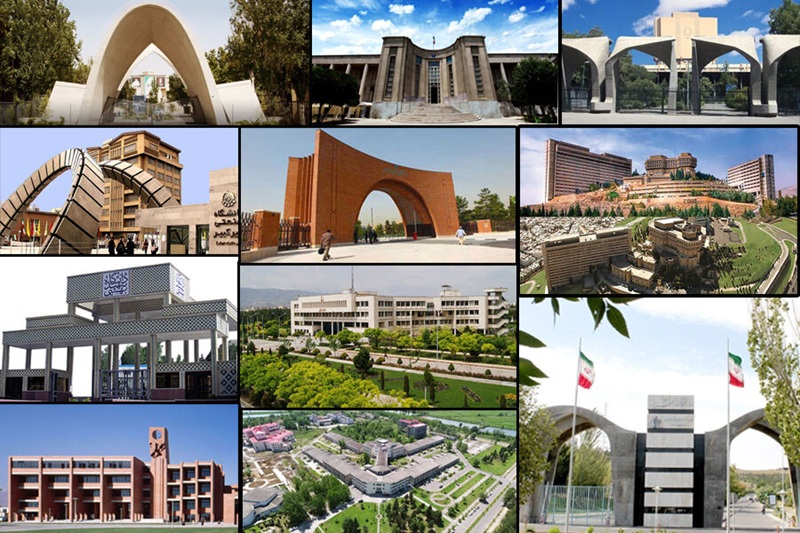

Iran’s absence from the 2026 Times Higher Education Impact Rankings is not an isolated academic setback. It is the predictable outcome of internet blackouts, political repression, and decades of systematic erosion of higher education.
For years, the Iranian regime has portrayed its universities as symbols of scientific progress and national achievement. Yet the complete absence of every Iranian university from the 2026 Times Higher Education Impact Rankings tells a very different story. This unprecedented omission is far more than a technical mishap—it is a warning that a higher education system cannot remain globally relevant while trapped behind digital walls and subjected to ideological control.
The regime may insist that the exclusion resulted from technical barriers rather than academic weakness. Even if that explanation is accepted, it only reinforces a deeper reality: a government that cuts itself off from the world inevitably cuts off its scientists, researchers, and students as well.
A Ranking Iran Never Entered
Times Higher Education (THE) evaluated 1,646 universities from 116 countries in its 2026 Impact Rankings, measuring institutions according to their contributions to the United Nations Sustainable Development Goals (SDGs). These include quality education, health, gender equality, innovation, environmental protection, reduced inequality, and accountable institutions.
Not a single university from Iran appeared on the list.
The absence is striking because 34 Iranian universities participated in the 2025 edition. Several had earned respectable positions in individual categories, including medical universities recognized for health and well-being and technical institutions noted for innovation and industry collaboration.
According to officials at Amirkabir University of Technology, Iranian universities were not excluded because of poor academic performance. Instead, they reportedly could not access THE’s online submission portal and therefore failed to upload the documentation required for participation.
That explanation deserves more attention than the regime would likely prefer.
Internet Blackouts Have Consequences Beyond Politics
When governments impose nationwide internet shutdowns, the immediate focus is often on censorship, protest suppression, and economic losses. Far less attention is paid to the devastating impact on scientific research.
Since the nationwide protests that expanded in late 2025, followed by the outbreak of war in early 2026, the Iranian regime imposed some of the most extensive internet restrictions in the country’s history. For months, access to the global internet was severely curtailed, with technical analyses indicating that most international internet routes became inaccessible.
Universities were among the casualties.
Researchers lost access to:
- International scientific journals
- Research databases
- Academic publishing platforms
- Cloud-based research software
- Online conferences
- International collaborators
- University email systems and digital infrastructures
Scientific work today depends on uninterrupted global connectivity. Research is no longer confined to laboratories or libraries. It is built upon constant interaction with international databases, collaborative software, peer-review platforms, and global academic networks.
When those connections disappear, research itself slows—or stops.
Isolation Is Not an Accident
Reports published during the internet blackout illustrated the scale of the disruption.
Iranian academics described severe difficulties accessing scholarly resources, submitting manuscripts, participating in virtual conferences, and maintaining collaborations with foreign institutions. Even domestic scientific databases attempted to compensate by expanding access to locally hosted research materials, an extraordinary measure that underscored how thoroughly international academic access had been disrupted.
The scientific journal Nature also examined the impact of the blackout, emphasizing that researchers deprived of access to institutional email accounts, journal submission systems, scientific databases, and international research tools are not simply delayed in publishing a paper. Their entire research cycle—from gathering data to collaborating with peers, responding to reviewers, revising manuscripts, and publishing results—can grind to a halt.
The Times Impact Rankings require universities to register, join the THE network, and submit extensive institutional evidence through an online platform. Universities unable to access that system simply cannot participate.
In other words, Iran’s universities were excluded not because they failed to meet academic standards, but because the regime’s own policies prevented them from entering the competition.
That distinction is hardly reassuring.
The Rankings Reveal a Larger Decline
The omission from the Impact Rankings should not be interpreted as a complete disappearance from global university rankings.
Several Iranian universities—including Tehran University, Sharif University of Technology, Amirkabir University of Technology, and Iran University of Science and Technology—still appear in THE’s overall World University Rankings for 2026.
However, their long-term trajectory tells a different story.
University rankings have steadily declined. International cooperation has weakened. Research funding has stagnated. Security agencies increasingly interfere in academic life. Professors and students face arrests, dismissals, and political persecution. Opportunities for international exchanges have diminished, while the emigration of scholars continues to accelerate.
None of these developments can be explained by sanctions alone.
They are symptoms of a university system increasingly shaped by political loyalty rather than academic excellence.
From Lost Potential to Systemic Decline
Iranian higher education did not begin in isolation. Before the 1979 revolution, several universities maintained academic partnerships with institutions in Europe and North America, and scientific exchanges contributed to the development of research and technical education. At the same time, universities operated under an authoritarian monarchy where political freedoms were severely restricted, student activists were frequently suppressed, and academic life was far from independent.
The 1979 revolution created expectations among many Iranians that universities would become more open and serve as engines of national development. Instead, those hopes were quickly undermined. The so-called Cultural Revolution closed universities for several years, purged thousands of professors and students, and subordinated higher education to ideological and political control.
Over the following decades, ideological vetting, interference by security institutions, restrictions on academic freedom, declining research investment, shrinking international cooperation, and the steady emigration of scholars eroded the competitiveness of Iranian universities. Institutions that should have become centers of innovation instead found themselves increasingly constrained by political priorities.
The nationwide internet blackouts of 2026 represent the latest phase of this long-running process. By severing universities from global scientific networks, the regime has further isolated researchers and students, adding digital isolation to decades of institutional decline.
Scientific Isolation Is Self-Inflicted
Supporters of the regime frequently argue that internet restrictions are temporary security measures designed to preserve national stability.
The evidence suggests otherwise.
A government that disconnects itself from the global internet does not merely silence journalists or protesters. It also isolates physicians from medical research, engineers from technological innovation, scientists from international collaboration, and students from the world’s largest body of human knowledge.
The consequences extend well beyond one university ranking.
Reduced research output, canceled international collaborations, lost scholarship opportunities, diminished foreign student recruitment, and an accelerating exodus of academics are all likely to become lasting features of Iran’s higher education landscape.
The disappearance of Iranian universities from one international ranking may seem symbolic today. Yet symbols often reveal realities before statistics fully catch up.
In the end, universities do not disappear because ranking organizations ignore them. They disappear when governments build walls so high that knowledge itself can no longer cross them.