


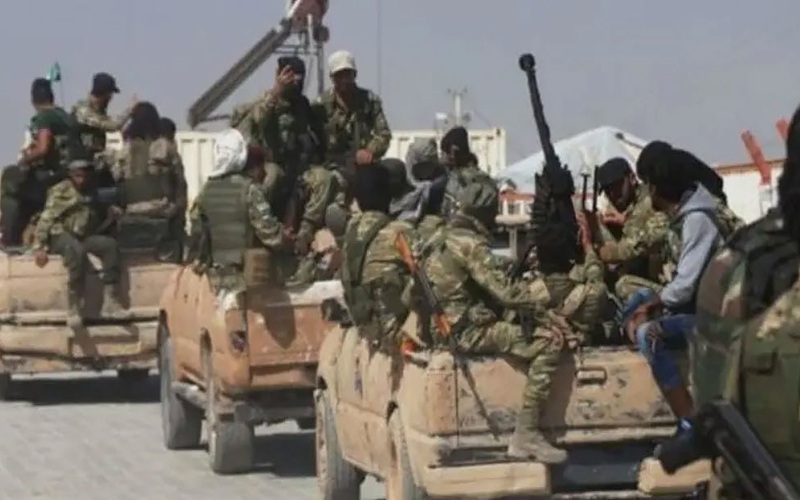

Analysts say Tehran-backed armed groups are adapting after major setbacks, prompting renewed concerns over the regime’s regional influence and its ability to project power through proxy organizations.
Armed groups backed by the Iranian regime appear to be regaining momentum across the Middle East after suffering significant setbacks over the past several years, according to a report by CNN citing regional analysts.
The assessment suggests that Tehran’s longstanding network of proxy organizations, while weakened by recent regional conflicts and leadership losses, remains operational and is adapting to changing conditions. Analysts argue that the recovery of these groups could strengthen the regime’s ability to exert pressure beyond its borders and complicate regional security dynamics.
Tehran Continues to Rely on Proxy Forces
For decades, the Iranian regime has pursued a strategy of expanding its influence through allied armed groups operating across the Middle East. These organizations have served as a central component of Tehran’s regional security doctrine, allowing the regime to project power while avoiding direct military confrontation.
Although many of these groups suffered serious losses in recent years—including the deaths of senior commanders and intensified military pressure—they have not disappeared. Instead, analysts believe they are reorganizing and adapting to a new regional environment.
According to CNN, these organizations are increasingly reopening operational fronts and expanding activities that could heighten regional instability and threaten international trade routes.
Analysts See an Evolving Network
Former intelligence officials quoted by CNN argue that Tehran’s proxy network remains intact despite recent setbacks.
Danny Citrinowicz, a former head of the Iran desk in Israeli military intelligence, told the network that the alliance has not been dismantled but is instead undergoing a transformation. In his view, the network continues to function while adjusting its methods and priorities.
Analysts also note that while these organizations often coordinate with Tehran, they maintain their own political agendas and local interests. Their relationship with the Iranian regime is therefore described as both ideological and strategic rather than one of complete operational dependence.
Houthis Display Increasing Independence
Among Tehran’s regional allies, analysts identify Yemen’s Houthi movement as one of the most autonomous.
Recent developments indicate that the group has expanded its regional activities and demonstrated an increasing willingness to pursue its own objectives while remaining aligned with Tehran’s broader strategic interests.
Earlier this month, the Houthis accused Saudi Arabia of targeting Sana’a airport to prevent the arrival of a senior delegation returning from Iran. The Saudi-backed government in Yemen acknowledged responsibility for the operation.
The dispute also underscored efforts by the Houthis to resume direct flights between Sana’a and Tehran for the first time in nearly a decade, a move viewed by observers as both politically and strategically significant.
Hezbollah Remains Central to Tehran’s Strategy
CNN also reports that Hezbollah continues to occupy a central place in the Iranian regime’s regional strategy.
According to the report, the group’s organizational structure has recovered more rapidly than many observers anticipated following recent military setbacks.
The report further notes that Mojtaba Khamenei, who assumed the regime’s leadership following the death of Ali Khamenei, recently reaffirmed Tehran’s support for Hezbollah in a letter addressed to the group’s leader, Naim Qassem. The message reportedly described Hezbollah as remaining at the forefront of Iran’s regional strategy and reaffirmed the regime’s long-term commitment to supporting the organization.
Regional Governments Increase Pressure
The renewed activity of Tehran-backed militias has prompted growing concern among neighboring countries.
According to reports, a Jordanian official recently warned Iraq that Jordan would respond militarily if Iranian-backed militias launched attacks against Jordanian territory. The official said Amman had shared intelligence regarding alleged militant plans and urged Iraqi authorities to prevent further cross-border operations.
Saudi Arabia has also reported attacks launched by Iranian-backed militias operating from Iraqi territory. These incidents have heightened regional tensions and prompted additional security measures aimed at limiting the activities of armed groups aligned with Tehran.
Proxy Strategy Remains a Pillar of Regime Policy
Despite years of military setbacks and leadership losses among its regional allies, the Iranian regime continues to rely heavily on proxy organizations as a cornerstone of its foreign and security policy.
Analysts increasingly believe that these groups are not disappearing but evolving, adjusting their structures and tactics to survive changing regional circumstances. Their continued activity underscores Tehran’s determination to preserve its regional influence through non-state armed actors, even as economic pressures and domestic unrest continue to challenge the regime at home.