


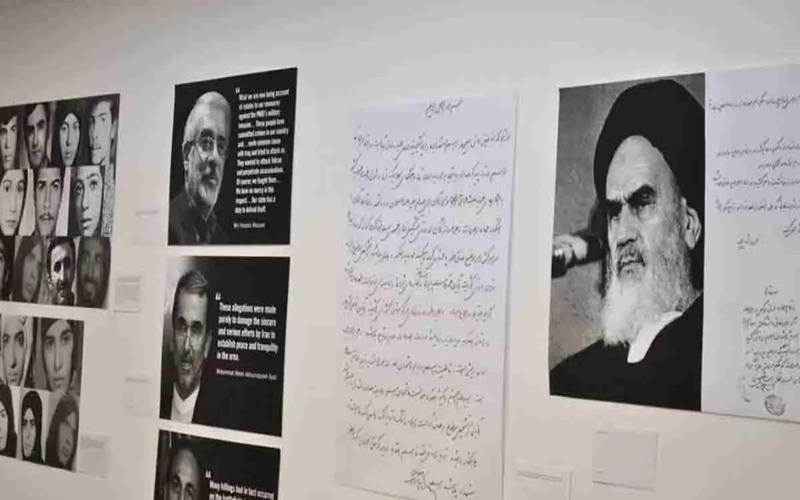

Amnesty International documented how officials implicated in the 1988 massacre continued to occupy senior positions, while victims’ families faced intimidation, silence, and retaliation.
The 1988 massacre of political prisoners in Iran was not simply a crime that ended when the executions stopped. Its consequences have continued for decades through the regime’s refusal to acknowledge the killings, its persecution of those seeking truth and justice, and the continued elevation of officials implicated in the massacre to positions of power.
This is the central conclusion emerging from extensive documentation by Amnesty International, including its landmark report on the 1988 massacre first published in 2018.
Iran: Blood-soaked secrets: Why Iran’s 1988 prison massacres are ongoing crimes against humanity
More than three decades later, the question remains unavoidable:
Why have those responsible for one of Iran’s gravest human rights crimes escaped accountability?
The answer lies in a system in which impunity was not an accidental failure of justice. It became part of the structure of power itself.
A Culture of Impunity
Amnesty International documented a deeply entrenched pattern of impunity for serious human rights violations committed by Iranian authorities.
According to the organization, most families of victims of the enforced disappearances and extrajudicial executions of 1988 have had little or no confidence in Iran’s judicial system. Those courageous enough to pursue justice have frequently encountered official inaction, intimidation, or retaliation.
This is crucial.
When the very institutions responsible for investigating and prosecuting crimes are controlled by, or staffed with, individuals implicated in those crimes, victims cannot reasonably expect an independent judicial process.
The result is a vicious cycle: perpetrators remain protected, victims remain without justice, and the state acquires an institutional interest in suppressing evidence of its own crimes.
The “Death Commissions” and the Rise of Their Members
One of the most disturbing aspects of the 1988 massacre is what happened afterward.
Rather than being removed from public life or investigated, numerous officials accused of participating in the so-called “death commissions” continued their careers in Iran’s judicial and executive institutions.
Amnesty International identified evidence implicating several senior officials in the commissions that oversaw the executions.
Among them was Alireza Avaei, who served as prosecutor in Dezful and was reportedly assigned to participate in the death commission there. By 2018, he was serving as Iran’s justice minister.
Hossein-Ali Nayyeri, identified as the religious judge on Tehran’s death commission, subsequently became deputy head of Iran’s Supreme Court and later headed the country’s Supreme Disciplinary Court for Judges.
Ebrahim Raisi, who was deputy prosecutor of Tehran in 1988 and a member of the Tehran death commission, subsequently occupied some of the highest positions in the judiciary and executive branch. He served as Tehran prosecutor, deputy head of the judiciary, and prosecutor general before eventually becoming president.
Rather than facing prosecution for his alleged role, Raisi defended his record publicly and attempted to distinguish his position as prosecutor from that of a judge. At the same time, he portrayed the actions taken against political prisoners in highly favorable terms.
Another prominent figure was Mostafa Pourmohammadi, who represented the Ministry of Intelligence on Tehran’s death commission and later served as justice minister. In 2016, responding to public discussion of the massacre and his role, he publicly defended the executions and stated that he considered carrying out the orders against the People’s Mojahedin Organization of Iran a source of pride.
Mohammad-Hossein Ahmadi, identified as a religious judge in Khuzestan and a member of its death commission, later became a member of the Assembly of Experts and spent years heading an institution responsible for the selection and appointment of judges.
The pattern is impossible to ignore.
Officials associated with the machinery of the massacre did not merely escape prosecution. In numerous cases, they advanced within the very institutions responsible for administering justice.
When the Evidence Emerged, the Regime Targeted the Messenger
The crisis of impunity became even more visible in 2016, when an audio recording of a meeting between Ayatollah Hossein-Ali Montazeri and members of Tehran’s death commission was released.
The recording generated unprecedented public attention to the massacre and provided a rare contemporary account of the decisions being made against political prisoners.
Instead of responding with an independent investigation, the regime reacted by attacking those who brought the evidence into the public domain.
Officials launched campaigns portraying discussion of the massacre as a threat to national security and attempted to discredit the victims and those demanding accountability.
The response demonstrated a fundamental principle of authoritarian impunity:
When the crime cannot be defended, suppress the evidence and criminalize the demand for truth.
In August 2016, then judiciary chief Sadegh Larijani warned that those who disseminated material concerning the massacre could face prosecution, accusing them of providing material for Western media.
The following month, Ahmad Montazeri, Hossein-Ali Montazeri’s son, was summoned and accused of acting against national security after publishing the recording.
He was subsequently sentenced by the Special Court for the Clergy on charges including acting against national security and propaganda against the regime. His original 21-year sentence was later reduced to six years suspended imprisonment.
The message was unmistakable: revealing the crime could be treated as a crime, while those implicated in the crime remained protected.
The Victims Were Put on Trial After Death
The regime’s strategy has also relied heavily on portraying the victims themselves as responsible for their fate.
This serves two purposes.
First, it attempts to transform perpetrators into defenders of national security.
Second, it deprives victims of their status as victims.
The 1988 executions were carried out against political prisoners, many of whom had already been imprisoned and sentenced. The subsequent effort to portray their executions as legitimate punishment has therefore been central to the regime’s attempt to avoid accountability.
The publication of the Montazeri recording challenged that narrative by providing direct evidence of the nature of the process used to determine the fate of prisoners.
That is precisely why the recording became so politically sensitive.
Impunity Is Not Just About the Past
The most important lesson of the 1988 massacre is that impunity does not remain confined to history.
When perpetrators of mass atrocities face no accountability, the institutional message is that political violence can be repeated without consequence.
The continued use of executions, arbitrary detention, torture, and repression in Iran must therefore be viewed against this historical background.
The same system that refused to investigate the killings of 1988 has continued to rely on capital punishment and coercion to suppress dissent.
The names and positions may change, but the underlying mechanism remains recognizable: political opposition is treated as a security threat, judicial procedures are subordinated to political objectives, and those who expose abuses risk punishment themselves.
Justice Delayed Is Not Justice Abandoned
For the families of the victims, the passage of time has not erased the crime.
They continue to demand answers about where their relatives were buried, what happened to them, who ordered their executions, and why those responsible have never faced an independent judicial process.
The 1988 massacre therefore remains both a historical crime and an unresolved contemporary issue.
Its victims were denied justice in life. Their families were denied truth afterward. And the officials accused of responsibility were allowed to continue exercising authority.
That is why accountability for the 1988 massacre matters far beyond the question of historical record.
It is a test of whether Iran can break with a political culture in which state power places itself above law and human life.
The regime may seek to bury the evidence, silence witnesses, criminalize remembrance, and portray perpetrators as heroes. But none of these measures can erase the historical record.
The central question remains:
How can a state claim justice while those implicated in mass executions are allowed to become its judges, prosecutors, ministers, and political leaders?
The answer is that there was never genuine accountability.
And until there is, the 1988 massacre cannot be considered a closed chapter. It remains an open wound—and a continuing indictment of a system built on impunity.