


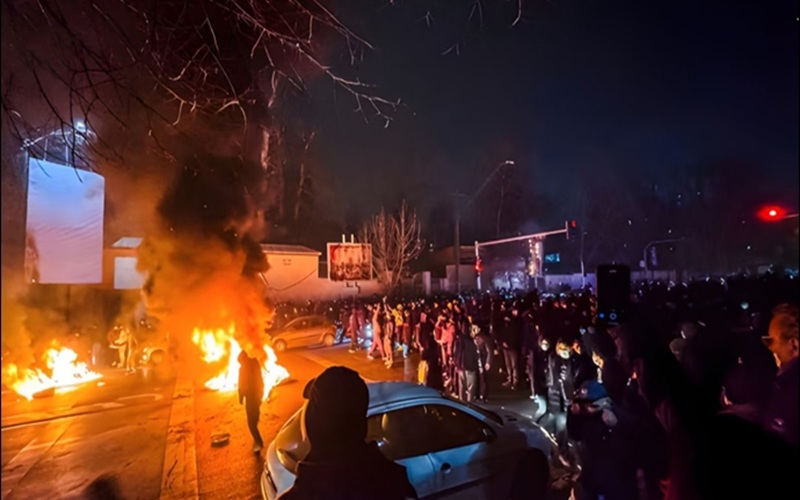

A daily gasoline deficit of up to 15 million liters has left the Iranian regime trapped between supply shortages, inflationary price shocks, and fears of renewed nationwide protests.
Iran’s deepening fuel crisis has once again exposed the structural weaknesses, economic mismanagement, and policy failures of the ruling regime. Recent remarks by a senior official in the Pezeshkian administration, who also heads the country’s energy optimization organization, revealed the scale of the gasoline imbalance: Iran is consuming approximately 135 million liters of gasoline per day while domestic production stands at only 121 million liters.
That leaves a daily shortfall of roughly 14 to 15 million liters.
The figures are more than an energy-sector statistic. They highlight a broader crisis in economic management, infrastructure, investment, and governance. After decades of policies that have failed to modernize the country’s energy system, the regime is now confronting a shortage that threatens transportation, household finances, and economic activity across Iran.
Three options, all carrying a heavy cost
The authorities have reportedly been considering three scenarios to deal with the gasoline shortage. Significantly, officials themselves have acknowledged that these are not genuine solutions but responses dictated by the regime’s growing constraints.
The first option is effectively to shut down gasoline stations once available domestic supplies are exhausted. Under this scenario, only around 120 million liters of domestically produced gasoline would be distributed each day. The consequences would be immediate: long queues at fuel stations, disruption of urban transportation, difficulties in moving goods, and further chaos in daily life.
The second option involves a price shock through so-called free-market fuel prices. Under this approach, each vehicle would receive a limited subsidized allocation, while additional consumption would be sold at a substantially higher price. Such a policy would inevitably raise transportation and distribution costs, feeding into already severe inflation and increasing the cost of food and other essential goods.
The third scenario is individual or household-based fuel rationing, under which limited gasoline allocations would be distributed according to the number of people or households. While presented as a potentially more targeted system, it would create considerable bureaucratic complications and could encourage fuel trading, intermediaries, black-market activity, and new forms of rent-seeking.
None of these scenarios addresses the underlying causes of the crisis.
Instead of investing systematically in modern refining capacity, promoting fuel-efficient vehicles, expanding railways and public transportation, and addressing the structural consequences of international isolation and economic mismanagement, the regime is once again attempting to shift the cost onto ordinary citizens.
A different proposal: Cut fuel allocations to security institutions
In response to the three options presented by the government, resistance leader Massoud Rajavi proposed what he described as a fourth solution: reducing fuel allocations to the regime’s security and military institutions.
Rajavi said: “To solve the crisis and for the mullah to rise from the gasoline soil, I propose a fourth solution to Shams, the minister of logistics, provided that King Mojtaba also agrees and does not obstruct it. The solution is very simple: reduce 5 million liters per day from the IRGC, the Basij, the Intelligence Ministry, and the police. That makes 20 million liters in total; there will be no shortage, and you will have 5 million liters left over!”
He concluded by warning that the regime should expect “the fire of the people’s uprising and the overthrow of the regime,” citing his remarks from August 16, 2026.
The proposal underscores a central political question surrounding Iran’s fuel crisis: who bears the burden of the country’s energy shortages? While ordinary citizens face rationing and rising prices, vast institutional resources continue to be allocated to the regime’s military, security, and coercive apparatus.
Fear of another November 2019
The regime’s dilemma is not limited to economics. It is also deeply political and security-related.
Officials have reportedly referred to a 10- to 15-day period for reaching a final decision and have emphasized the need to “prepare public opinion” before implementing any major change. Such language reveals the authorities’ concern about the potential consequences of another fuel-price shock.
The memory of the November 2019 uprising remains particularly significant. A sudden increase in gasoline prices at that time triggered widespread protests across Iran, which rapidly developed into a nationwide uprising. The regime responded with a brutal crackdown and a nationwide internet shutdown.
Today, the authorities face a similarly dangerous combination of circumstances. On one side is the growing inability to meet domestic gasoline demand, including the financial and technical limitations associated with increasing production or importing sufficient quantities. On the other is an increasingly impoverished population already struggling with inflation, declining purchasing power, housing costs, the depreciation of the rial, and widespread social restrictions.
A sharp increase in fuel prices could therefore become far more than an economic measure.
A symptom of a broader crisis
Iran’s gasoline shortage cannot be understood simply as a technical imbalance between production and consumption. It is a symptom of a much broader crisis of governance.
The country possesses substantial energy resources, yet chronic underinvestment, inefficient management, corruption, institutional monopolies, and distorted economic priorities have contributed to recurring shortages in gasoline, electricity, gas, and other essential services.
The regime now faces a difficult choice between policies that all carry significant social costs. Cutting supplies could paralyze transportation. Raising prices could accelerate inflation. Expanding rationing could fuel corruption and black-market activity.
But postponing the decision will not eliminate the underlying problem.
The gasoline crisis is therefore becoming another point of confrontation between the Iranian population and the ruling regime. What begins as a shortage measured in millions of liters could ultimately become a catalyst for broader social unrest—particularly if the authorities once again attempt to make ordinary people pay for decades of structural failure and economic mismanagement.
Gasoline is no longer merely a commodity in Iran. It has become a measure of the regime’s economic deadlock—and a potential flashpoint for renewed popular anger.