


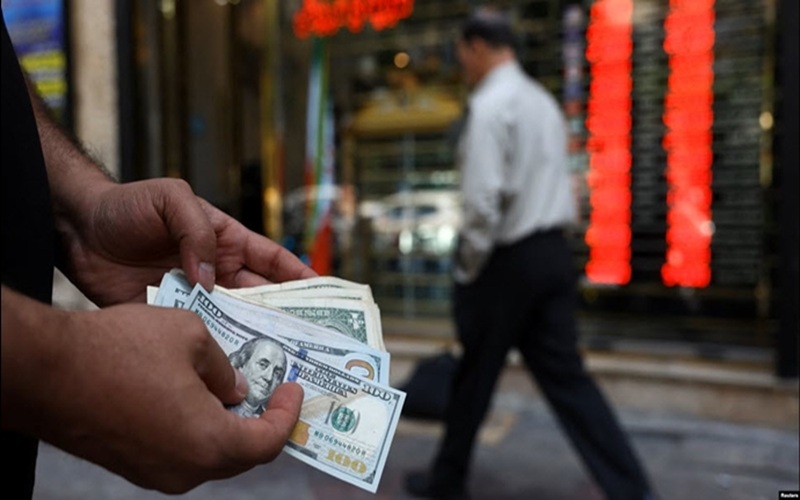

The dollar’s unprecedented rise beyond 200,000 tomans is deepening Iran’s cost-of-living crisis and intensifying fears of renewed nationwide protests.
The Iranian currency has fallen to a historic new low, with the dollar breaking through the 200,000-toman threshold. The unprecedented plunge is intensifying an already severe cost-of-living crisis, pushing inflation and prices higher while further eroding household purchasing power.
For millions of Iranians already struggling with poverty, unemployment, and soaring living costs, the currency collapse represents more than an economic statistic. It is another layer of pressure on households whose ability to absorb additional shocks has been exhausted.
The regime’s policies have played a central role in creating this crisis. Resources that could have been directed toward the economy and public welfare have instead been consumed by military ambitions, regional intervention, and the entrenched networks of corruption surrounding the Islamic Revolutionary Guard Corps (IRGC).
The consequences are increasingly difficult for the regime itself to conceal.
A crisis the regime knows can trigger protests
The ruling establishment is well aware of the connection between economic shocks and social unrest.
Government-controlled Arman Melli, in its August 23 edition, recalled the nationwide protests that followed the November 2019 gasoline price increase, writing that the government at the time had not anticipated that the decision would leave society turbulent for months.
The warning is significant because the circumstances today are considerably more severe.
The collapse of the currency affects virtually every aspect of daily life. Imported goods become more expensive, production costs rise, and the purchasing power of wages and pensions declines. For workers, teachers, retirees, and other low-income groups, even relatively small increases in essential goods can translate into a dramatic deterioration in living standards.
The experience of November 2019 demonstrated how quickly an economic measure can become a political crisis when it strikes a population already burdened by accumulated grievances.
Poverty is no longer hidden in national averages
The scale of the crisis is also appearing in the regime’s own media.
The state-linked Jahan-e Sanat, in an article titled “The New Map of Hardship,” acknowledged the unprecedented expansion of poverty across Iran. It noted that deprivation can no longer be concealed behind nationwide averages, arguing that poverty in Iran has not merely increased but has acquired a geographic dimension.
This is an important admission.
Economic hardship is not distributed evenly. Entire cities, provinces, and communities are experiencing increasingly severe deprivation, while the collapse of the national currency continues to widen the gap between wages and the cost of basic necessities.
For the regime, this creates a particularly dangerous political environment. Economic grievances are no longer isolated complaints over individual prices or wages. They are converging into a broader perception that the political system itself is responsible for the deterioration of people’s lives.
Officials fear a repeat of November 2019
The regime’s growing anxiety is reflected in warnings from its own officials and media.
Parliament Speaker Mohammad Bagher Ghalibaf has acknowledged the fundamental danger facing the establishment, stating that regardless of its military strength, it cannot survive if people are hungry.
The statement exposes a profound contradiction.
The regime continues to devote enormous resources to its military and security apparatus while the economic foundations of everyday life continue to deteriorate. Yet even officials within the system recognize that military power cannot compensate indefinitely for a population facing hunger and economic collapse.
The regime-affiliated Jamaran website has likewise warned against assuming that future protests would simply repeat the events of November 2019. Instead, it raised the possibility of “multilayered and combined” protests.
That warning is revealing.
It suggests that the regime no longer sees economic protests as isolated labor or livelihood disputes. It fears the convergence of different grievances and social groups into a broader political movement.
The line between economic and political protest has disappeared
Workers, teachers, retirees, farmers, and other struggling sectors have repeatedly taken to the streets over wages, pensions, employment, inflation, and deteriorating living conditions.
But as economic conditions worsen, the distinction between an economic protest and a political protest becomes increasingly difficult to maintain.
When people protest unpaid wages, they confront the policies that created the economic crisis. When retirees protest inadequate pensions, they confront a system that has failed to protect their livelihoods. When workers protest inflation, they confront the collapse of their purchasing power.
Economic grievances therefore increasingly lead directly to political questions.
Why are national resources being spent on military and security priorities while basic living standards deteriorate?
Why does corruption persist?
Why does the currency continue to lose value?
And why are ordinary citizens repeatedly asked to pay the price for policies over which they have no control?
These questions cannot be resolved through temporary economic adjustments alone.
A growing threat to the regime
The dollar’s passage beyond 200,000 tomans is therefore not simply another milestone in Iran’s economic deterioration. It is a political warning.
The regime has repeatedly attempted to manage crises through repression, emergency measures, and appeals to wartime conditions. But repression cannot restore purchasing power, and military strength cannot fill empty tables.
Every new economic shock adds to the accumulated anger of a population that has already experienced repeated waves of protest.
The regime’s own warnings reveal that it understands the danger. Its officials fear hunger, its media fear another uprising, and its commentators warn that future protests could combine economic, social, and political grievances on a scale that is more difficult to contain.
The deeper problem is that the regime has created a crisis it cannot resolve without confronting the policies and power structures responsible for it.
The collapse of the currency is consequently more than an economic crisis. It is another pressure point in an increasingly unstable political system—one in which the distance between economic hardship and demands for fundamental change is rapidly disappearing.