
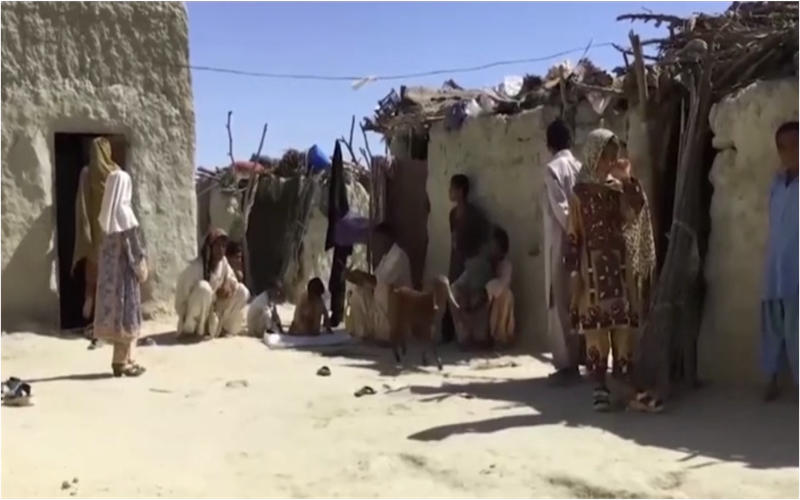

From villages without proper bathing facilities to families forced to cross rivers to reach medical care, conditions in some of Iran’s poorest regions expose the stark gap between the country’s wealth and how it is spent.
In parts of Iran, poverty has reached a level where basic infrastructure and essential public services remain out of reach for entire communities. In Sistan and Baluchestan and Bushehr, particularly in rural areas, residents continue to face conditions that would be difficult to imagine in a country with Iran’s vast natural resources and wealth.
Reports published even by Iranian state-affiliated media have documented some of these conditions.
In one report by the Iranian Labor News Agency (ILNA), a local resident points to a rudimentary structure and explains that it serves as the community’s bathroom. Images and reports from Zahedan, the provincial capital of Sistan and Baluchestan, have likewise highlighted severely inadequate roads and urban infrastructure.
These are not isolated shortcomings. They offer a glimpse into a much broader crisis of poverty, underdevelopment and deprivation affecting millions of Iranians.
When a River Becomes the Only Route to Medical Care
Perhaps the most striking example comes from a community where a river effectively separates residents from essential services.
A Bakhtiari man interviewed in a local report said he has spent approximately 45 years transporting people across the river. Now around 60 years old, he continues the work because there is no adequate alternative.
His testimony describes a reality in which medical emergencies can become life-threatening simply because residents cannot reach a hospital quickly.
He recalled people signaling him at night with flashlights or fires when someone urgently needed to cross the river. Among those he has transported are women in labor.
“Believe me, there have been hundreds of women who wanted to give birth,” he said, describing the desperate calls he receives from people who need to cross.
The fact that a community still depends on an individual using an improvised river crossing for emergency transportation illustrates the depth of the infrastructure crisis.
For residents, the distance to a hospital is not measured only in kilometers. A river, without a proper bridge or reliable transportation system, can become a barrier between life and death.
Where Is Iran’s Wealth Being Spent?
These conditions raise a fundamental question: How can a country with Iran’s enormous oil, gas and mineral resources leave millions of its citizens without basic infrastructure?
The question becomes even more pressing when public spending priorities are examined.
A regime-affiliated analyst recently compared budget allocations for four southern provinces—Hormozgan, Sistan and Baluchestan, Bushehr and Khuzestan—with reported funding for Hezbollah in Lebanon.
According to figures cited in the discussion, the four provinces received a combined allocation equivalent to approximately $330 million in the 2026 budget, while Hezbollah was reportedly allocated around $700 million.
The comparison becomes particularly stark when population is considered. The four provinces have a combined population of approximately 11.7 million people, while the analyst cited an estimated Hezbollah population base of around 400,000.
Using the exchange rate cited in the discussion, the analyst calculated a dramatically higher per-capita allocation for Hezbollah than for residents of the four Iranian provinces.
The figures themselves warrant scrutiny, particularly because budgetary and external-financing estimates can vary. But the broader issue is difficult to ignore: Iranian citizens living in some of the country’s poorest regions continue to face severe deprivation while substantial resources are directed toward the regime’s regional priorities.
A Broader Pattern of Poverty
The conditions in Sistan and Baluchestan, Bushehr and other deprived regions are not merely a story about inadequate roads, bathrooms or bridges.
They reflect a broader failure to invest in the living conditions of ordinary Iranians.
Communities struggling with inadequate infrastructure also face unemployment, inflation, declining purchasing power, inadequate healthcare and shortages of essential services. Rural and marginalized populations are often hit hardest, despite living in a country possessing enormous energy resources.
The contrast between Iran’s natural wealth and the daily reality of its citizens has consequently become one of the defining features of the country’s economic crisis.
A nation capable of generating enormous revenues from oil and gas should not have communities where residents must rely on an improvised river crossing to transport a pregnant woman to medical care.
The Cost of the Regime’s Priorities
The question is ultimately not whether Iran possesses the resources to address these problems. It does.
The question is where those resources are being directed and whose interests determine spending priorities.
For residents of deprived provinces, poverty is not an abstract economic statistic. It means living without basic infrastructure, watching essential services deteriorate and confronting emergencies without the roads, bridges, hospitals and public transportation that should be taken for granted.
The examples from Iran’s southern and southeastern regions therefore provide a glimpse into a much larger national crisis: a country rich in resources but increasingly poor in the ability of ordinary citizens to access a dignified life.
The widening gap between Iran’s wealth and the living conditions of its people is fueling growing public anger—and raising increasingly urgent questions about the priorities of the regime governing the country.