
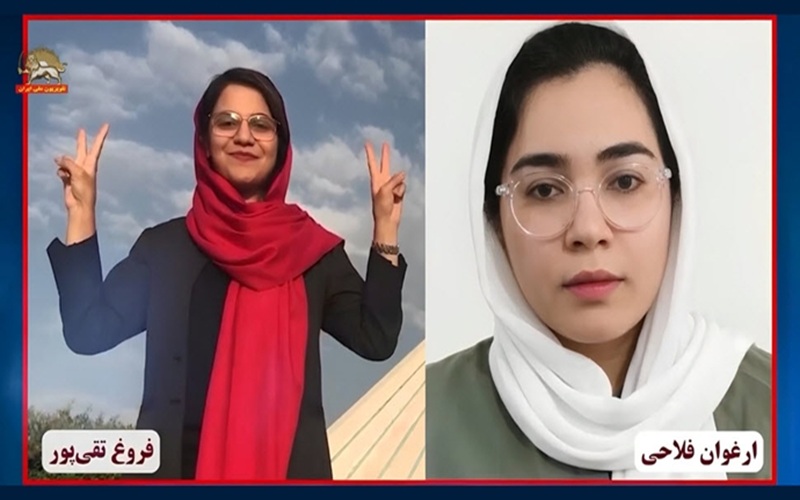

Political prisoners Arghavan Falahi and Forough Taghipour send a message from Evin Prison marking the MEK’s 61st anniversary and reaffirming their commitment to freedom and a democratic Iran.
Political prisoners Arghavan Falahi and Forough Taghipour have issued a message from Evin Prison marking the 61st anniversary of the founding of the People’s Mojahedin Organization of Iran (PMOI/MEK), saluting the Iranian people, Resistance Units, and those continuing the struggle against dictatorship.
Political prisoners Arghavan Falahi and Forough Taghipour, writing from Evin Prison in Tehran, have issued a message commemorating the 61st anniversary of the founding of the People’s Mojahedin Organization of Iran (PMOI/MEK).
The prisoners emphasized that they wanted their message to reach Iran’s youth and people despite the restrictions imposed on political prisoners. Their statement presents the anniversary as an occasion to reaffirm their commitment to freedom and their opposition to dictatorship.
A message from behind Evin’s walls
Marking the 61st anniversary, Falahi and Taghipour sent greetings to the Iranian people, Resistance Units, and those they described as the standard-bearers of the resistance.
“From behind the fragile walls of Evin Prison,” they wrote, they extend their greetings and congratulations to the Iranian people, the courageous Resistance Units, Maryam and Massoud Rajavi, and MEK members in Ashraf.
The two prisoners traced their political commitment to the organization’s founders—Mohammad Hanifnejad, Saeed Mohsen, and Ali Asghar Badizadegan, who established the MEK in September 1965.
“We are from the blood-stained lineage of Mohammad Hanifnejad, Saeed Mohsen and Ali Asghar Badizadegan,” they wrote, describing the founders as having planted the seeds of an organization that, in their view, has continued to evolve throughout six decades of struggle.
“A new thought” against dictatorship
The prisoners characterized the MEK as an organization that challenged what they described as outdated and reactionary political and social ideas.
They portrayed its history as a struggle against both the former monarchy and the current clerical regime, arguing that the organization’s opposition to dictatorship had become a defining element of its political identity.
According to their message, the organization’s ability to mobilize and organize extended from Iranian streets and prisons such as Evin and Qezel Hesar to communities outside Iran.
They also emphasized the concepts of truth and sacrifice, portraying the organization’s history as one marked by sacrifices made in the name of freedom.
Remembering those who died for their cause
A significant portion of the message focused on members and supporters of the Resistance whom Falahi and Taghipour described as having sacrificed their lives.
They referred to themselves as belonging to the generation that followed the victims of the 1988 massacre of political prisoners, invoking the memory of those killed during the mass executions that year.
The prisoners also referred to members of the younger generation, including Babak Alipour, Vahid Banian Amerian, Pouya Ghobadi, and Mehdi Khanki, presenting them as examples of a new generation committed to opposing dictatorship and political dependence.
“Grieving the loss of such precious people does not bring us to our knees,” they wrote, asserting instead that such losses strengthen their determination to continue their struggle.
“We have become a living spirit”
Falahi and Taghipour also condemned what they described as the Iranian regime’s increased use of executions and repression, particularly amid the country’s broader crisis.
They argued that imprisonment and executions could not extinguish their political convictions.
“Whether you throw us into prison or tighten nooses around our throats, we have become a living spirit that will never die,” they wrote.
The message repeatedly links resistance to the preservation of memory, portraying those who died as continuing to inspire those still active inside Iran.
“We read with Pouya’s voice, see with Vahid’s eyes, walk with Babak’s feet, and love the people with Mehdi’s heart,” they wrote.
“We have learned to fly”
The prisoners concluded their message by presenting the 61st anniversary as a continuation rather than a conclusion of the MEK’s history.
They argued that, despite six decades of political struggle and significant setbacks and sacrifices, the path they support has not become outdated but has instead acquired renewed relevance for a new generation.
“We have learned to fly from the doves who became stars,” they wrote.
Falahi and Taghipour ended their statement by commemorating the founding anniversary of the MEK and expressing their support for what they described as a new democratic republic in Iran.
The message from Evin comes amid continued reports of political repression, imprisonment, and executions in Iran, highlighting the role that political prisoners and their supporters seek to play in maintaining opposition to the regime even from inside detention facilities.