
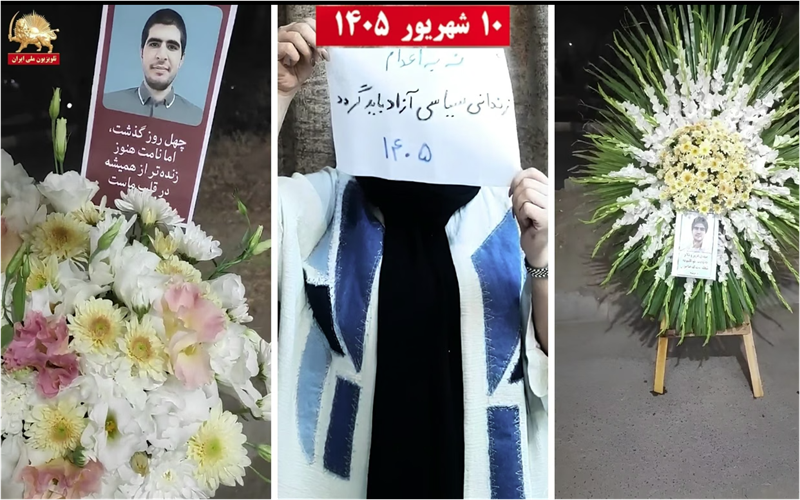

Supporters of the “No to Execution Tuesdays” campaign staged memorial displays, poster campaigns, and commemorative actions in Tehran, Karaj, Shiraz, Isfahan, Mashhad, Abadan, and numerous other Iranian cities, calling for an end to executions and the overthrow of the regime.
The nationwide campaign against executions in Iran continued on Tuesday, September 1, 2026, as Resistance Units and supporters of the “No to Execution Tuesdays” campaign carried out a series of public and commemorative activities across Tehran, Karaj, Shiraz, Isfahan, Mashhad, Abadan, and many other cities.
The actions combined opposition to the regime’s use of the death penalty with commemorations marking the 40th day since the death of Mehdi Khanaki. Through posters, floral tributes, memorial tables, and other forms of public messaging, participants reiterated their rejection of executions and expressed their determination to continue the struggle for freedom.
In Tehran, activists organized a memorial table marking the 40th day since Khanaki’s death and placed a floral tribute bearing his photograph. The accompanying message read: “Dear and courageous Mehdi, in your memory, there is a flame in my heart that will never be extinguished.” Another poster declared: “We stand with the memory of our comrades until the end,” alongside the slogan of the No to Execution Tuesdays campaign.
In Karaj, supporters placed a flower basket featuring Khanaki’s photograph with the message: “Forty days have passed, but your name is more alive than ever in our hearts.” A memorial display described the occasion as a day to remember a person who gave meaning to his life through his aspiration for freedom and a dignified future for Iran. The message emphasized that although Khanaki was gone, his ideals of dignity, humanity, freedom, and hope remained alive among the Iranian people. The display concluded with a tribute to “hero Mehdi” and support for the No to Execution Tuesdays campaign.
Similar commemorative actions were reported in Kerman, Someh Sara, and Varamin. Posters in Kerman said that Khanaki’s memory and path would be honored and that his struggle would continue until the regime was overthrown, alongside a rejection of executions. In Someh Sara, activists displayed a message honoring “Mehdi Khanaki, the fallen Mojahed,” while a poster in Varamin stated: “Mehdi Khanaki, your path continues.”
The anti-execution campaign also spread through numerous other cities. In Shiraz, activists called for an end to executions and the release of political prisoners. In Isfahan, posters condemned executions and quoted a message attributed to Massoud Rajavi concerning the regime’s use of killing and execution. In Mashhad, activists expressed support for the No to Execution Tuesdays campaign and opposed executions.
In Golpayegan, posters called for an end to the death penalty and the execution of young people. In Yazd, activists demanded the cancellation of executions of young Iranians, while another poster linked the campaign to the case of Arghavan Falahi. In Rasht, a poster specifically called for the annulment of the death sentence against Manouchehr Fallah.
In Lahijan, the messages directly challenged the regime’s use of executions as an instrument of intimidation. One poster declared that executions would not frighten the population but would instead strengthen their determination to overthrow the regime. Another described execution not as justice but as a mechanism for preserving the regime’s rule and called on people to oppose the death penalty.
In Eslamshahr, several posters emphasized that imprisonment and execution cannot provide an answer to popular demands. Messages called for nationwide opposition to executions, from Qezel Hesar prison to cities across Iran, and stated: “We will not remain silent; we support No to Execution Tuesdays.” Other posters warned that every execution further intensifies public anger and linked rejection of the death penalty to rejection of the “government of death.”
In Abadan, activists used particularly direct slogans, including: “This is the final message: execute and there will be an uprising,” and “Uprising is the answer to execution.” Other posters specifically opposed the execution of Isa Chari and Arghavan Falahi.
In Bandar Abbas, activists displayed messages rejecting both executions and what they described as a “government of death,” alongside the call for “one voice, one cry: No to execution.”
Taken together, these activities demonstrate the continuing effort by Resistance Units and campaign supporters to turn opposition to executions into a nationwide political message. The commemorations for Mehdi Khanaki also connected remembrance with continued resistance, portraying the memory of those who died in the struggle as a source of renewed determination.
The actions came amid continued concern over the regime’s extensive use of capital punishment and its role in suppressing dissent. The repeated message across the country was clear: No to executions, no to repression, and continued resistance for a free Iran.