


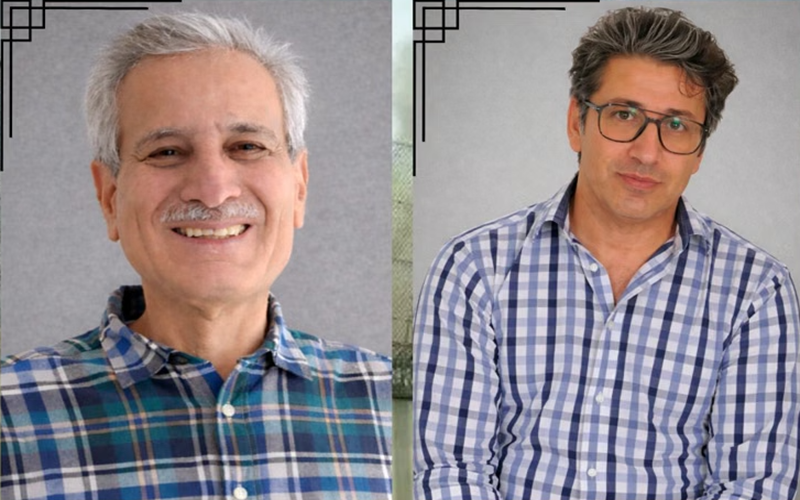

Akbar Bagheri and Asadollah Hadi, writing from Qezel Hesar Prison, paid tribute to the PMOI’s founders and stressed sacrifice, resistance, and the struggle for popular sovereignty in Iran.
Two Iranian political prisoners held in Qezel Hesar Prison in Karaj have issued messages marking the 61st anniversary of the founding of the People’s Mojahedin Organization of Iran (PMOI/MEK), paying tribute to the organization’s founders and emphasizing the role of sacrifice and perseverance in Iran’s struggle for freedom.
The messages, written by Akbar Bagheri and Asadollah Hadi in September 2026, come from one of Iran’s most notorious prisons, where political prisoners have repeatedly faced executions, prolonged imprisonment, and harsh conditions. Both prisoners presented the PMOI’s history as part of a broader struggle against dictatorship and for the sovereignty of the Iranian people.
Akbar Bagheri: “The flame” of resistance cannot be extinguished
In his message, Akbar Bagheri commemorated the three founders of the PMOI—Mohammad Hanifnejad, Saeed Mohsen, and Ali-Asghar Badizadegan—and described the organization’s establishment 61 years ago as the lighting of a flame that successive repression has failed to extinguish.
Bagheri wrote that the organization had survived decades of pressure and conspiracies, arguing that its endurance was rooted in the sacrifices made by its members.
“The lamp that they lit in 1965 cannot be extinguished by any wind.”
He described the PMOI’s six decades of struggle as a passage through successive periods of repression under both the former monarchy and the current Iranian regime.
Bagheri then focused on what he described as the central principle behind the organization’s endurance: sacrifice.
“The secret of the organization’s survival is its giving up all the deceptive attractions of this world.”
He characterized the concept of feda, or self-sacrifice, as more than an abstract political slogan, arguing that it requires individuals to place the cause of freedom above personal interests, possessions, and even their own lives.
“The Mojahed is the embodiment of sincerity and sacrifice.”
According to Bagheri, this commitment has continued across generations of PMOI members and supporters. He cited imprisoned and executed activists as examples of people who, in his view, had remained committed to the struggle despite the personal cost.
He specifically referred to individuals ranging from 70-year-old executed political prisoner Behrouz Ehsani to 26-year-old executed political prisoner Mehdi Khanki, presenting them as examples of different generations united by a commitment to political freedom.
Bagheri concluded by congratulating PMOI leaders Maryam Rajavi and Massoud Rajavi, as well as Zahra Merikhi, PMOI members in Ashraf-3, supporters of the resistance, and the Resistance Units on the organization’s 61st anniversary.
Asadollah Hadi: A struggle for popular sovereignty
In his message, Asadollah Hadi placed the PMOI’s history within a broader account of Iran’s modern political struggles. He began by remembering historical figures including Sattar Khan, Mirza Kuchik Khan, Mohammad Mossadegh, and Mohammad Hanifnejad.
Hadi argued that throughout modern history, Iranian society has been marked by a confrontation between those who hold wealth and political power and those deprived of political and economic rights.
“Two social phenomena have always stood against each other: the exploited and the exploiter.”
He argued that when governments deny people their right to determine their own political future, popular resistance inevitably emerges. In his account, Iran’s constitutional movement, the struggles associated with Mirza Kuchik Khan, and Mossadegh’s political movement were stages in a longer history of resistance to authoritarian rule.
Hadi then turned to the founding of the PMOI in 1965, saying that Hanifnejad, Mohsen, and Badizadegan concluded from earlier political experiences that a sustained struggle required an organized movement.
He wrote that the three founders recognized what they considered the shortcomings of earlier reformist approaches and therefore established the PMOI as an organized revolutionary movement.
According to Hadi, the organization subsequently pursued a struggle against both the former monarchy and the Iranian regime, with popular sovereignty at the center of its political outlook.
He described the struggle as one against what he called exploitation and authoritarianism, while presenting the National Council of Resistance of Iran as an instrument for political unity and organized opposition.
Messages from behind prison walls
The two messages carry particular significance because they were written from Qezel Hesar Prison, where political prisoners remain subject to severe restrictions and the threat of execution.
Rather than focusing primarily on their own circumstances, both Bagheri and Hadi used the anniversary to place their imprisonment within a much broader political narrative. Their messages emphasize continuity between generations of Iranian opposition activists and portray political imprisonment and execution as part of the Iranian regime’s broader effort to suppress dissent.
Bagheri’s message centers on personal sacrifice and the endurance of an organized resistance movement. Hadi’s message focuses more heavily on Iran’s modern political history and the concept of popular sovereignty.
Both ultimately express the same political objective: an end to authoritarian rule and the establishment of a political system based on the sovereignty of the Iranian people.
Hadi concluded his message by expressing hope for what he called a “new democratic republic of Iran” and congratulating the PMOI and its supporters on its 61st anniversary.
From inside Qezel Hesar Prison, their messages thus serve not only as commemorations of the PMOI’s founding but also as declarations of continued political commitment in the face of imprisonment and repression.