


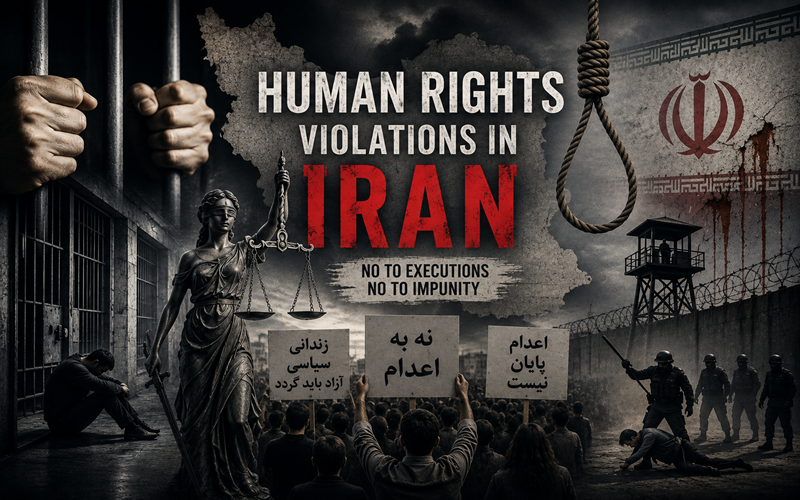

At least 82 people were executed and 152 were arrested in Iran during August, according to documented reports, while women, political prisoners, Kurds, Baluch citizens, and January uprising detainees remained particularly vulnerable.
Iran’s human rights crisis continued to deteriorate throughout August 2026, as the ruling regime relied increasingly on executions, arbitrary arrests, lethal force, and physical punishment to intimidate society and suppress dissent.
According to figures compiled from published reports, at least 82 people were executed in Iranian prisons during August, including six women and four political prisoners. The victims also included members of Iran’s ethnic minorities: six Baluch and eight Kurdish prisoners, as well as one Afghan national.
The figures reflect only cases that could be documented and reported. Other human rights organizations have also recorded a sharp increase in executions during the month, although their totals differ because executions are frequently carried out without advance public notification and information about individual cases is often withheld.
The pattern is significant. As the regime faces mounting political, economic, and social pressures, the use of executions and other coercive measures has become an increasingly visible instrument of control.
82 executions documented in August
Of the 82 executions documented during August, 72 were men and six were women, while four were political prisoners.
The executions took place in prisons across the country and were carried out under a range of charges, including murder, drug-related offenses, and vaguely defined national-security charges such as moharebeh—“enmity against God.”
Independent documentation confirms the broader trend. HRANA reported 78 executions in August, while Iran Human Rights Monitor documented 92, illustrating both the scale of the killings and the difficulty of establishing a complete figure.
The discrepancy between the various databases should not obscure the central fact: dozens of people were put to death by the regime during a single month.
Women among those executed
Women were among the most vulnerable victims of the execution system.
Six women were reportedly executed during August. Among them were:
- Mahtab Shirmohammadi, 32, executed on August 2 at Yasuj Central Prison on a murder charge.
- Marzieh Niri, 24, executed on August 8 at Qazvin Central Prison on a murder charge.
- Donya Mohammadi, 20, executed on August 19 at Ilam Central Prison on a murder charge. Her execution was also independently reported by human-rights organizations.
- Fatemeh (Maryam) Kamal Zareh, 30, executed on August 23 at Karaj Central Prison on a murder charge.
- Arezoo Rostad, 23, executed on August 24 at Isfahan Central Prison on a drug-related charge.
- Zahra Azizpour, 43, executed on August 25 at Rasht Central Prison on a murder charge.
The execution of young women such as Donya Mohammadi, who was only 20, underscores the human cost of Iran’s continued reliance on capital punishment.
Political prisoners and January uprising detainees executed
August also saw the execution of prisoners whose cases were directly connected to political repression and the January 2026 uprising.
Four political prisoners were among those executed in the documented figures.
Arvin Kheirkhahan was executed on August 1 at Shahrud Prison on a moharebeh charge. He had been arrested during the January 2026 uprising.
Shahram Sadeghi was executed on August 16 at Ghezel Hesar Prison. The regime accused him of operational activities benefiting the United States, Israel, and hostile groups.
Ghaem (Arian) Hosseini, a 20-year-old Afghan national, was executed on August 20 at Isfahan Central Prison on a moharebeh charge. He had also been arrested during the January uprising.
Majid Adineh was executed on August 23 at Karaj Central Prison. He too had been detained during the January uprising. Iranian authorities accused him of operational activities benefiting foreign powers and hostile organizations. His execution was reported following the judiciary’s confirmation of his death sentence.
The targeting of January uprising detainees is particularly significant. Human-rights organizations have documented an increase in death sentences and executions against people accused of participating in the protests. Hengaw, for example, reported six political prisoners and prisoners of conscience executed in August.
These cases demonstrate how the death penalty is being used not merely as a criminal punishment but as part of a broader campaign against political dissent.
152 arrests as repression expands
Executions were accompanied by widespread arbitrary detention.
At least 152 people were arrested during August, according to the documented figures. Of these, approximately 150 were detained in connection with political, social, ethnic, or security-related activities, while two were members of the Baha’i religious minority.
Those targeted included people arrested during the January uprising, relatives of political prisoners, political and labor activists, environmental activists, artists, Baluch and Kurdish citizens, and individuals accused by the regime of espionage.
Some arrests were reportedly carried out without clearly stated charges.
The crackdown was particularly pronounced in Kurdish areas. A separate August assessment documented at least 66 Kurdish citizens arrested or detained, including activists, cultural figures, women, former political prisoners, relatives of opposition figures, and other civilians.
The breadth of these arrests illustrates that repression extends well beyond organized political opposition. Civil society, ethnic minorities, families of prisoners, and people engaged in peaceful social activity can all become targets.
Extrajudicial killings of border workers and civilians
The regime’s use of lethal force was not confined to prisons.
At least nine people were reportedly killed by regime agents during August, including:
- Three fuel carriers, known as sookhtbars;
- Four Kurdish porters, or kolbars;
- Two other civilians.
Fuel carriers and porters from economically marginalized border communities routinely face the risk of being shot by security forces while attempting to earn a livelihood.
These killings add another dimension to the regime’s human rights record: lethal force is being used against vulnerable civilians outside the formal judicial system, with little apparent accountability.
Flogging and renewed punishment of women protesters
Physical punishment also remained part of the regime’s repression.
At least two women who had previously been arrested during the January 2026 uprising and later released on bail were rearrested during August.
Authorities carried out flogging sentences against them before transferring them to prison to serve additional sentences.
The use of flogging against women arrested in connection with protests demonstrates the regime’s determination to continue punishing dissent long after the initial demonstrations have ended. Reports in August also documented the implementation of flogging sentences against Kurdish women detained during protests earlier in the year.
A system built around intimidation
Taken together, the August figures reveal a consistent pattern: execution, imprisonment, arbitrary detention, lethal force, and corporal punishment are functioning as interconnected instruments of repression.
The regime’s treatment of January uprising detainees is particularly revealing. Rather than closing the chapter on the protests, authorities continue to pursue those detained months earlier, including through death sentences and executions.
The continuing executions also come amid a broader escalation documented by multiple human-rights organizations. Hengaw recorded at least 89 executions in August, including political prisoners and prisoners of conscience, while reporting that the figure represented a substantial increase compared with July.
The varying totals reported by human-rights organizations point to the difficulty of documenting executions in a system where authorities routinely restrict information. But even the lowest available figures demonstrate the scale of the crisis.
Repression as a symptom of political crisis
The August record suggests that the regime’s reliance on coercion is not diminishing. On the contrary, the continued use of executions against political prisoners, the persecution of protesters, and the expansion of arbitrary arrests indicate an administration increasingly dependent on fear to maintain control.
The execution of people arrested during the January uprising is especially telling. The regime is sending a message that participation in anti-government protests can carry the ultimate punishment months after the protests themselves.
Yet the persistence of arrests, executions, and other forms of repression also reflects the regime’s underlying vulnerability. A government confident in its political legitimacy does not need to govern through a constant cycle of detention, flogging, and execution.
August 2026 therefore stands as another month in which the Iranian regime’s human-rights violations were inseparable from its broader struggle to preserve power. The documented executions, arrests, extrajudicial killings, and corporal punishments point to a system attempting to suppress social discontent through escalating coercion rather than addressing the grievances driving it.