


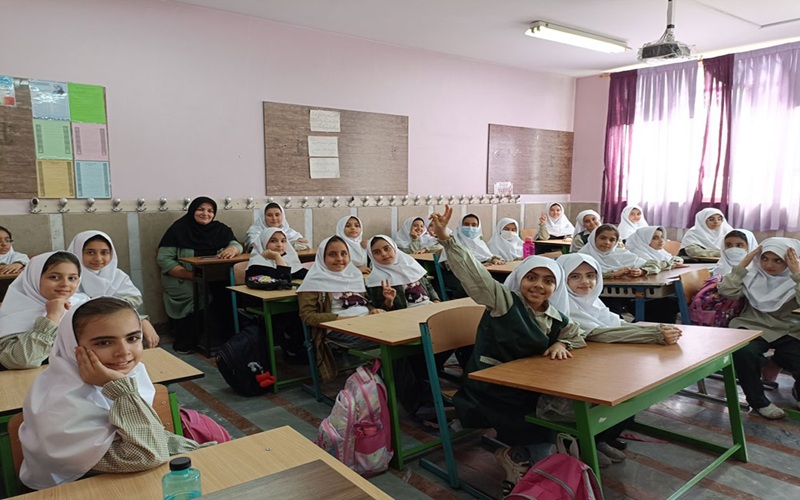

For children in Iran, the beginning of the school year should be a time of excitement—the smell of new books, the anticipation of meeting classmates, and the simple joy of wearing a new school uniform. Under the rule of the Iranian regime, however, even these basic experiences are increasingly becoming unattainable luxuries.
As September approaches, families across Iran are confronting a harsh reality: the cost of notebooks, pens, colored pencils, uniforms, backpacks, and other basic school supplies has risen beyond the reach of many households. For children from impoverished families, returning to school is no longer simply an educational milestone. It can become a painful reminder of deprivation and inequality.
The crisis extends far beyond the price of school supplies. It reflects a broader collapse of Iran’s education system, where poverty, inadequate infrastructure, unequal access to quality education, and the growing number of children who are unable to attend school are placing the future of an entire generation at risk.
When School Supplies Become a Luxury
The situation in Iran’s markets illustrates the pressure facing families as the new academic year begins. A shopkeeper recently described the dramatic decline in customers during the traditionally busy back-to-school season, attributing it to the collapse in purchasing power and the soaring value of the U.S. dollar.
Instead of selling at normal margins, many retailers are being forced to offer repeated discounts simply so that families can afford the most basic supplies.
The problem is not merely economic. For a child, arriving at school without a new notebook, pencil case, uniform, or other basic supplies can carry a profound psychological burden.
A child who repeatedly hears “we cannot afford it” may begin to internalize a sense of deprivation, exclusion, and failure. The inability of parents to provide what their children need can also create feelings of shame and helplessness within families.
School uniforms themselves have reportedly become significantly more expensive than in previous years, with some families facing prices that have doubled or even tripled.
For millions of households already struggling with inflation and declining incomes, these additional costs can determine whether a child returns to school at all.
Millions of Children Left Behind
The scale of the education crisis becomes clearer when examining the number of children who have already fallen out of the educational system.
According to figures cited during the interview from the regime’s own Parliamentary Research Center, approximately four million students have been left out of education.
The figure is particularly alarming because it concerns children and adolescents who should be developing the knowledge and skills needed for their future.
Where are these children now?
Some may have been forced into child labor. Others may remain confined to their homes. Many have effectively disappeared from the educational system without any clear mechanism ensuring their return.
The consequences are not limited to missed lessons or lost school years. Prolonged exclusion from education can affect children’s psychological well-being, social development, future employment prospects, and ability to participate meaningfully in society.
The question therefore extends beyond whether children can attend school this year. It is about what kind of future awaits a generation that is being deprived of education during its formative years.
An Education System Deeply Divided by Class
Iran’s education system has also become increasingly stratified.
Children from wealthy families can attend expensive private schools with better facilities and greater educational resources. For children from working-class and impoverished families, however, access to even basic educational services can be difficult.
This divide means that a child’s educational opportunities are increasingly determined by the economic circumstances of their parents.
The result is an education system in which inequality is reproduced rather than reduced. Instead of providing children with a pathway out of poverty, education itself increasingly reflects the economic divisions already present in Iranian society.
Low Educational Performance Reveals a Deeper Crisis
The problem is not limited to access to education. The quality of education is also a major concern.
Iranian students have performed poorly in international assessments such as TIMSS, which evaluates mathematics and science achievement, and PIRLS, which assesses reading comprehension.
Poor results in such assessments point to broader structural problems in the education system, including inadequate resources, unequal access to quality instruction, insufficient infrastructure, and the inability of the authorities to provide effective educational opportunities for the majority of students.
At a time when technological transformation is accelerating globally, these deficiencies carry particularly serious consequences.
The modern economy increasingly depends on digital literacy, advanced technical skills, scientific knowledge, and the ability to work with emerging technologies such as artificial intelligence.
A generation deprived of quality education will struggle to compete in such an environment.
The Digital Divide Deepened During the Pandemic and Crises
The disruption caused by the COVID-19 pandemic exposed and intensified another weakness: the digital divide.
When education shifted online, many Iranian children lacked computers, smartphones, reliable internet access, or other educational resources needed to participate effectively.
The regime promoted its online education platform, known as “Shad,” but access was far from universal. Children from poorer families were particularly disadvantaged.
Periods of crisis and instability have compounded these difficulties, repeatedly disrupting children’s education and making continuity of learning even more difficult.
For children who were already economically vulnerable, every interruption increases the risk of permanent exclusion from school.
The Cost of Losing a Generation
The consequences of Iran’s education crisis will extend far beyond the classroom.
Education is one of the foundations of a country’s economic and social development. A society that fails to educate its children cannot maintain a skilled workforce capable of responding to technological and economic change.
This is particularly significant as the world moves rapidly toward an economy shaped by artificial intelligence, automation, digital technologies, and advanced scientific knowledge.
Iran’s children should be preparing to participate in that future. Instead, millions are struggling simply to remain in school.
The result could be a widening gap between Iran and countries that are investing in education, technology, and human capital.
More importantly, the consequences will be borne by the children themselves. A child denied education today may face limited employment opportunities, lower income, greater vulnerability to exploitation, and fewer possibilities for social mobility tomorrow.
A Crisis That Reflects the Regime’s Priorities
The education crisis cannot be separated from Iran’s broader economic and social conditions.
When families cannot afford a notebook or school uniform, the problem is not simply the price of stationery. It reflects declining purchasing power, inflation, poverty, and a system that has failed to guarantee adequate educational opportunities for its children.
The millions of students excluded from education represent more than a statistic. They are children whose opportunities are being lost in real time.
Iran’s education crisis therefore raises a fundamental question: what happens to a country when an entire generation is denied the education it needs to build its future?
Without profound change, the answer is increasingly visible. The children now standing outside the classroom doors risk becoming tomorrow’s generation without adequate skills, opportunities, or hope.
The back-to-school season should be a celebration of learning and possibility. In today’s Iran, for millions of families, it has instead become another measure of how deeply poverty and mismanagement have penetrated everyday life.