


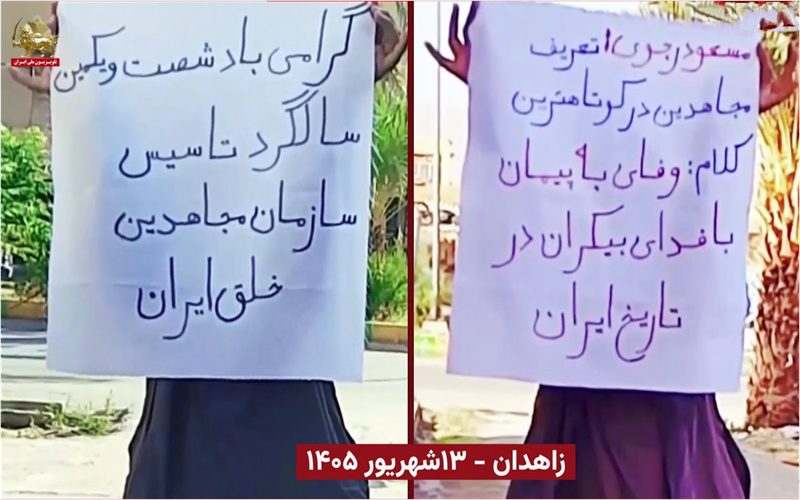

Banners and leaflets displayed across Zahedan highlighted the PMOI’s 61-year struggle against dictatorship, emphasizing rejection of both the monarchy and the clerical regime and calling for a democratic republic.
On Friday, September 5, 2026, the Resistance Units of the People’s Mojahedin Organization of Iran (PMOI/MEK) carried out a series of activities across Zahedan to mark the 61st anniversary of the organization’s founding.
The activities, conducted ahead of September 6, featured the installation and distribution of banners and leaflets carrying messages associated with the Iranian Resistance’s leadership. The campaign emphasized the PMOI’s six decades of confrontation with dictatorship in Iran and presented its political identity as one centered on resistance, sacrifice, and opposition to both monarchical and clerical rule.
The messages highlighted the significance attributed by the Resistance to the organization’s founding in 1965, describing its history as a continuous struggle against dictatorship, political repression, and foreign dependency. They also portrayed the PMOI as an organization whose political and organizational traditions are intended to guide younger generations participating in protests and resistance activities inside Iran.
Six decades of opposition to dictatorship
A central theme of the activities in Zahedan was the PMOI’s claim of 61 years of uninterrupted struggle against what its supporters describe as the two forms of dictatorship that have dominated Iran’s modern political history: the former Shah’s monarchy and the current clerical regime.
The banners and leaflets repeatedly invoked the concepts of truthfulness and sacrifice, presenting them as defining principles of the organization. They also emphasized the deaths, imprisonment, torture, and executions endured by PMOI members and supporters under both the Pahlavi monarchy and the clerical regime.
The anniversary campaign therefore sought to portray the organization not simply as a political movement, but as part of a historical continuum of resistance in Iran. Its messages argued that the struggle begun by the PMOI’s founders has continued through successive periods of repression and remains directed toward the establishment of a democratic political system.
The Resistance Units also used the anniversary to reinforce the slogan “Neither Shah nor Mullah”, rejecting both monarchy and theocratic rule as alternatives to the current regime.
Messages directed at a new generation of protesters
Another prominent element of the Zahedan campaign was the presentation of the PMOI’s organizational experience as a source of political guidance for younger generations involved in protests and resistance.
Messages associated with Maryam Rajavi emphasized the PMOI’s role as a source of hope and a political and organizational reference for the generation taking to the streets. The material portrayed the organization’s values and methods as relevant to the current struggle against repression and as a guide for continuing resistance.
The campaign also drew on Massoud Rajavi’s longstanding emphasis on resistance, sacrifice, and the organization’s determination to continue its struggle until the establishment of political freedom in Iran.
Taken together, the messages presented the PMOI as a continuing political force whose history, according to the Resistance Units, provides an organizational foundation for confronting the Iranian regime.
Rejecting both monarchy and clerical rule
The Zahedan activities placed particular emphasis on the Resistance’s opposition to both forms of authoritarian rule.
The banners and leaflets stressed that the PMOI’s political position is based on rejecting both the former monarchy and the current clerical system. Slogans displayed during the activities included variations of “Neither Shah nor Mullah”, “Down with the oppressor, whether Shah or Supreme Leader,” and calls for a democratic republic.
This message was also linked to the Resistance’s broader argument that dictatorship, regardless of whether it is justified through religion or monarchy, represents a denial of popular sovereignty.
The campaign highlighted the issue of discrimination against women as another point of continuity between authoritarian systems. Messages attributed to Maryam Rajavi described misogyny as a common feature of both monarchical and clerical forms of dictatorship and presented opposition to all forms of authoritarianism as a central element of the Resistance’s political platform.
“From Zahedan to Tehran”
The choice of Zahedan for the anniversary campaign also carried significance within the broader geography of opposition to the regime.
Among the slogans displayed were calls linking Zahedan with Tehran and other parts of Iran, underscoring the idea of a nationwide struggle against repression. The messages sought to connect local resistance activities with the broader protest movement and its demand for political change.
The slogans also rejected attempts to frame Iran’s political future as a choice between the current clerical establishment and a return to monarchy. Instead, the Resistance Units promoted the establishment of a democratic republic based on popular sovereignty.
The September 5 activities in Zahedan thus combined commemoration of the PMOI’s 61st anniversary with a contemporary political message: that the organization’s supporters intend to continue confronting the Iranian regime while rejecting any restoration of monarchical rule.
For the Resistance Units, the anniversary represents both a reflection on six decades of struggle and a call to continue organizing resistance inside Iran. The banners and leaflets displayed in Zahedan presented the PMOI’s history of sacrifice as a foundation for what they describe as the ongoing struggle for freedom, independence, and a democratic future.